Short answer: An RMU is a compact form of medium-voltage switchgear. Choose an RMU for a standard secondary ring node with few feeders when the selected units meet the current and fault duties. Choose a modular switchgear lineup for main distribution, multiple large feeders, complex protection or a clear expansion requirement. Current, fault duty, protection complexity and expansion define the boundary; the equipment name does not.
First, a correction: an RMU is switchgear
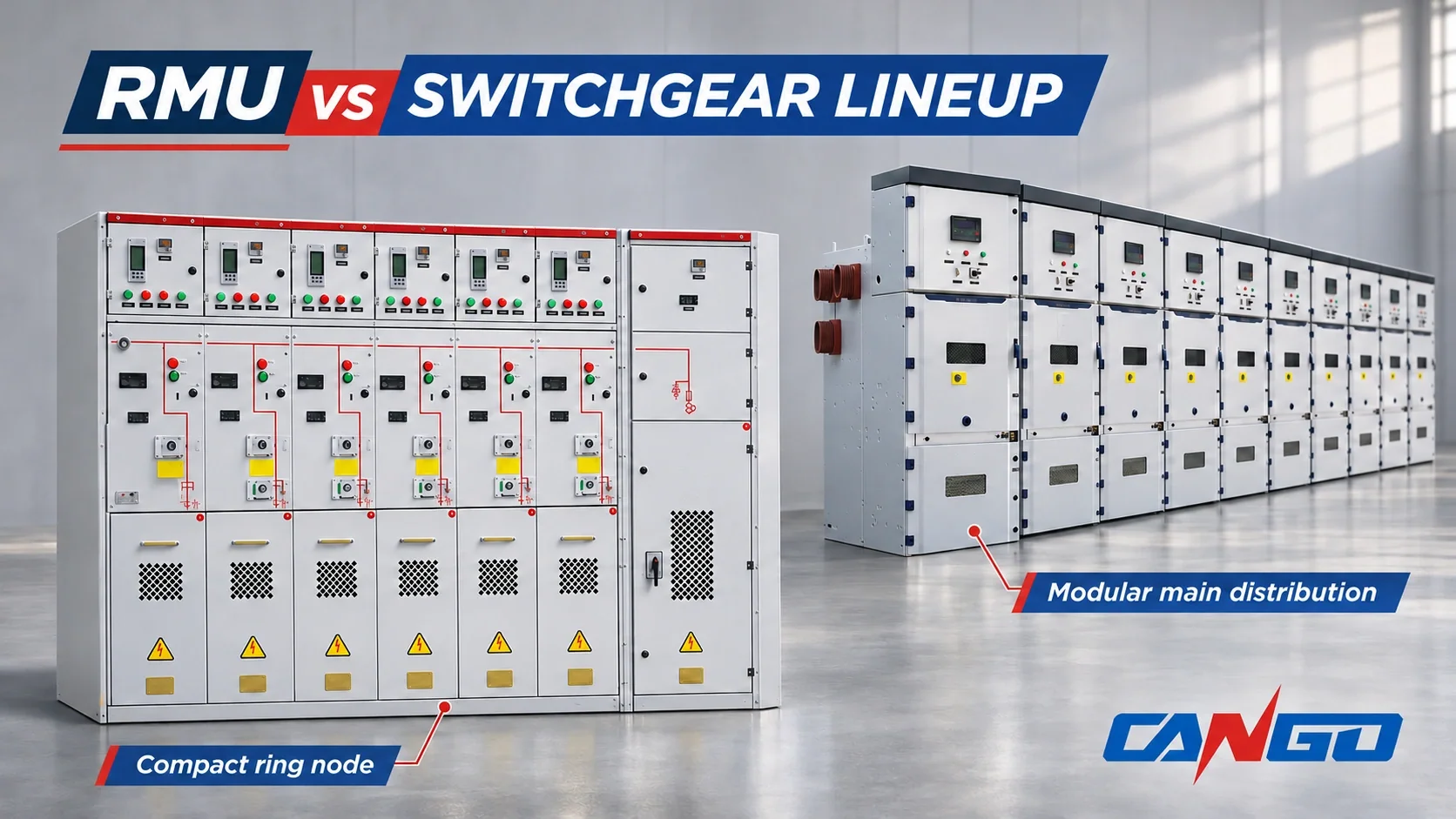
The useful ring main unit vs switchgear comparison is between equipment forms. It asks whether a distribution node can use a compact factory-assembled package or needs a lineup of separately specified functional panels. Treating RMU and switchgear as unrelated categories obscures that decision.
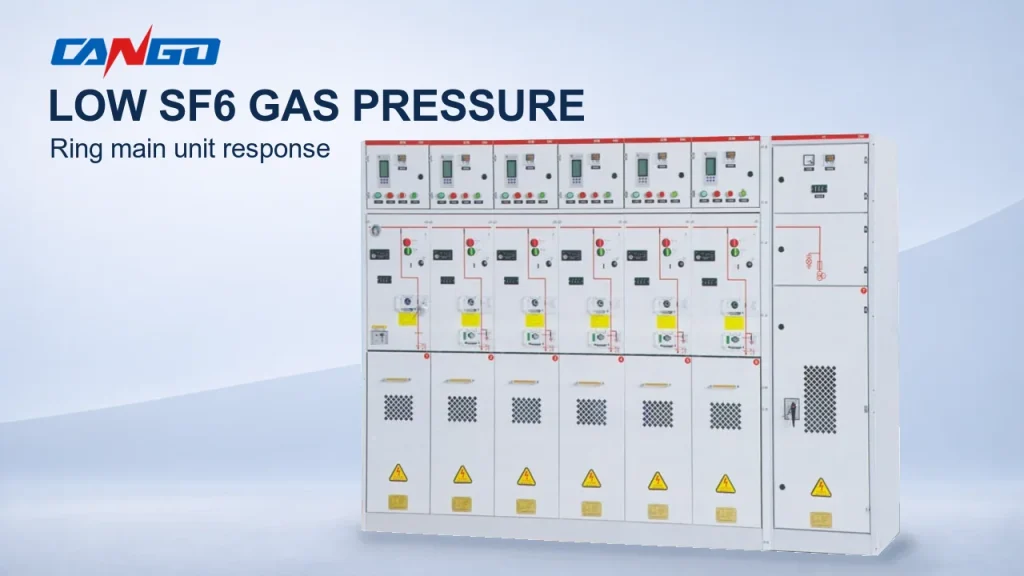
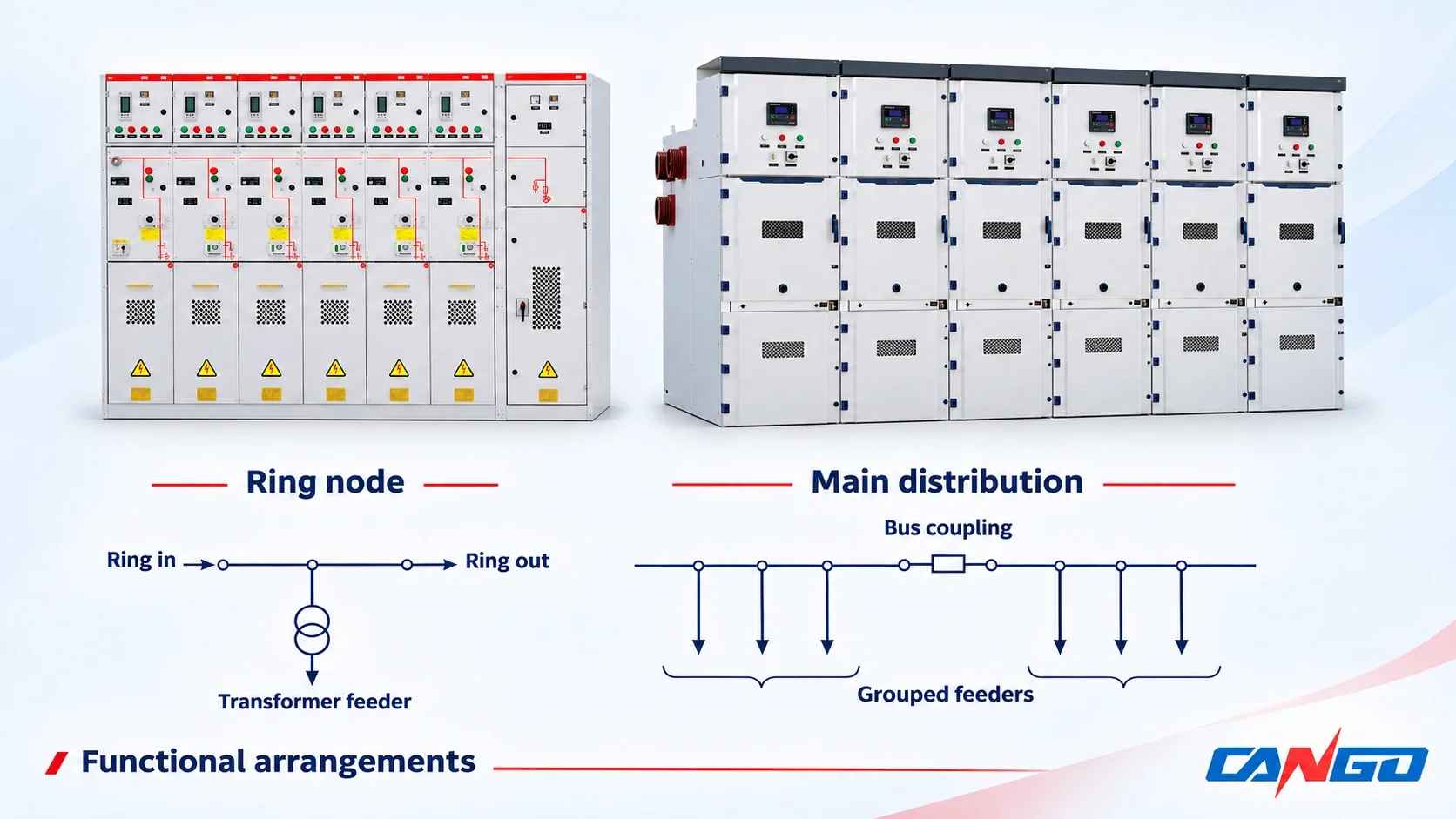
In this article, an RMU means a compact assembly typically combining ring incoming and outgoing load-switch functions with a transformer feeder. The transformer function may use a switch-fuse combination or a circuit breaker with a relay. Its attraction is an integrated node arrangement, not the assumption that every RMU has identical protection or insulation.
A modular lineup combines incomer, feeder, bus-coupler and metering functions as required. Withdrawable metal-clad panels are the representative comparison here: a circuit-breaker truck can be removed under the documented isolation arrangements. Fixed-panel alternatives also exist; modularity does not automatically mean every device is withdrawable.
Both forms belong within the metal-enclosed assembly scope of IEC 62271-200. Component functions have their own standards: IEC 62271-103 for switches, IEC 62271-105 for switch-fuse combinations and IEC 62271-100 for circuit breakers. These standard scopes describe equipment functions; they do not make the two forms interchangeable or establish compliance for an unspecified assembly.
Full comparison table
Use the table to identify which form deserves a detailed quotation. Check each functional unit against the single-line diagram rather than treating a product family’s largest published figure as the rating of every circuit.
| Aspect | Ring main unit (RMU) | Modular switchgear lineup |
|---|---|---|
| Network role | Compact secondary ring, terminal or transformer node | Main distribution, grouped feeders, bus sections and couplers |
| Typical voltage level | Overlaps lineup applications within the CANGO RMU class discussed here | Also serves the overlapping class; higher-voltage CANGO panel families are identified below |
| Busbar and feeder current | CANGO examples: ring/load-switch circuits mainly 630 A; GTXGN-12 offers 630/1250 A by configuration* | CANGO KYN28-12 circuit-breaker current: 630-3150 A by configuration* |
| Short-circuit level | CANGO SRM-12: 20/25/31.5 kA breaking values by functional unit; GTXGN-12: 25/31.5 kA breaking by configuration; HXGN17-12: 20 kA/4 s thermal stability* | CANGO KYN28-12: 16-50 kA short-time withstand for 4 s, by configuration* |
| Main switching devices | Ring load switches, switch-fuse or breaker transformer functions | Circuit breakers with separately allocated feeder, incomer and coupling duties |
| Transformer and feeder protection | Function-specific fuse coordination or breaker/relay arrangement | More space and panel allocation for feeder-specific protection and coordination |
| Metering and automation | Available functions depend on selected modules and interfaces | Dedicated panels and secondary space accommodate broader project requirements |
| Construction and footprint | Integrated compact arrangement; access and cable space still matter | Multiple functional panels; room, access and cable-routing provisions shape the site |
| Insulation options | Gas, solid or air arrangements depend on the model | Air-insulated panels are common in this comparison; insulation remains a separate specification |
| Expansion after installation | Depends on ordered extensible design and supported interfaces | Additional panels may be planned, subject to bus, layout and shutdown compatibility |
| Maintenance form | Sealed parts may reduce internal intervention; accessible mechanisms and controls still need attention | Withdrawable equipment permits a different servicing/replacement arrangement, with isolation requirements |
| Typical applications | Residential, urban cable-ring, compact-substation and terminal nodes | Factory main rooms, large distribution nodes and grouped industrial feeders |
CANGO range note (*), not an industry limit: current and fault figures above come from the current SRM-12, GTXGN-12, HXGN17-12 and KYN28-12 product tables. Each value belongs to its stated function and configuration. Breaking current and short-time withstand are different duties; the RMU and lineup columns are not a direct comparison of interchangeable ratings. XGN15-12 fuse ratings appear separately below and are not a whole-assembly fault-duty rating.
Where the current and fault ratings draw the line
Voltage alone does not settle the choice. At 12 kV the forms overlap, so establish ring through-current, transformer-feeder current, fault duty and protection before choosing an enclosure. The transformer rating by itself cannot establish that a particular RMU feeder is suitable.
CANGO ring/load-switch circuits discussed here are mainly 630 A; GTXGN-12 also lists 1250 A by configuration. That scope fits ring through-current and appropriately sized transformer feeders, subject to the selected switching and protection function. KYN28-12 lists circuit-breaker currents of 630-3150 A and short-time withstand up to 50 kA for 4 s by configuration, providing a different envelope for main buses and large feeders.
Move toward a lineup proposal when any of these signals appears:
- The transformer or feeder duty has no suitable configuration within the proposed RMU feeder unit.
- The calculated system fault duty exceeds the selected RMU configuration’s applicable breaking or withstand rating.
- The feeder arrangement needs bus coupling and sectionalizing beyond the proposed compact assembly.
These are signals to reconsider the form, not permission to accept an unverified lineup. Its bus, breaker, cable interfaces and protection must still satisfy the project. A high fuse breaking figure does not establish the through-current or thermal withstand of an unrelated ring switch.
For higher-voltage duties, CANGO’s published panel choices include KYN28-24, KYN61-40.5 and XGN17-40.5; the RMU families covered here concentrate on 12 kV. Use that catalogue boundary without presenting it as a universal limit for RMU technology.
Protection and control: what each form can carry
For an RMU transformer feeder, choose between switch-fuse protection and a breaker/relay arrangement using transformer duty, coordination needs and operating requirements. Confirm the complete combination rather than specifying a fuse independently. Breaker protection is relevant when the project needs adjustable functions, reporting or a more involved coordination scheme. The RMU transformer-protection guide owns the operating principles and detailed coordination discussion.
Ring through-circuits commonly provide switching and sectionalizing rather than complex feeder-selective protection. Do not assume that an automated ring switch has the same protection capability as a relay-controlled breaker. Equally, an RMU can carry meaningful monitoring and automation when the ordered configuration supports them.
A lineup can allocate space and functional panels for multifunction protection, selective coordination, metering CTs/VTs, power-quality measurement and automation interfaces. The buyer must identify the required devices, wiring, communications and functions; a large enclosure alone supplies none of them. Protection complexity can push a project toward a lineup before continuous-current duty does.
For a breaker feeder, keep interruption medium separate from the assembly choice; the vacuum versus SF6 circuit-breaker article addresses that comparison. Neither an RMU name nor a lineup name identifies every insulating and breaking medium inside it.
Costs: the five drivers
Compare complete node scopes. A compact integrated package and a panel-by-panel quotation organize costs differently; neither format establishes a lower total without the same circuits, protection and site assumptions.
| Cost driver | RMU | Switchgear lineup | What decides it |
|---|---|---|---|
| Equipment scope per node | For a small standard ring node, one assembly integrates the required functions; extra special functions change that scope | For grouped feeders, costs are assembled panel by panel; shared infrastructure may spread across more feeders | Node role, feeder count and whether protection/metering functions match |
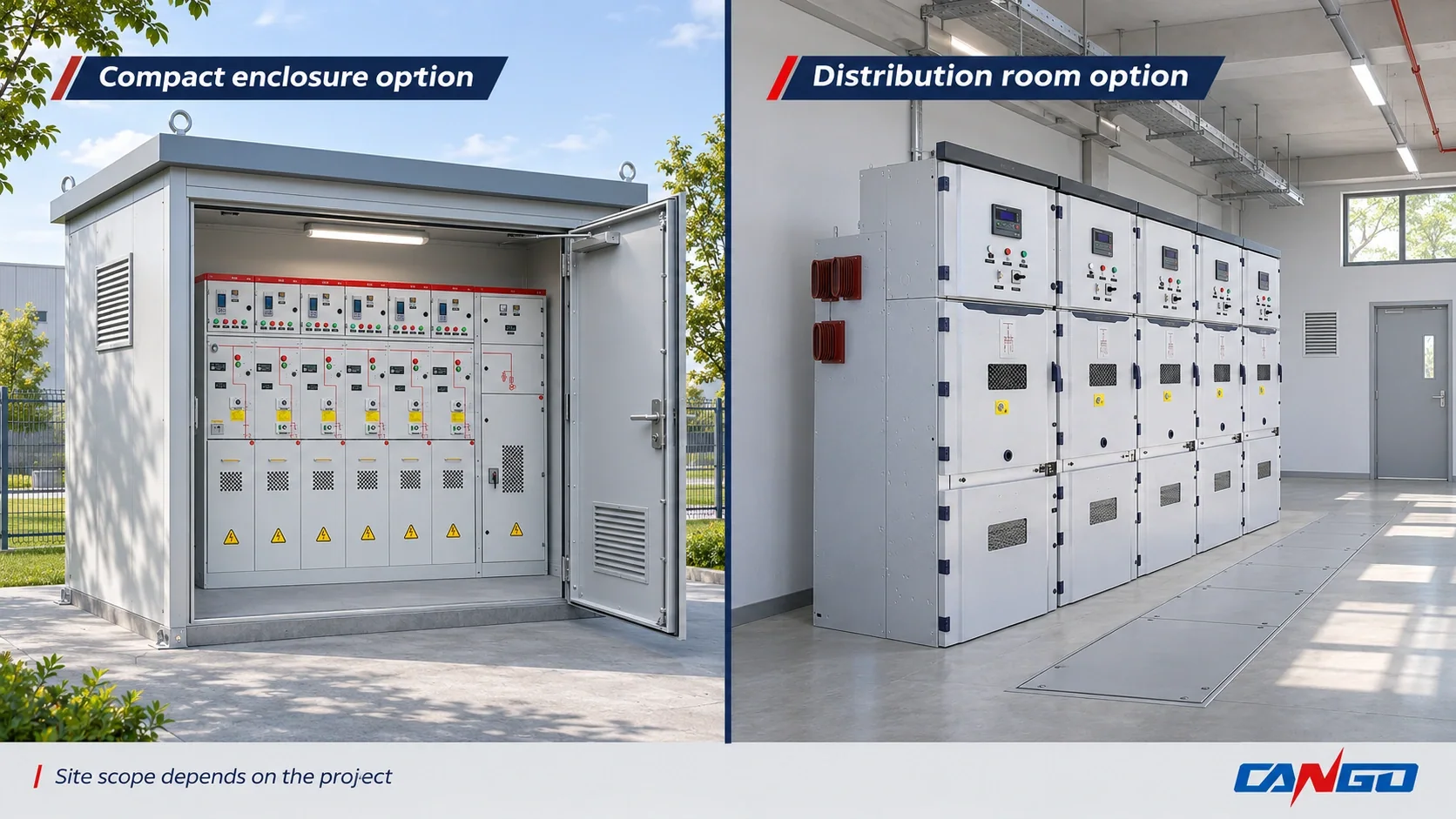
| Footprint and civil work | Where an approved compact-substation or outdoor enclosure arrangement fits, room requirements may differ | Where a dedicated room is needed, include room, cable trenches and access provisions | Existing building, approved enclosure, cable routing and usable space |
| Installation and cabling | A factory-assembled node may reduce site assembly, if its delivered scope includes internal connections | A site-assembled lineup may require panel alignment and bus connections; factory assembly scope can change this | Delivery sections, cable count, bus interfaces and contractor work included |
| Expansion and later modification | For a non-extensible order, a later feeder may require replacement or redesign; extensible designs need confirmed interfaces | Adding a panel is a planning option only if bus capacity, end interfaces, room and outage access allow it | Written expansion plan, compatibility and future circuit duty |
| Maintenance and outage form | If sealed sections need intervention, manufacturer handling or section replacement may determine outage scope | Where withdrawable devices and compatible replacements are planned, servicing can use a different isolation arrangement | Service access, replacement scope, isolation plan and actual maintenance instructions |
For many feeders, spreading common lineup infrastructure across the circuits can change the comparison with separate compact nodes. For a small standard node that already fits an approved enclosure, that same room infrastructure may be unnecessary. Neither observation establishes a price result without project quotations.
Require both offers to state whether protection, automation, installation and civil work are included. Comparing totals without those boundaries is not meaningful. Normalize the equipment schedule and exclusions using the MV switchgear guide, then compare the same node outcome.
When to use each: a five-question decision sequence
Ask these questions in order, retaining the answers in the inquiry:
- Is this a ring/terminal node or main distribution? Identify its role before selecting the assembly; see the utility-distribution network guide.
- Do maximum feeder current and system fault duties fit the selected RMU? A configuration outside either envelope needs a revised proposal.
- How complex are protection, metering and automation? Allocate actual functions and interfaces rather than requesting a generic intelligent cabinet.
- How likely are added feeders or a larger transformer within three to five years? Treat committed expansion as present design input, not an optional future discussion.
- Can the site accommodate the required distribution room? Evaluate approved compact arrangements and room-based alternatives with cable and access needs included.
Choose an RMU when…
- The inquiry describes a standard secondary ring or terminal function.
- A limited circuit arrangement fits the offered functional units.
- Every selected unit meets its applicable current and fault duty.
- The required protection and automation fit documented interfaces.
- The fixed or extensible arrangement suits the confirmed site and future plan.
Choose a switchgear lineup when…
- The node gathers main incomers and multiple significant outgoing feeders.
- Required duties exceed the suitable compact configurations on offer.
- Protection and measurement need dedicated functions and secondary space.
- Bus sections, couplers and future panels are already part of the scheme.
- The project can provide the necessary room, installation access and servicing arrangements.
Neither checklist replaces a protection study or approved layout. A positive answer about footprint cannot override a negative answer about fault duty. Where the answers conflict, request revised compact and lineup proposals against the same single-line diagram.
Three worked node examples
Urban ring node and a transformer
Illustrative example: An urban residential distribution node receives and returns the ring cable and supplies a 630 kVA transformer. The proposed duty is ring continuity plus a transformer branch, rather than a collection of large independently protected feeders. A compact RMU is therefore the starting form for the inquiry.
The deciding factor is the network role and limited functional arrangement, provided the selected through-circuit and transformer-feeder units meet the calculated current, fault and coordination duties. The transformer nameplate alone does not prove suitability. The buyer still confirms fuse-combination or breaker protection, cable interfaces, metering and local operating requirements.
If no expansion is planned, a fixed arrangement may fit the brief. If another transformer is expected, extensibility becomes an order requirement. No installation cost, room saving or protection result is assumed from the RMU label.
Factory main distribution room
Illustrative example: A factory distribution room gathers the incoming supply, multiple large outgoing circuits and motor feeders. The scheme needs bus coupling, selective protection and coordinated measurement rather than just a transformer branch on a ring. The buyer requests a KYN28 lineup proposal against the circuit schedule.
The deciding factors are the bus arrangement and protection workload. Separate functional panels allow the inquiry to allocate incomer, feeder, coupler and metering duties clearly. Motor-feeder requirements must be specified for engineering review; naming a lineup does not establish the right breaker, relay functions or coordination.
The quotation comparison includes the room, cable trench, site bus connections and automation scope. It also checks whether future panels can be accommodated. This is a selection scenario, not evidence that a particular cabinet rating or configuration has already been approved for the factory.
A node close to the compact envelope
Illustrative example: A proposed node fits an RMU configuration today, but calculated fault duty is close to the selected unit’s applicable limit and a later project phase explicitly adds feeders and a larger transformer. Present-day compliance does not answer the expansion question.
The buyer should assess a lineup from the outset or obtain a written proposal for an extensible compact configuration whose completed arrangement remains suitable. Extensibility by itself does not increase current or fault ratings. The future network study and protection plan must support the eventual configuration, and the site must retain installation and cable space.
The deciding factor is committed change combined with limited duty headroom. A lineup may be justified by that combined scope; an extensible RMU remains a candidate only when its interfaces and future duties are confirmed. Comparing only initial equipment totals would omit the relevant later modification.
Common mistakes when choosing between them
- Buying by name or habit: define network role and circuit duties before deciding that an RMU or a familiar panel family is the default.
- Ordering a fixed RMU before discussing expansion: obtain written confirmation of the selected design’s extension method and limitations before placing the order.
- Comparing unlike totals: an offer excluding protection, automation or building work cannot be compared directly with an inclusive node proposal.
- Assuming every RMU uses SF6: solid and air-insulated arrangements also exist; use the AIS/GIS guide for the insulation boundary. For insulation-alternative context, see the GIS insulation and partial-discharge article.
- Reading sealed as maintenance-free: mechanisms, controls and condition monitoring still require attention; apply the switchgear maintenance checklist to the actual assembly.
CANGO ranges on both sides
These are CANGO product-page values, not industry ceilings. Confirm the selected functional units and configuration before using any figure in a specification.
- SRM-12: gas-insulated, 12 kV; ring circuit 630 A; published short-circuit breaking values 20/25/31.5 kA by functional-unit configuration. The table assigns 31.5 kA to the F unit, not a universal ring-switch rating.
- GTXGN-12: solid-insulated, 12 kV; 630/1250 A and 25/31.5 kA breaking, by configuration.
- XGN15-12: 12 kV; main bus 630 A; fuse breaking current 31.5/40/50 kA, according to the equipped fuse configuration.
- HXGN17-12: 12 kV; FN12-12 or FZN25-12 load-switch current 630 A; thermal stability 20 kA for 4 s, according to the selected configuration.
- KYN28-12: withdrawable metal-clad lineup family with breaker current 630-3150 A and short-time withstand 16-50 kA for 4 s, by configuration.
- KYN28-24: a higher-voltage modular panel option for project-specific lineup review.
- KYN61-40.5: a higher-voltage switchgear option for distribution arrangements outside the RMU range discussed here.
- XGN17-40.5: a fixed-switchgear alternative where that construction suits the approved scheme.
Send the single-line diagram, circuit duties, protection/automation scope, site arrangement and expansion plan together. Final configuration is confirmed against project requirements before quotation.
FAQ
Is a ring main unit a type of switchgear?
Yes. An RMU is a medium-voltage switchgear form that packages ring switching and feeder functions into a compact assembly. The useful buying comparison is between that arrangement and a modular lineup of separately specified functional panels. Both need suitable assembly and switching-device requirements. Decide from the node’s network role, current and fault duties, protection and expansion plan, rather than treating RMU and switchgear as unrelated product categories.
What is the main difference between an RMU and a switchgear lineup?
The main difference is how functions are packaged for the node. A compact RMU commonly combines ring switching with a transformer feeder, while a modular lineup allocates incomer, feeder, coupler and metering functions across panels. That affects protection space, site layout and later modification. Voltage alone does not separate them. The selected configuration must meet all relevant duties, and neither equipment form automatically provides every required protection or automation function.
Is an RMU cheaper than conventional switchgear?
There is no unconditional cost winner. For a small standard ring node, integration and an approved compact installation can change equipment and civil scope. For many feeders or complex protection, a lineup organizes shared infrastructure differently. Later expansion and maintenance arrangements can change either proposal. Compare equipment, building work, installation, protection and automation on the same basis; a quotation excluding those items does not establish a lower total for the required node.
When is an RMU not enough, and a switchgear lineup is needed instead?
Reconsider the RMU when its selected feeder configuration cannot carry the required load, its applicable breaking or withstand duty is below the calculated system requirement, or the scheme needs bus sections and coupling beyond the proposed assembly. Complex protection and committed expansion can also favor a lineup. A lineup is then a proposal to verify, not an automatic approval: check its bus, breakers, cable interfaces, protection and installation against the complete project.
Can a ring main unit be expanded later?
It depends on whether the ordered model and configuration have an extensible design. Do not assume that another feeder can be attached to any RMU after installation. Before ordering, obtain the manufacturer’s written confirmation of the extension method, compatible modules, interface requirements and installation constraints. Future current and fault duties must also remain suitable. A fixed arrangement may need replacement or redesign, while an extensible arrangement still needs planned space and an approved outage approach.
References
- IEC, IEC 62271-200:2021, metal-enclosed switchgear assembly scope; official publication description.
- IEC, IEC 62271-103:2021, switches and switch-disconnectors; official publication description.
- IEC, IEC 62271-105:2021, switch-fuse combinations; official publication description.
- IEC, IEC 62271-100:2021, alternating-current circuit breakers; official publication description.
- CANGO product information: the SRM-12, GTXGN-12 and KYN28-12 product tables linked above, plus XGN15-12 and HXGN17-12. Values describe the named equipment and configuration, not independent test certification.