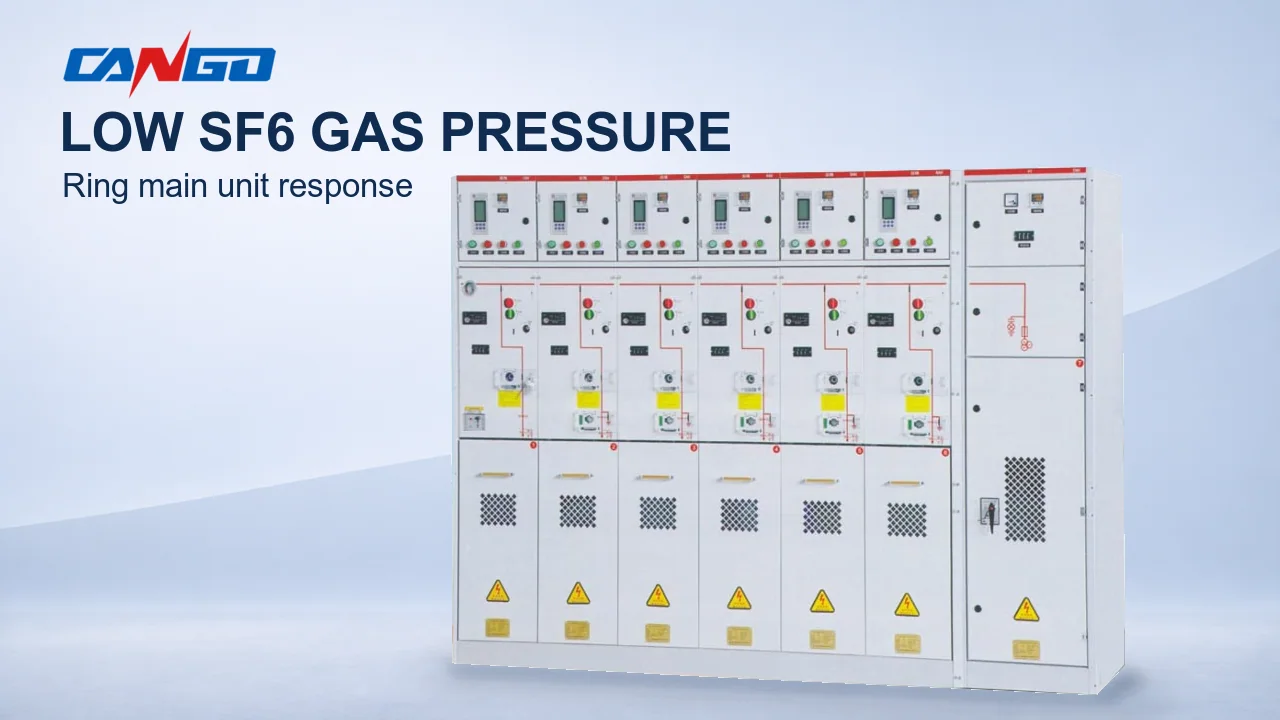
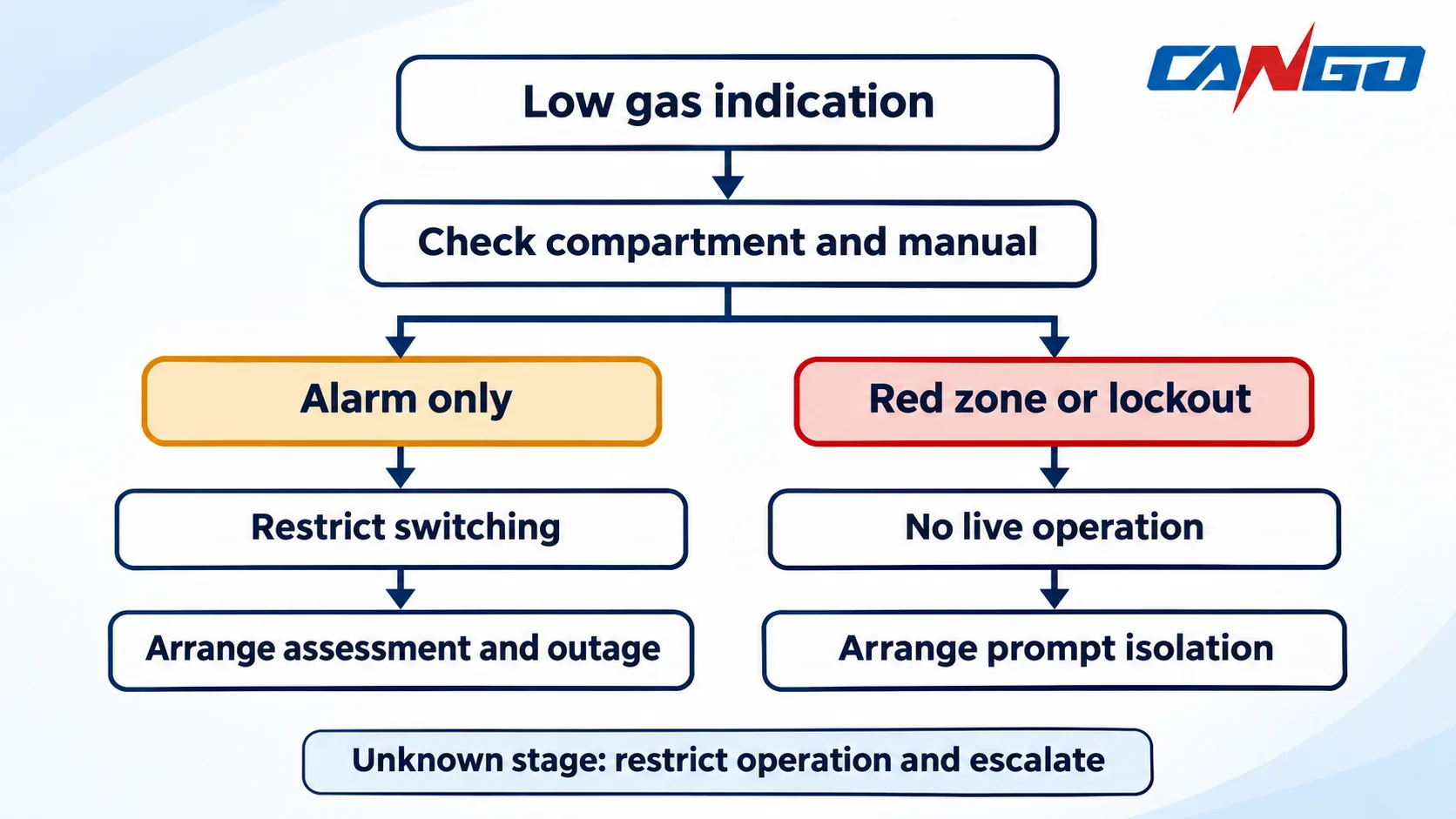
If an SF6 ring main unit (RMU) indicates low gas, notify the person responsible for switching and confirm what the installed unit’s manual calls that indication. Apply operating restrictions while the stage is uncertain.
| Indication | Can it remain energized? | Can you operate it? | Next action |
|---|---|---|---|
| Confirmed alarm only | Only if the manufacturer’s instructions and site rules allow temporary service | Restrict or avoid switching the affected unit | Contact the manufacturer, record the trend, and arrange an outage |
| Red zone or lockout | Arrange prompt isolation under the site’s authorized procedure | Do not operate the affected unit while energized | Escalate immediately and arrange isolation through suitable equipment |
Classify the indication before acting. Routine switching of the affected unit in the red zone is the action to prevent.
What low pressure actually takes away
Start with insulation margin. The gas helps insulate live parts from one another and from earth. When an insulating compartment loses gas, the unit can still appear to carry normal system voltage while having less margin against a voltage rise. The absence of a flashover at the time of inspection tells the operator little about how the unit will respond to the next disturbance.
Next, check interruption duty. Where the affected device depends on gas to interrupt current, gas loss can impair that capability too. A vacuum interrupter uses a separate interruption medium, but gas around the live parts still serves an insulation function. The actual order in which operating limits are reached depends on the design, the affected compartment and the duty. Read the indication against the equipment manual before assigning a limit to either function.
These events are the reason to distinguish permission to remain energized from permission to operate:
- Switching. An operation can expose the equipment to a transient or require an affected switching device to perform an interruption duty.
- Lightning or incoming switching surges. A disturbance can reach the unit even when its own controls have been left alone.
- Single-phase earth faults. The resulting overvoltage can test reduced insulation margin. The site also needs to consider what equipment would be relied on to clear a fault.
The switching transient mechanism is covered separately. Vacuum breaker switching transients
An Eng-Tips operator asked, “Do you think the switchgear needs to be deenergized asap?” Some replies favored removing it from service. Others considered temporary energization under particular conditions. The first view prioritizes exposure to the next fault or surge. The second distinguishes normal voltage withstand from the extra demands of switching and disturbances. Neither forum position authorizes an operator to retain a different unit in service. The installed equipment manual and the person responsible for the network determine that decision. [2]
For the equipment boundary between an RMU and other switchgear, see the separate comparison. Ring main unit vs switchgear
First check: real leak or faulty indicator?
Treat the warning as unresolved until it is verified. On a closed compartment, a low indication may reflect a gas loss or an instrument or signalling problem. A participant in the Eng-Tips case questioned whether the pressure switch itself was faulty. That possibility justifies checking the evidence while retaining the appropriate operating restrictions. It does not establish a false alarm. [2]
Use observations that are already available from the approved operating position, site records or remote indications:
- Identify the source. Record the unit, circuit and compartment named by the alarm. Confirm the mapping against the drawing or manual. Several ways may share a tank, so the physical panel beside the indication may not define the full affected boundary.
- Compare available indications. Record what the local display and the remote alarm report, if both are available through approved access. A disagreement is a finding to report. Similar indications elsewhere may help explain the circumstances, but a normal neighboring compartment cannot verify the affected one.
- Identify the instrument. Read the manual to determine whether the unit has a simple low/high indication or separate alarm and lockout signals. Preserve the exact wording displayed. A single low signal cannot be assigned to an early-warning stage by analogy with a different model.
- Check recent changes. Compare the event time with recent temperature changes, transport, installation or other documented work. Record the last known normal indication and whether the warning persisted or recurred. Give the manufacturer the record rather than a diagnosis based on timing alone.
An ordinary pressure gauge responds to temperature as well as gas loss. A temperature-compensated density monitor is intended to indicate the gas condition without treating normal temperature-driven pressure changes as a loss of gas. Confirm which instrument the unit actually has. A cold spell can help explain a change on a plain gauge, but it cannot establish that a low signal is harmless. [1]
These checks narrow the possibilities. Confirmation belongs to the manufacturer or a qualified diagnostic team working under an approved plan. Leave the indicator attached and the sealed compartment closed. Record observations using the site’s existing inspection process. Medium-voltage switchgear maintenance checklist
Alarm stage vs lockout stage
Confirmed alarm only
Contact the equipment manufacturer or supplier with the equipment identification, exact indication and observations. Ask the switching authority to define the permitted service conditions and arrange an outage. If temporary energization is authorized, document the restrictions, who will review the trend and what change requires escalation. Use available records and approved observation points. Keep unnecessary operations off the affected unit while the plan is in effect.
A steady indication can help the team plan its response. It does not resolve a suspected leak or turn a temporary permission into indefinite service. Reassess any change in indication, evidence of damage or loss of a reliable reading. Confirm which equipment remains available for protection and isolation. The feeder’s protection arrangement matters to the outage plan. RMU transformer protection: switch-fuse vs circuit breaker
Red zone or lockout
Stop live operations on the affected unit and notify the switching authority promptly. The ABB SafeRing / SafePlus 12–24kV Installation and operating instructions, section 11.1, says for its red pointer condition that “the operation of the switchgear can not be done under live conditions”. The manual requires authorized corrective handling before live operation resumes. That instruction belongs to the ABB models covered by the manual. Use the instructions supplied for the installed unit to identify its own restrictions. [1]
Arrange prompt isolation under the approved switching plan using suitable equipment outside the affected unit where the plan requires it. The red indication does not itself isolate the circuit. Escalate if there is no confirmed isolation route or if the indication cannot be classified. Do not try a local operation to find out whether the mechanism is blocked.
The Eng-Tips discussion GIS Bus – Trip On Low-Low Gas Pressure? illustrates why alarm, blocking and automatic tripping depend on the installed manufacturer’s scheme and site rules. [4]
What never to operate, and never to do
- Do not operate the affected unit live in the red zone or at lockout. A switching movement or interruption can demand capability that the unit no longer has. Apply the restriction to routine local and remote operation and use the site’s approved isolation plan.
- Do not switch a unit suspected of air or moisture ingress. Loss of gas containment may also compromise the insulating condition inside the vessel. A doubtful instrument reading cannot establish that the compartment remains fit for switching.
- Do not look for a way to fill a unit with no authorized refill provision. An improvised connection or an opened indicator fitting can compromise the sealed boundary. Refer the affected assembly to the manufacturer for disposition.
- Do not treat replenishment alone as a completed repair. On a serviceable unit, a leak left in place can cause the indication to recur. Establish what leaked and what evidence the manufacturer requires before accepting the repair.
- Do not bypass an interlock or ignore a warning to finish a routine operation. A bypass removes a safeguard without recovering the lost insulation or interruption margin. Use the escalation route if the approved plan cannot be carried out.
Keep these decisions tied to the identified compartment and the affected functions. A broad fault investigation may be needed after an incident. Common switchgear faults and failures
Sealed-for-life vs refillable: two different endings
Sealed unit without an authorized refill provision
If the manufacturer specifies that the compartment has no field refill facility or authorized refill procedure, there is no top-up option. Ask which assembly must be removed from service and whether the authorized outcome is replacement or factory disposition. The label “sealed for life” should prompt a check of the service instructions. ABB uses that wording in the same manual that defines a replenishment procedure for trained and qualified personnel. The instructions for the exact assembly settle the question. [1]
In the Eng-Tips low-gas case, the poster identified the unit as a Siemens 8DJH with a two-state indication, rated 24 kV and installed on a 13.8 kV system and reported that its manual listed no gas filling facility. The poster later relayed manufacturer advice allowing temporary energization under normal voltage and recommending de-energization and replacement. That was advice reported for that installation, not a general service period or switching permission. The case involved Siemens equipment and had no connection to CANGO products. [2]
Unit with an authorized service procedure
Confirm that the manufacturer authorizes gas service for the affected assembly. Have qualified personnel investigate the leak and decide what corrective work and verification are required under the manufacturer’s procedure. The work plan should identify who accepts the repair and what documented evidence releases the operating restriction. The unit stays subject to the site’s restrictions until that release is given. [1]
The September 2022 Eng-Tips case concerned a 15 kV pad-mounted SF6 switch. The poster described a serious outage consequence, and a respondent called continued service “a calculated risk” in discussing faults, switching, lightning and possible air entry. That was a practitioner discussion about a separate installation. It gives no safe holding period and involved no CANGO equipment. If retaining supply is important, the switching authority still needs a documented disposition for the affected equipment. [3]
For the CANGO SRM-12 gas-insulated RMU, confirm the construction, indication scheme and authorized service route from the documentation for the delivered configuration. Use the exact unit identification when contacting the equipment supplier. The public product information identifies the equipment family. Its wording does not establish the refill classification, alarm thresholds or lockout settings of an installed unit. CANGO SRM-12 product page
When the answer is replacement
Repeated alarms, a confirmed slow leak or a manufacturer decision to retire the assembly move the discussion to the outage plan. Compare these routes:
- Like-for-like replacement. Confirm availability and whether the replacement can be put into service at the site. Check the affected assembly and its interfaces before committing to the outage.
- Manufacturer-authorized overhaul. Consider it where the manufacturer supports restoration of the actual assembly and specifies how to verify the result.
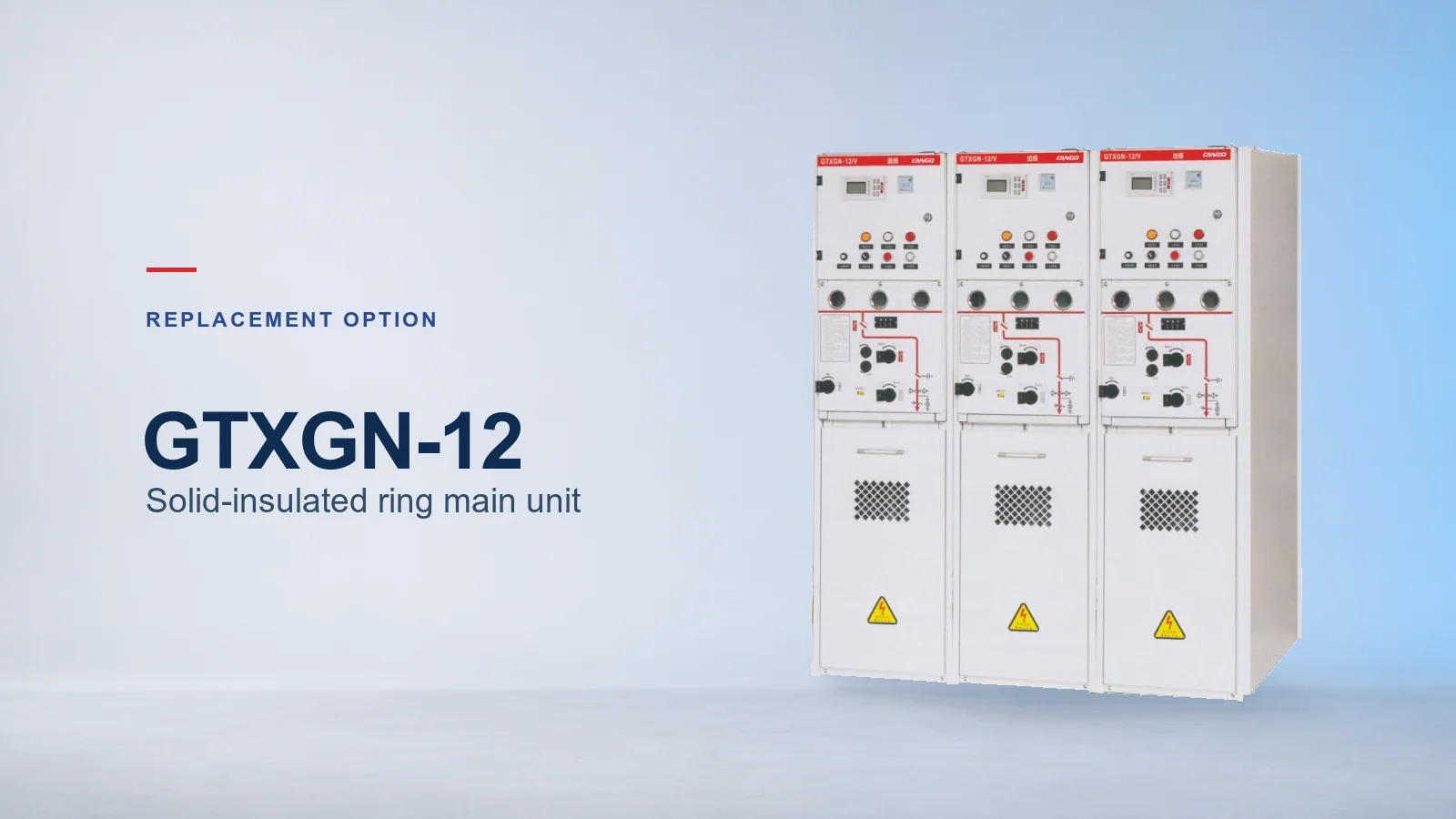
- Replacement with solid insulation. Where the project requires an SF6-free route, verify the actual replacement configuration against the site’s requirements. The GTXGN-12 product page identifies a solid-insulated unit with vacuum switching. Confirm fit and project suitability before choosing it. CANGO GTXGN-12 product page
Article 13(9)(a) of Regulation (EU) 2024/573 restricts putting covered F-gas switchgear for distribution up to and including 24 kV into operation from 1 January 2026, subject to applicable exceptions, without requiring automatic retirement of units already in service. [5] AIS vs GIS and the F-gas timeline
FAQ
The alarm is on but the RMU is running fine. Can I leave it in service?
For a confirmed alarm-only indication, temporary service depends on the installed manufacturer’s instructions and the site’s authorization. Notify the equipment supplier, restrict switching, record the condition and plan an outage. If the indication is red, locked out or uncertain, escalate promptly and apply the restrictions described above. Stable service at normal voltage cannot establish that the unit will withstand the next surge or fault.
Can I still operate the switch when the pressure is low?
Restrict or avoid operation at the confirmed alarm stage unless the applicable instructions and site authority expressly allow the duty. For its red pointer condition, ABB SafeRing / SafePlus prohibits live operation. Follow the manual for your equipment and the approved site switching plan. Arrange the isolation route without attempting a trial operation of the affected unit. [1]
Can I just top up the SF6?
A unit with no authorized refill provision has no top-up route. Where the manufacturer permits gas service, qualified personnel must first investigate the leak and follow the applicable procedure. An addition of gas by itself leaves the cause unresolved. Ask what repair and verification are required before the operating restriction can be lifted.
How do I know if it is a real leak or a faulty indicator?
Identify the affected compartment and instrument, compare available local and remote indications, and record the trend and any recent temperature or installation changes. These observations narrow the possibilities. The manufacturer or a qualified team must confirm the condition. Keep the compartment closed and maintain the applicable restrictions until the indication has been resolved.
Do the EU SF6 rules force me to retire a running RMU?
The putting-into-operation restriction described in the replacement section does not impose automatic retirement of an RMU already in service. Make the immediate service decision from its condition, manufacturer instructions and site rules. Check the applicable EU restrictions and any exceptions when planning to put replacement equipment into operation. [5]
Sources
- [1] ABB, SafeRing / SafePlus 12–24kV Installation and operating instructions, section 11.1, page 24. Model-specific warning and qualified replenishment boundary.
- [2] Eng-Tips, Gas Insulated MV Switchgear Low Gas, February 2021 discussion. Practitioner account and reported manufacturer response.
- [3] Eng-Tips, SF6 Switch/breaker at very low gas pressure, September 2022 discussion. Practitioner observations, not an operating limit.
- [4] Eng-Tips, GIS Bus – Trip On Low-Low Gas Pressure?, April 2010 discussion. Examples of different site protection approaches.
- [5] Regulation (EU) 2024/573, Article 13(9)(a) and associated exceptions.
- CANGO Power, SRM-12 gas-insulated ring main unit and GTXGN-12 solid-insulated ring main unit. Product pages linked in the respective body sections and checked on 11 November 2026. Product and photograph provenance only.