Choose fixed low-voltage switchgear when its agreed isolation, access and component-replacement plan fits the project’s permitted outages. Shortlist withdrawable functional units when exchanging a defined feeder unit has operational value—and the project will provide compatible spares, trained personnel and the required handling arrangements.
The purchasing decision is not simply “fixed costs less” or “drawers avoid shutdowns.” It is which circuits need a supported unit-exchange strategy, and what must be in place for that strategy to work. Neither construction alone guarantees uninterrupted supply or authorizes energized maintenance.
Identify what is fixed or withdrawable
A functional unit performs a circuit function, such as an outgoing feeder or motor starter. Do not confuse its construction with the mounting of one device inside it. A draw-out incoming circuit breaker does not establish that the outgoing feeders are withdrawable. Ask for a circuit-by-circuit schedule, not just a switchboard label.
In the official GSO public preview adopting IEC 61439-2:2020, clause 3.2.101 defines a withdrawable part as moving between connected and isolated positions, and an optional test position, while remaining mechanically attached to the assembly. Clause 3.2.102 makes an important distinction: at the test position, the relevant main circuits are open on the supply side but not necessarily isolated; auxiliary circuits remain connected for operational tests. A test position is therefore not a general maintenance-isolation statement.
For this buying comparison, a fixed arrangement means the specified equipment remains mounted rather than being exchanged as a withdrawable unit. Fixed does not mean impossible to replace. Require the supplier to identify the actual mounting and connection arrangements for the work you expect.
GGD, GCK, GCS and MNS names help locate product families, but do not answer those circuit-level questions. Use the separate GGD vs GCK vs GCS vs MNS comparison for that family shortlist.
Compare the same replacement task in both offers
Before discussing price, select a realistic task: replacing a motor-starter unit, changing a feeder breaker, or repairing a cable termination. Those are different jobs. Ask both suppliers to respond to the same task and the same electrical duty.
The matrix below is a procurement framework, not a prescribed maintenance procedure or a claim that every fixed or withdrawable design behaves alike.
| Buying question | Fixed offer must explain | Withdrawable offer must explain |
|---|---|---|
| What is being replaced? | The device or assembly portion removed, and connections disturbed | The contents of the exchangeable unit, and components left in the compartment |
| What outage is required? | The affected feeder, section or wider supply boundary for the named task | The same boundary, including whether the proposed exchange actually meets the owner’s availability requirement |
| What restores the circuit? | Replacement parts, mounting work, reconnection and checks | Approved spare-unit identity, interfaces, settings and return-to-service checks |
| What space is needed? | Terminal access and a route for component removal | Movement/removal envelope, handling equipment and a place to put the removed unit |
| What must the site maintain? | The specified devices, joints and access provisions | Those requirements plus the documented moving/contact interfaces relevant to the design |
| What supports the bid? | Drawings and instructions covering the offered fixed arrangement | Drawings, position descriptions and instructions covering the offered withdrawable arrangement |
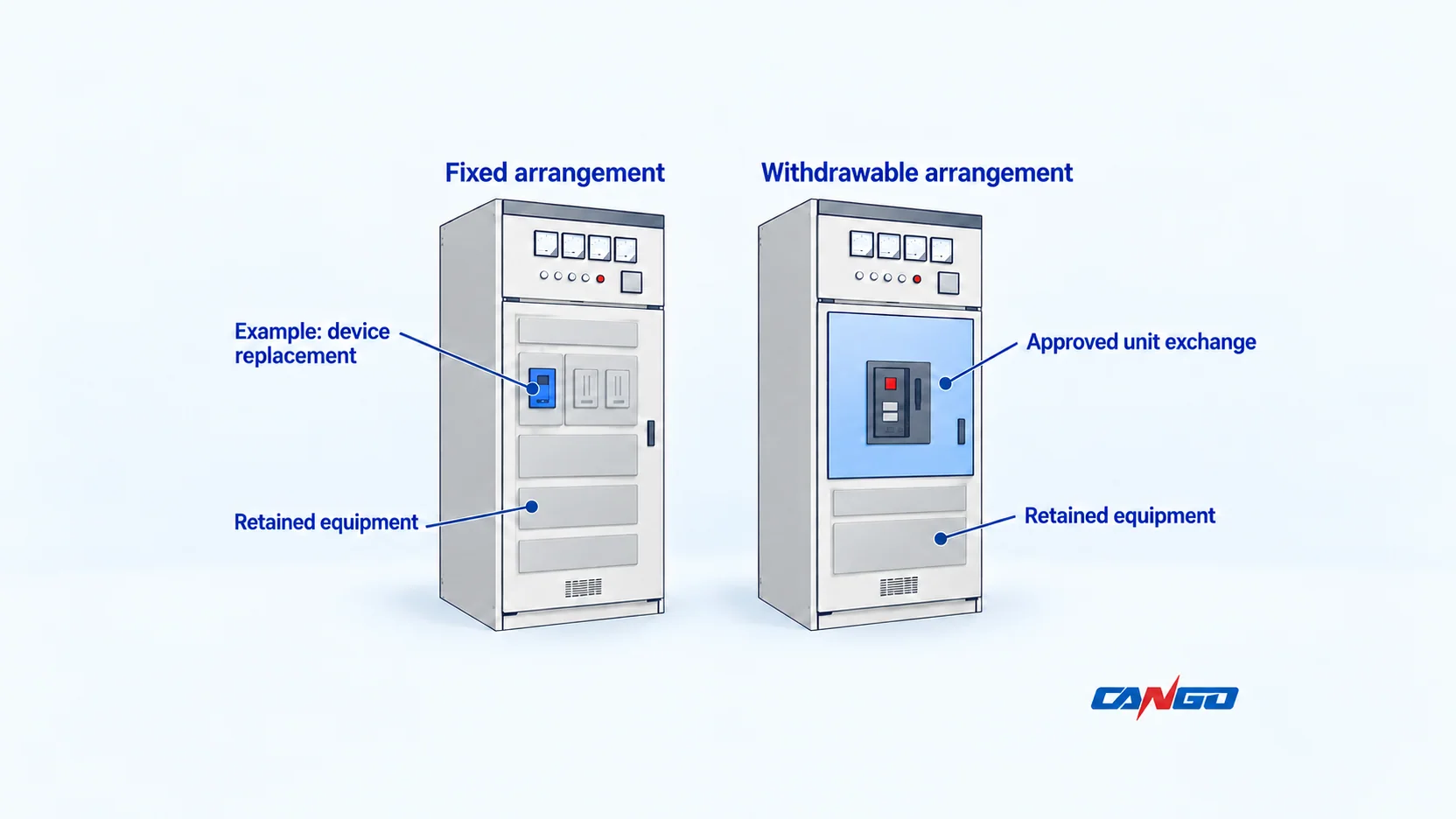
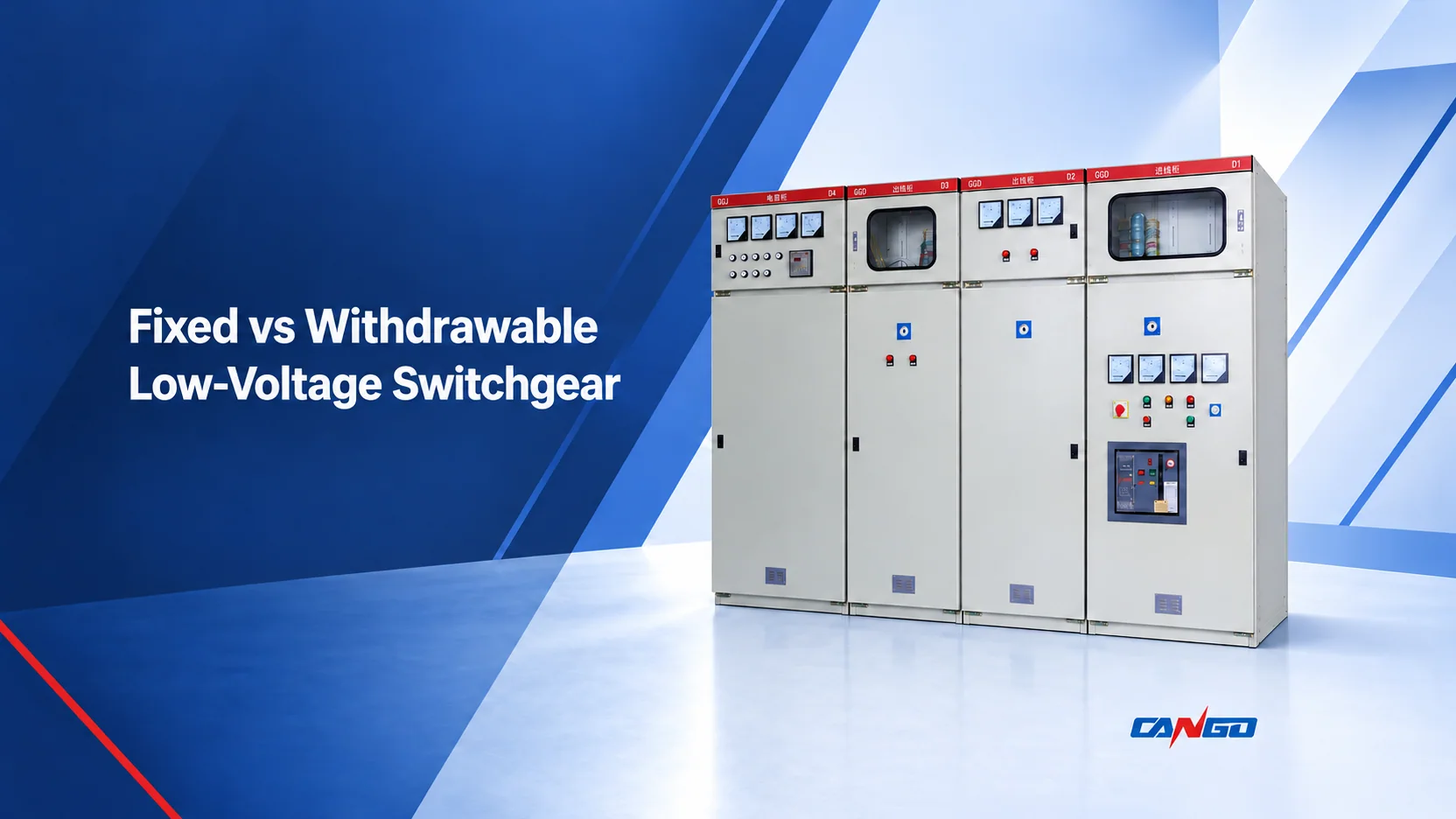
In CANGO’s range, the GGD product page explicitly identifies fixed AC low-voltage switchgear for distribution and control duties. That makes it a fixed-construction starting point—not evidence that every GGD configuration has the same access, separation or replacement requirements.
Decide which feeder groups justify withdrawable units
Do not assign a construction merely because a building is called a hospital, factory or data center. First identify what the individual load can tolerate and how the owner intends to restore it.
For each feeder group, record five items:
- Affected load: what stops if this circuit is unavailable?
- Permitted interruption: what outage window and affected-load boundary has the owner accepted?
- Target replacement: which failure or maintenance task is the exchange strategy intended to address?
- Available resources: which compatible spares, qualified personnel, tools and access are funded?
- Acceptance evidence: what must the bidder show before the claimed operational value is accepted?
Use the following hypothetical conditions to allocate the requirement. They are decision examples, not CANGO project results or industry-wide rules.
| Feeder-group condition | Construction direction | Condition before accepting it |
|---|---|---|
| Stable distribution circuits with an accepted planned section outage | Keep a fixed offer in the comparison | Document that component access and replacement work fit the accepted outage plan |
| Repeated motor circuits where the owner wants a stocked complete-unit exchange strategy | Compare withdrawable functional units | Identify which units genuinely share approved spares, and demonstrate the required interfaces and handling arrangements |
| A critical load for which no interruption is acceptable | Resolve the supply-continuity architecture first; construction alone is insufficient | The responsible designer must establish the necessary alternative supply or process provision, then specify the unit arrangement |
| Different circuit groups have different maintenance needs | Request an explicitly scheduled mixed arrangement where the supplier supports it | Mark the construction and evidence boundary for each group rather than applying one label to the whole lineup |
The resulting decision record should read: “For these feeders, we require this replacement capability under these outage conditions, supported by these resources.” That is more testable than “provide the highest-reliability withdrawable panel.”
Price the full restoration plan, not the drawer movement
A spare unit only earns its place in the business case when it covers the intended repair. Ask what stays behind: cable terminals, connection interfaces, distribution conductors or other compartment equipment. A fault in a retained part is not repaired merely by exchanging the removable unit.
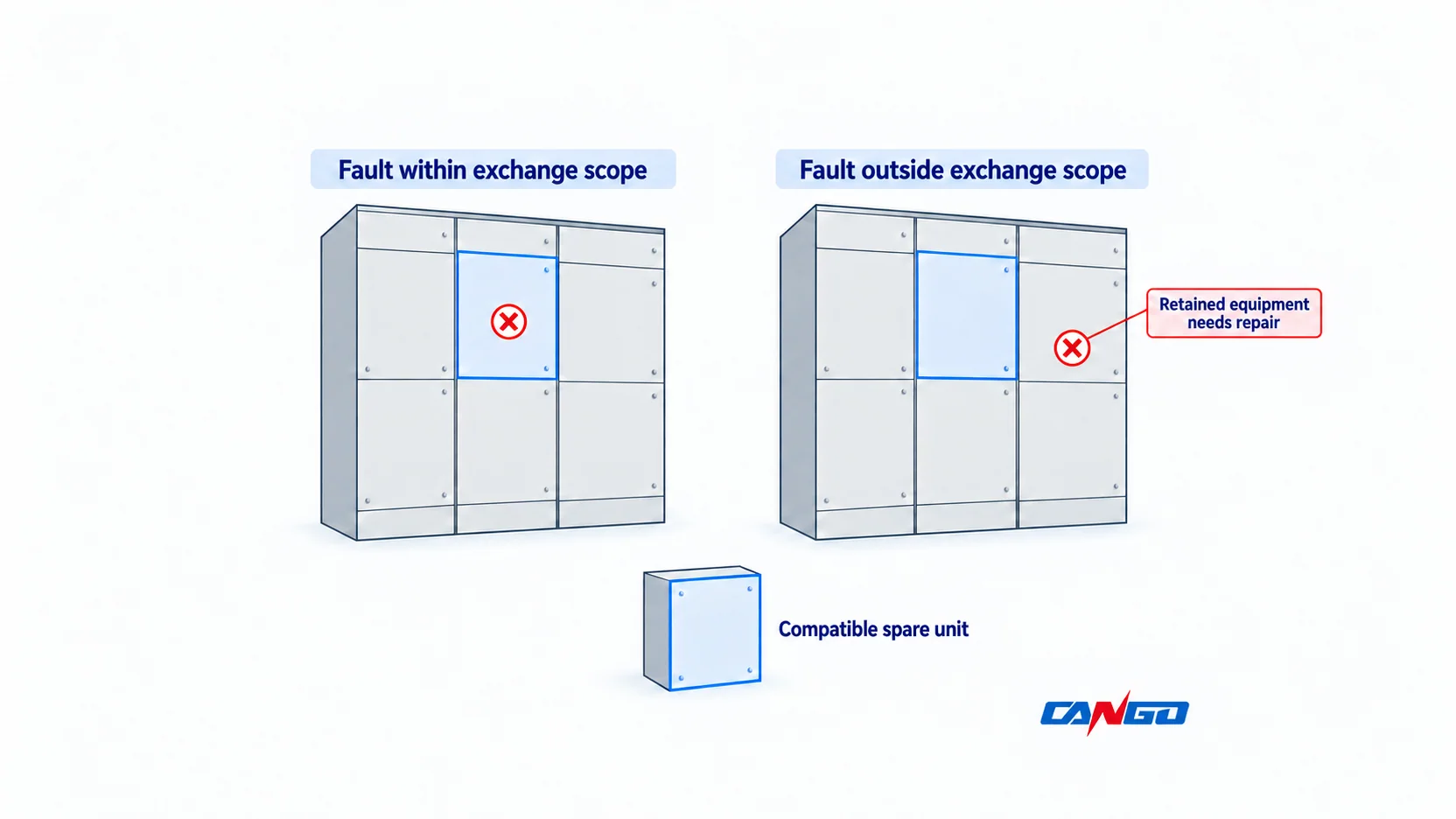
For each proposed spare, request an approved compatibility schedule covering the circuit duty, mechanical interface, power and auxiliary connections, protection settings, control functions and configuration revision. Similar dimensions are not sufficient evidence of interchangeability. Distinguish a complete spare unit from a spare breaker, an empty compartment and reserved expansion space.
Then compare the whole restoration plan:
Make the task safe and accessible → obtain the correct replacement → exchange or reconnect → check configuration and function → authorize restoration.
This is a planning sequence, not an operating instruction. Require the supplier and site team to identify dependencies and exclusions at each stage. If a time claim covers only physical removal, do not treat it as the total circuit-restoration time.
Normalize the commercial comparison accordingly: equipment scope, compatible spare inventory, handling accessories, training, maintenance provisions and the owner’s stated outage consequences. Obtain project quotations rather than applying a universal price premium or assumed payback period. An exchange strategy without funded spares and competent support should not receive the same operational value as a fully supported one.
Keep construction, performance and work permission separate
Assembly evidence applies to both alternatives
IEC 61439-1:2020 provides general assembly rules and verification requirements; it is used with the relevant product part. IEC 61439-2:2020 covers power switchgear and controlgear assemblies. Neither a construction label nor a photograph establishes conformity of the offered equipment.
Keep voltage, current, fault duty, loading conditions and installation environment on the same basis in both offers. Request documentation applicable to the proposed arrangement rather than relying on the rating or certificate of an individual breaker. The separate design verification vs routine verification guide explains the two evidence roles.
Internal separation concerns physical boundaries within the assembly, not whether a unit moves. Specify it separately; use the Form 2, Form 3 and Form 4 guide when defining those boundaries.
Internal-arc performance needs its own evidence
IEC TS 61641:2026 addresses assessment of internal arc-fault protection. It replaced IEC TR 61641:2014 and IEC TS 63107:2020. Its scope excludes maintenance-work conditions and personal protective equipment. Do not infer an internal-arc assessment or permission for energized maintenance from a withdrawable designation.
Position indications do not replace a safe-work system
For US workplaces within its scope, OSHA 29 CFR 1910.333 addresses deenergization, lockout/tagging and qualified-person verification. Interlocks cannot substitute for lockout/tagging, and verification must consider possible backfeed. Other destinations need their applicable rules. This article supplies no racking or energized-work procedure; the actual equipment instructions and authorized site work controls remain essential.
Apply the decision to CANGO’s actual product range
Alongside GGD, CANGO’s website lists GCK as a withdrawable system including power distribution center and motor control center arrangements. GCS is described as withdrawable switchgear for distribution, centralized motor control and reactive-power compensation. MNS is described as modular withdrawable switchgear; its inquiry information also asks buyers to identify drawer or fixed cabinet structure.
These are product entry points, not proof of every circuit’s execution. Request the offered functional-unit schedule, interfaces and supporting documents for your project. Do not assume that every unit in a lineup is withdrawable or that spares interchange across product families.
For a configuration review, send CANGO the feeder-group decision record, single-line diagram and load schedule, required ratings and fault duty, room/cable layout, proposed spare strategy and document requirements. The low-voltage switchgear inquiry guide covers the broader project inputs.
Ask CANGO to compare fixed and withdrawable configurations. Require each proposed option to state what it supports, what it excludes and which assumptions remain unresolved before purchase.
References
- Gulf Standardization Organization — GSO IEC 61439-2:2025 official public preview, adopting IEC 61439-2:2020 without technical modifications; visible clauses 3.2.101–102 and 3.1.103.
- CANGO product information — GGD low-voltage distribution switchgear.
- IEC — IEC 61439-1:2020, General rules, official scope/abstract.
- IEC — IEC 61439-2:2020, Power switchgear and controlgear assemblies, official scope/abstract.
- IEC — IEC TS 61641:2026, Internal arc-fault protection, official scope/abstract.
- US Occupational Safety and Health Administration — 29 CFR 1910.333, Selection and use of work practices, particularly (b)(2)(ii)(B) and (b)(2)(iv)(B).
- CANGO product information — GCK, GCS and MNS product descriptions and photographs.