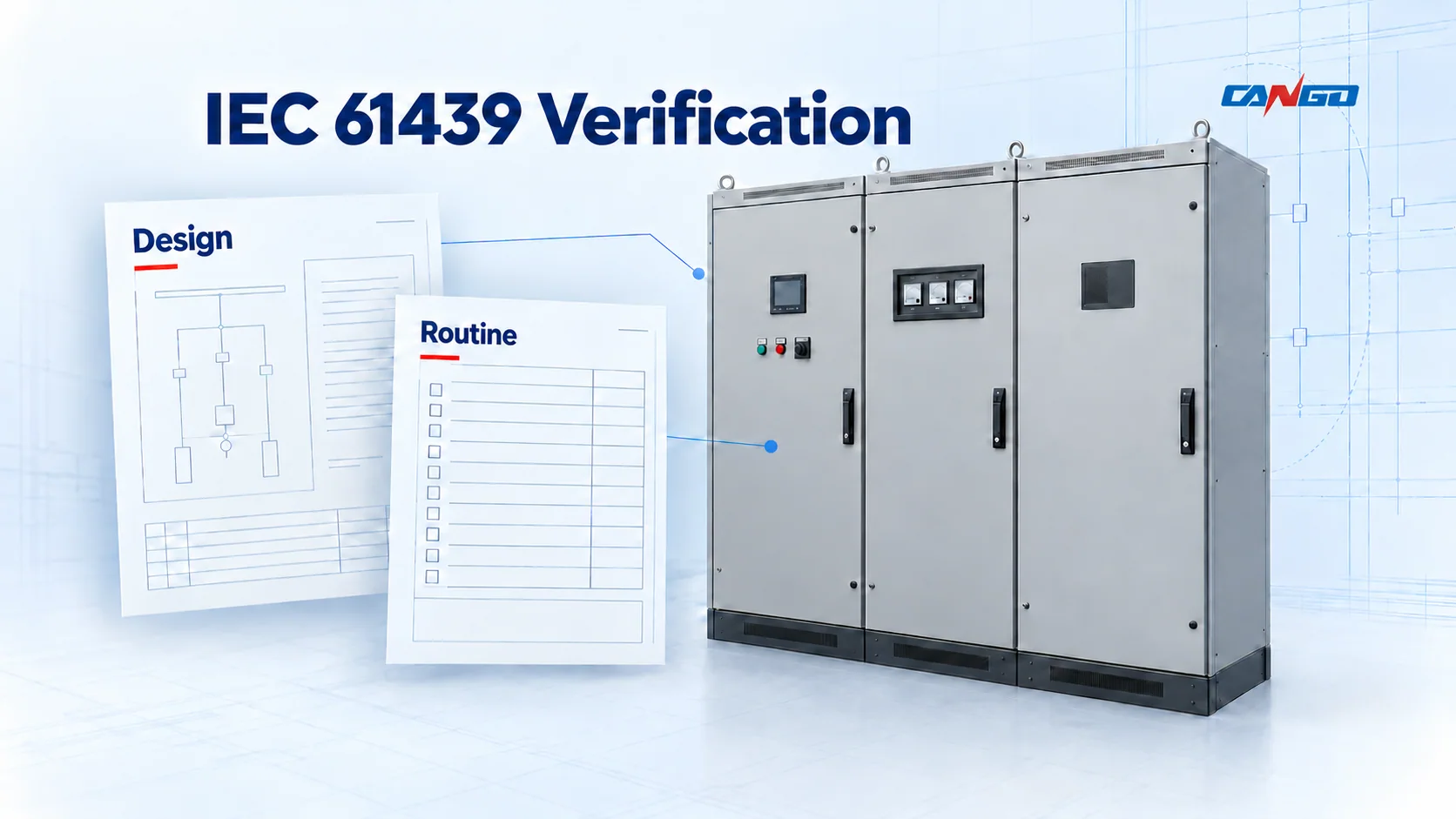
Design verification addresses the assembly design. Routine verification addresses each manufactured assembly. A low-voltage switchgear buyer needs both: evidence applicable to the offered design and identifiable routine records for the equipment delivered. One does not replace the other. Schneider Electric Electrical Installation Guide.
The practical question is whether the documents connect to the actual assembly: its design reference, revision, ratings, construction and individual identity. A component certificate or a report for a different cabinet configuration cannot close that connection on its own.
Design verification and routine verification serve different purposes
| Review point | Design verification | Routine verification |
|---|---|---|
| Purpose | Verify the assembly design | Detect manufacturing faults and check function |
| Object | A design or assembly system within its verified scope | Each manufactured assembly |
| Responsibility | Original manufacturer; modified designs need assigned design responsibility | Assembly manufacturer for the completed assembly |
| Timing | During development; applicability reviewed for changes | Each assembly before delivery |
| Evidence establishes | A basis for the design meeting applicable requirements | Verification results for the identified manufactured assembly |
| Evidence does not establish | Correct manufacture of every delivered assembly | Design performance outside the applicable design evidence |
The responsibilities and timing are described in Siemens SIVACON S8 planning guidance, printed page 108. The original manufacturer and assembly manufacturer can be the same organization; the two verification functions still remain distinct.
First agree which standard and edition the project specifies. IEC 61439-1:2020 provides the general rules and verification framework; assembly conformity also uses the relevant assembly-specific part. IEC 61439-2:2020 gives the specific requirements for power switchgear and controlgear assemblies. Part 1 alone is therefore an incomplete specification for an assembly to which Part 2 applies.
Match design evidence to the offered assembly
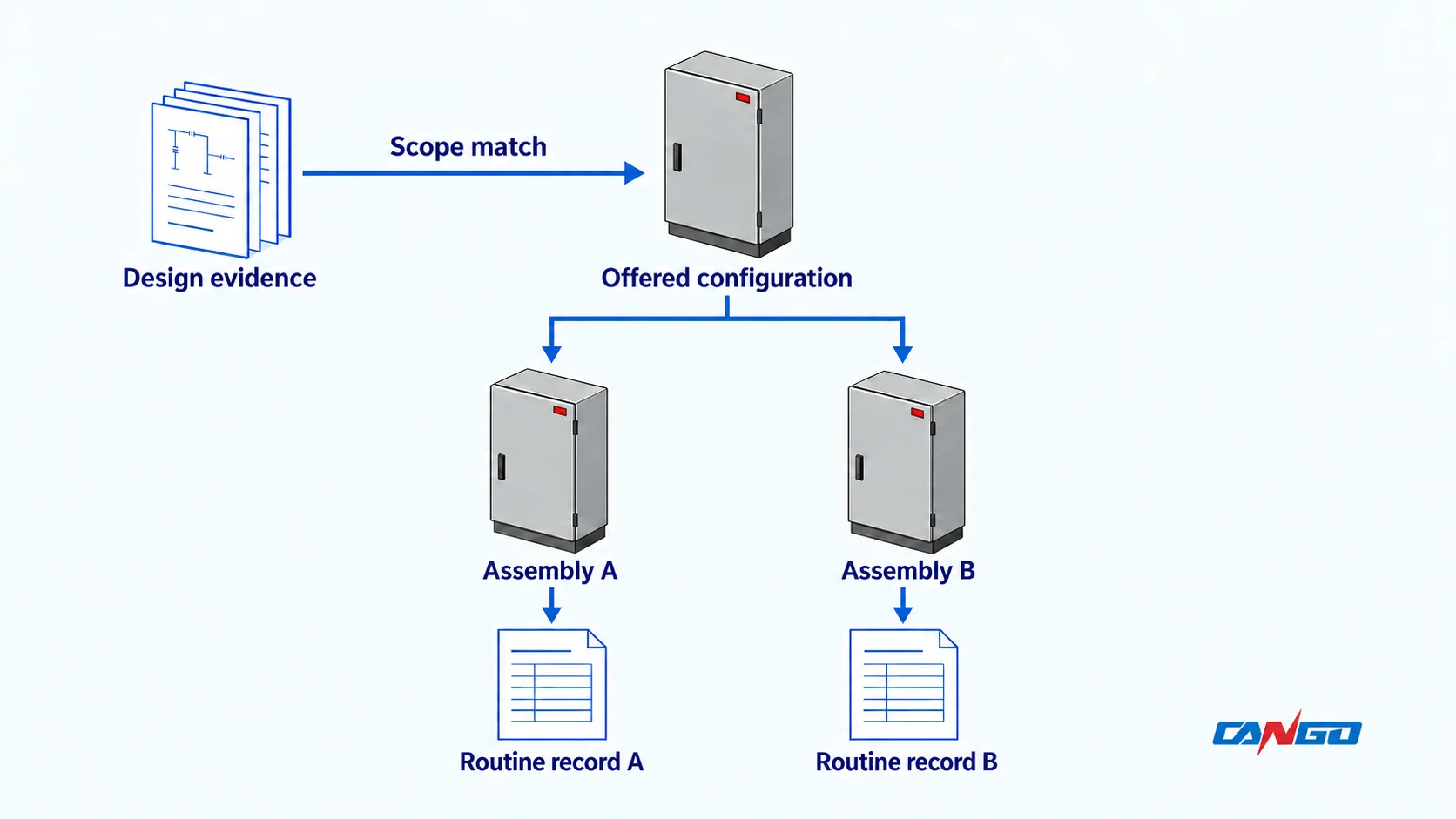
Start with an evidence index that identifies the design or assembly system, the relevant verification documents and their scope. Then ask the supplier to explain how the proposed assembly falls within that scope. This is more useful than collecting reports without a configuration match.
Design verification can use different routes, including testing, comparison with a reference design and assessment where permitted. The available route depends on the characteristic and applicable requirements; a calculation or reference comparison is not a universal substitute for testing. Schneider Electric Electrical Installation Guide.
For procurement review, compare four groups of information:
- Identity and revision: assembly-system reference, manufacturer, drawing revisions and the offered bill of materials.
- Declared duty: voltage, assembly and circuit currents, short-circuit characteristics, loading assumptions and specified service conditions.
- Construction: enclosure, busbar arrangement, functional units, component selections, internal separation and cooling arrangement.
- Applicability limits: permitted variants, assembly instructions and any conditions attached to the verification evidence.
These are document-matching questions, not a replacement for the technical review of the evidence. Ask the responsible manufacturer to identify differences and state how they are covered. For an offer based on a cabinet family, CANGO’s GGD, GCK, GCS and MNS comparison helps clarify construction choices; the family name itself does not establish the evidence scope.
Component certificates do not prove the complete assembly
A breaker, drive or other component has its own product requirements. Incorporating it into a cabinet adds assembly questions about its connections, enclosure and interaction with other parts. IEC’s Part 1 scope explicitly distinguishes product-standard testing of items such as converters, UPS equipment and drives from their incorporation into an assembly. IEC 61439-1:2020.
The procurement implication is to use component documents to support the selected devices and assembly evidence to support their assembled configuration. A folder of component certificates alone leaves the assembly-level evidence question unanswered.
Identify routine records for every delivered assembly
Routine verification belongs to the assembly manufacturer. Eaton’s guidance also assigns assembly marking and documentation to that manufacturer and identifies routine verification as part of the assembled switchboard documentation. Eaton low-voltage installation guide, printed page 23.
Agree the record format before delivery. As a buyer’s traceability requirement, ask each record to identify the assembly or lineup, the relevant sections where appropriate, the as-built drawing revision, verification date, responsible manufacturer and recorded results. If several assemblies share a document bundle, the bundle should make the individual coverage clear.
A blank routine-verification template shows a planned recording format. It does not show that verification was performed on the delivered unit. Similarly, a completed record carrying an unrelated serial number or earlier drawing revision needs clarification before it can support the project handover.
Keep the design evidence reference in the delivery dossier alongside the individual routine records. This allows the reviewer to answer two separate questions: which design basis applies, and which manufactured assemblies have been verified?
What changes can break the evidence chain?
Consider a hypothetical offer that replaces the specified incoming breaker with another model carrying the same nominal current. This is an illustrative procurement example, not a CANGO test result or customer case. The matching current label alone does not demonstrate that the revised assembly remains within the original evidence scope.
Ask the supplier to record the proposed substitution and review the affected construction and performance: device installation, connection arrangement, heat dissipation and the short-circuit verification basis. The responsible manufacturer should identify which existing evidence remains applicable and what further verification is needed for the changed design.
ABB’s guidance explains the responsibility boundary: when a modification affects verified characteristics, the assembly manufacturer takes the original-manufacturer role for the customized area and must carry out the relevant design verification. This is a responsibility for the affected design, not an instruction to repeat every test on every change. ABB System pro E power catalogue, printed page 4-6.
The answer is configuration-specific. For example, Schneider Electric’s Masterpact replacement guidance describes documented substitutions that may avoid recertification, while also identifying applications or new performance that require additional action. That guidance supports a scoped review; it does not authorize arbitrary breaker substitutions or establish a universal retest rule.
Until the applicability question is resolved, keep the change open in the technical review. Do not treat a routine record for the revised board as proof that the design change is covered.
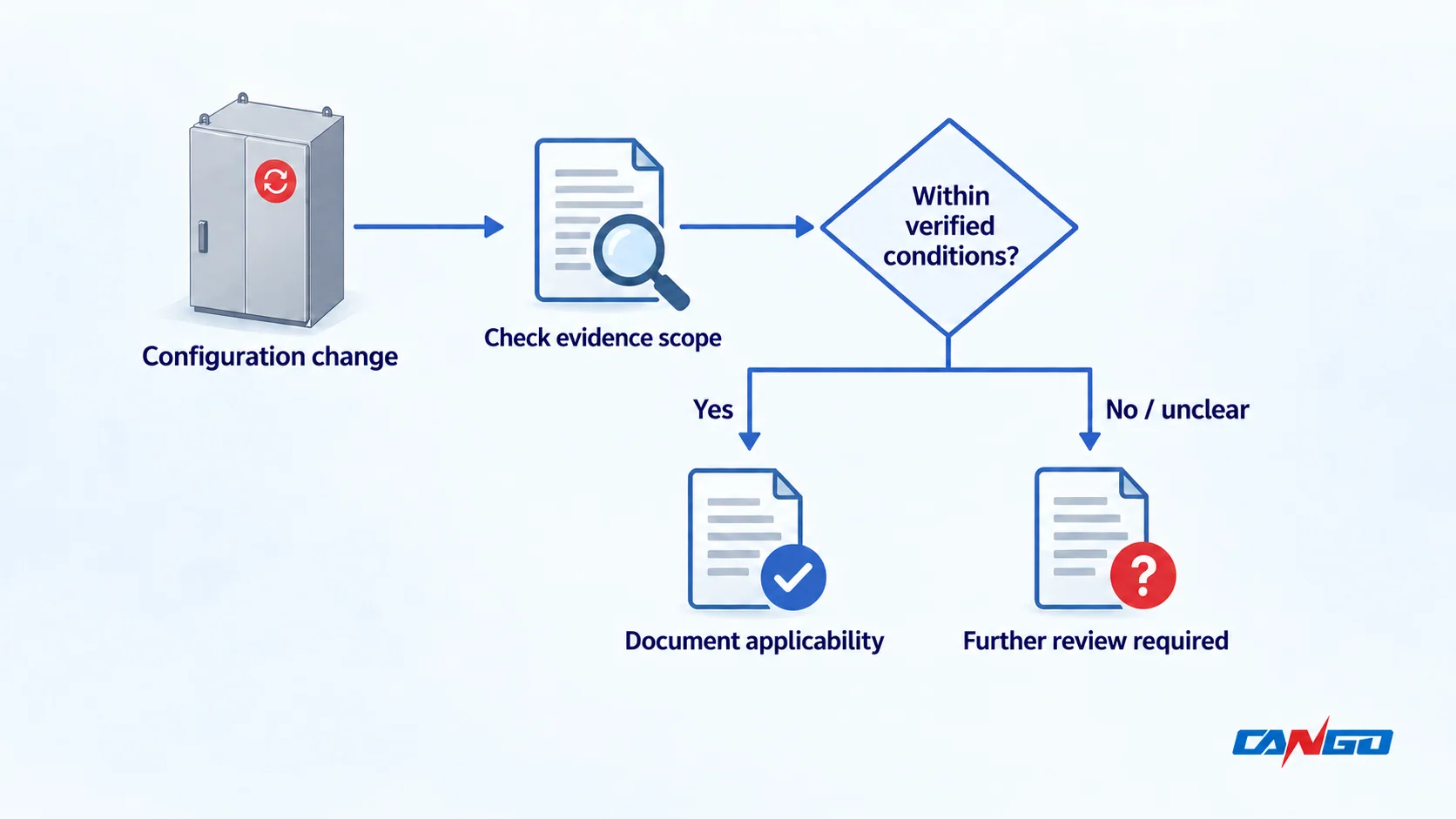
Apply the same review discipline when changing enclosure dimensions, cooling, busbar construction or compartment boundaries. If separation changes are part of the proposal, use the Form 2, Form 3 and Form 4 separation guide to define the intended boundaries, then request evidence for that arrangement.
A document review matrix for LV switchgear buyers
Use the following matrix to organize a supplier review. It is a procurement framework, not an IEC-prescribed document template or an exhaustive list of verifications.
| Document or evidence | Match it to | Question to close | Confirmation owner |
|---|---|---|---|
| Project standards schedule | Required assembly type, parts and editions | Has the supplier declared the same conformity basis and any deviations? | Project engineer and supplier |
| Design-evidence index | Offered design reference and documented variants | Which evidence covers this configuration, and under what conditions? | Responsible manufacturer |
| Ratings, drawings and component schedule | Quoted configuration and revision | Do declared duty and construction agree across the offer? | Supplier technical team |
| Change or substitution register | Differences from the verified design | Which characteristics are affected, and how is applicability established? | Responsible manufacturer |
| Completed routine-verification records | Each delivered assembly and its as-built identity | Are coverage, results and document references identifiable? | Assembly manufacturer |
| Final dossier and document index | Agreed purchase-order deliverables | Are the accepted revisions and outstanding deviations closed? | Supplier and buyer reviewer |
Make missing information specific. “IEC certificate required” leaves the object and scope unclear. A more reviewable request is: identify the design evidence applicable to the listed assembly and revision, explain any departures, and provide routine-verification records traceable to each delivered assembly.
Agree any independent review, witness requirements and acceptance documents in the project specification. A document title or certification-body logo does not remove the need to check what configuration and characteristics the evidence covers.
Prepare a verification-focused CANGO inquiry
IEC TR 61439-0:2022 is guidance for specifying assemblies. It explains why the specifier needs to define system and application details so the manufacturer can meet the required characteristics. Use CANGO’s low-voltage switchgear planning guide to prepare the wider electrical and site information.
CANGO’s low-voltage switchgear range includes GGD, GCK, GCS and MNS families. For a configuration discussion, provide the project standard and edition, single-line diagram, assembly schedule, required ratings, service conditions, proposed construction and requested document scope. Identify substitutions or special requirements before the offer is finalized.
Discuss the proposed LV assembly and document scope with CANGO. The inquiry should establish what evidence and delivery records are required for the offered configuration; a catalog family name alone does not establish project-specific verification coverage.