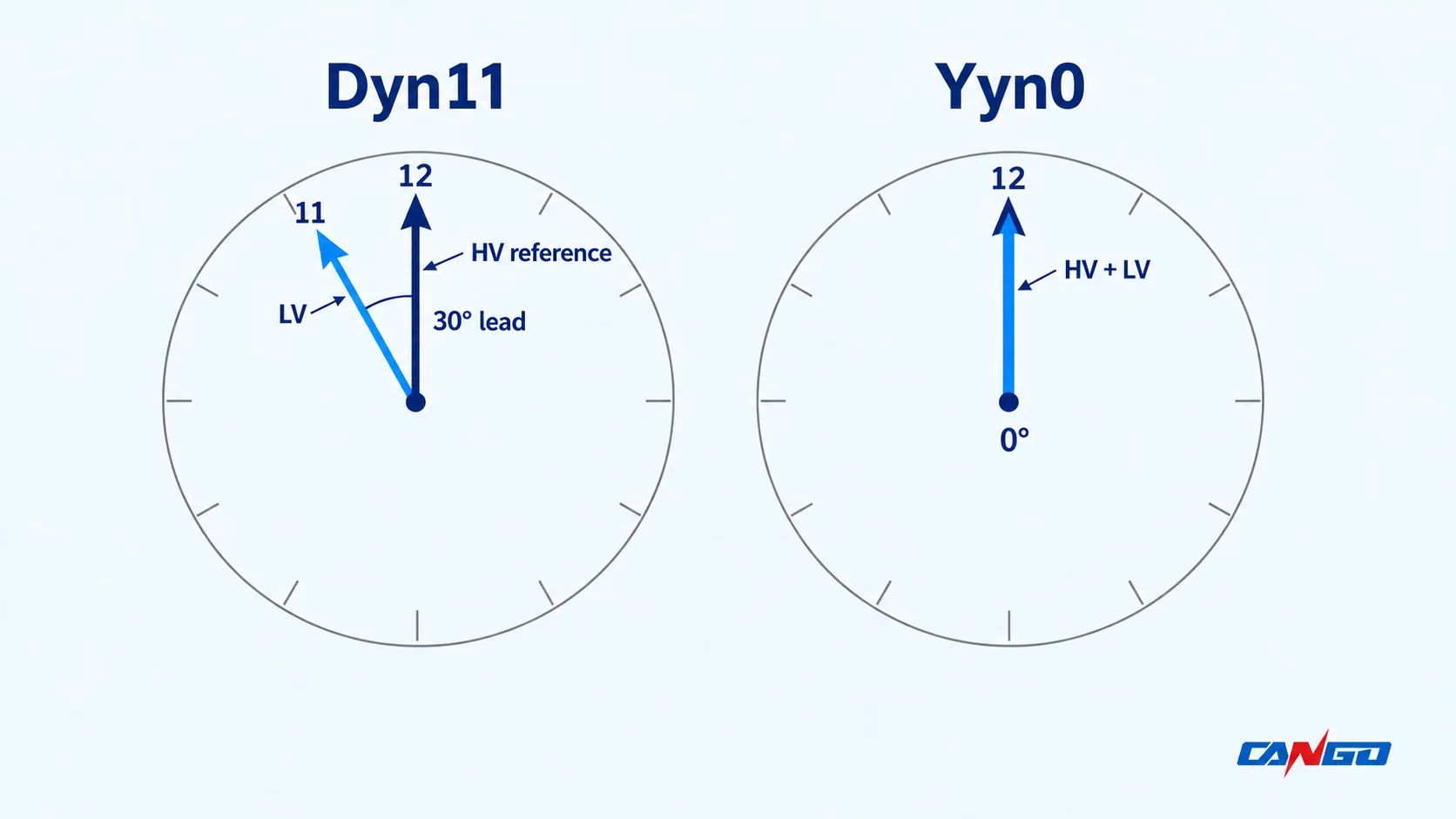
Dyn11 and Yyn0 specify different high-voltage (HV) winding connections and different phase relationships between the HV and low-voltage (LV) windings. Both include an LV neutral terminal, but equal kVA and voltage ratings do not make them interchangeable at an existing electrical interface. The group is a connection designation, not a capacity or efficiency grade.
The Bureau of Indian Standards (BIS) educational handbook, section 2.32 describes the winding examples used here. Its star–star example is YNyn0, not Yyn0.
Dyn11 vs Yyn0 on the same electrical basis
Read the groups on the same HV/LV basis.
| Comparison point | Dyn11 | Yyn0 |
|---|---|---|
| HV winding | D: delta | Y: star |
| LV winding | y: star | y: star |
| LV neutral | n: brought out as a terminal | n: brought out as a terminal |
| Clock position | 11 | 0 |
| LV against the HV clock reference | 30° lead | 0° |
| HV neutral-terminal designation | No N; HV winding is delta | No N; do not read this as YNyn0 |
| What the group does not specify | Project earthing method, kVA, guaranteed losses or complete compatibility | Project earthing method, kVA, guaranteed losses or complete compatibility |
The clock rows use the Guru Nanak Institute of Technology (GNIT) clock-reference convention. The last row sets a buyer-review boundary, not a performance ranking.
How to read clock 11 and clock 0
With HV at 12, each hour represents 30°. Dyn11 places LV at 11: 30° leading, equivalently 330° lagging. Yyn0 places LV at 12: 0° displacement. GNIT courseware, PDF pages 497–499 explains this reference.
Use corresponding phase-to-neutral reference voltages, with an imaginary neutral where necessary—not a physical HV neutral on Dyn11. Do not mix line-to-line and phase-to-neutral comparisons.
Yyn0 is not YNyn0—and n is not an earthing instruction
The handbook’s YNyn0 example brings out both neutrals. Removing the capital N changes the HV-neutral designation, not the star winding: do not substitute that example for Yyn0. Capital N identifies a brought-out primary neutral in Sudan University of Science and Technology’s substation-design study, section 2.4.5.
Request the offered connection drawing if the upstream interface needs a neutral terminal. An available terminal and its project earthing requirement are separate specification questions.
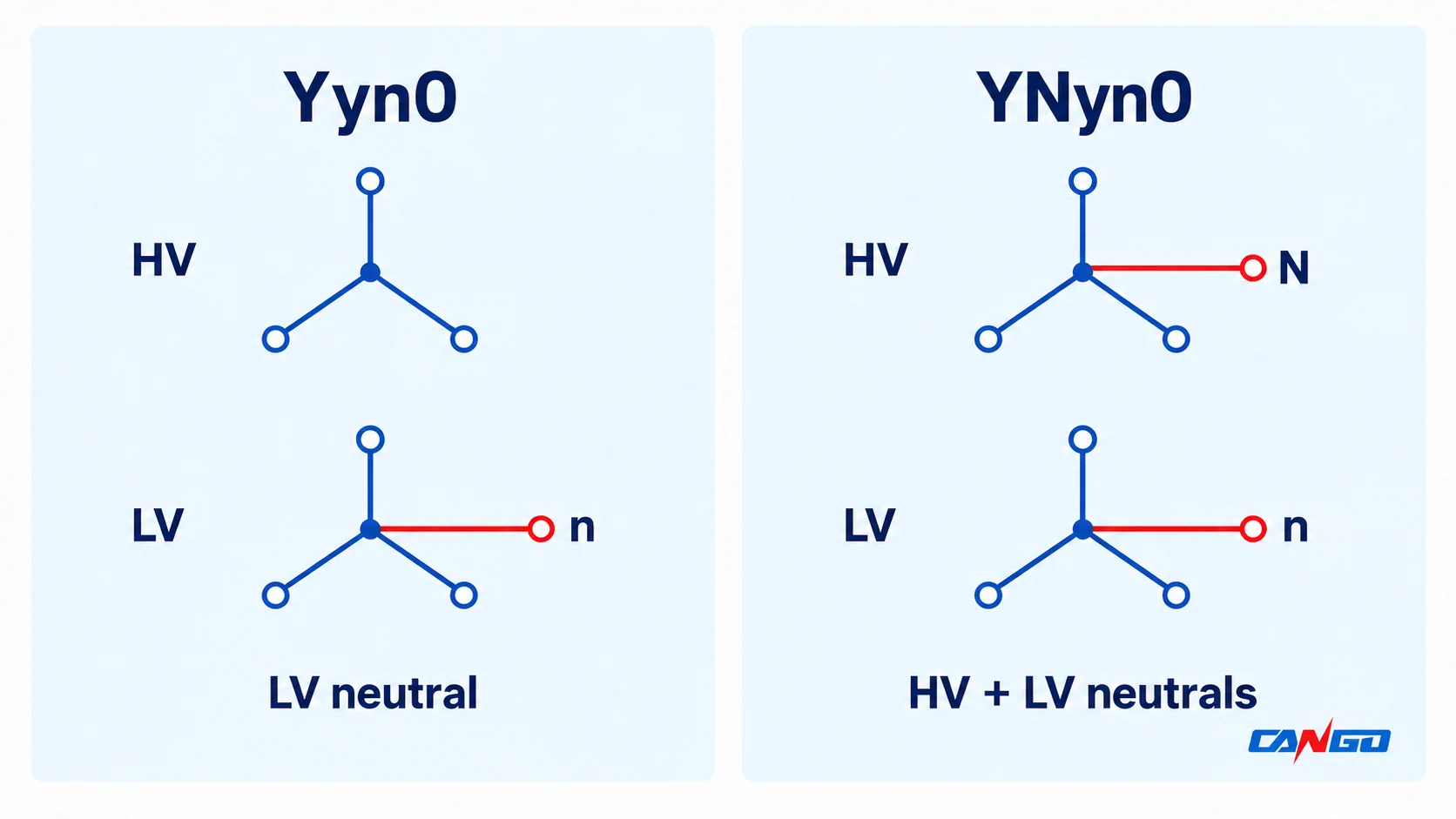
Keep two questions separate in the inquiry: “Which neutral terminals does the transformer provide?” and “What earthing arrangement does the project require?” Ask the responsible designer to resolve the second question and the supplier to confirm the terminal arrangement against the agreed equipment drawing. A catalogue code should not silently become an earthing design.
Match the group to the project interface
There is no useful universal rule that one group wins every industrial or utility project. For this comparison, the decision is whether the proposed winding arrangement and phase relationship satisfy the defined interface. Use the following buyer-review matrix to expose unresolved assumptions. It is an original procurement aid, not a prescribed standard form.
| Project situation | Information to obtain | Decision to resolve before ordering |
|---|---|---|
| New transformer on an independently operated LV section | Approved single-line diagram, required group and terminal drawing | Which group does the project design require? |
| Like-for-like replacement | Existing nameplate, connection drawing and the approved replacement specification | Does the offer preserve the required electrical interface, or identify an approved change? |
| Two sources may feed an interconnected LV system | Operating states, source identities and intended coupling or transfer arrangement | Which states require a coordinated phase and compatibility review? |
| A neutral is needed on either side | Required terminal schedule and separate earthing specification | Is each required terminal actually brought out, and is its use defined? |
| Load duty raises additional concerns | Load schedule and the project studies relevant to that duty | What additional manufacturer data or engineering review is required beyond the group label? |
If harmonic or unbalanced-load performance is important, state that requirement separately and request an application-specific assessment. Do not purchase Dyn11 or Yyn0 on the assumption that the code alone guarantees harmonic filtering, a loss reduction or suitability for every load profile.
Why matching kVA and voltage does not settle replacement or parallel use
Consider a hypothetical replacement review: an existing Dyn11 transformer and a proposed Yyn0 unit have the same nominal kVA and HV/LV voltage ratings. Those equal values answer the rating questions, but not the phase-interface question. The different clock relationships remain. They must not be treated as direct parallel substitutes with the same HV phase reference and corresponding terminal sequence.
For parallel use, Indian Institute of Technology (IIT) Madras notes, printed pages 98–100 address ratio, polarity, phase sequence/displacement and impedance/load sharing. A phase mismatch can produce circulating current even without the intended load.
Matching Dyn11 labels do not complete that review. Confirm actual ratio and taps, terminal polarity/sequence and impedance/load-sharing data. This is an engineering-review boundary, not a reconnection or live-test guide.
Keep the associated tasks distinct. Use the distribution-transformer kVA sizing guide to establish capacity, and the transformer impedance explanation for the separate fault-current question. Neither calculation replaces the vector-group interface check.
Confirm the vector group in a CANGO inquiry
CANGO’s S11-M 10 kV oil-immersed transformer product information lists Dyn11 and Yyn0 among the connection-group options in its 10 kV-series table. That is model-specific catalogue information, not proof that every family, voltage class or offered unit has both options. Confirm the selected rating and configuration in the quotation and drawing.
For the wider inquiry package, use the power transformer project-information guide. Add a focused vector-group schedule that identifies:
- the required group, written in full rather than “delta/star” alone;
- HV/LV voltage ratings, frequency, capacity and tap requirements;
- the connection drawing and required neutral terminals;
- the separately approved earthing requirements;
- existing transformer details and any intended replacement, coupling or parallel operation;
- the responsible engineering review and any unresolved deviations.
If the required group is not yet approved, mark it as an open design item. Send CANGO the specification and interface drawings to confirm the proposed equipment configuration, while keeping system compatibility and earthing approval with the responsible project engineer.
References
- Bureau of Indian Standards — Educational transformer handbook, section 2.32, printed pages 26–27. Educational explanation, not the complete normative standard.
- Amit Debnath, GNIT — Electrical Machines I (EE401), Online Courseware, 2020–21, PDF pages 497–499.
- Ola Hassan Abd_Alqadir Mubarak et al., Sudan University of Science and Technology — Design of High Voltage Transmission Substation, Chapter Two, 2018 undergraduate project, section 2.4.5, printed pages 12–13.
- Krishna Vasudevan, G. Sridhara Rao and P. Sasidhara Rao, IIT Madras / NPTEL — Electrical Machines I: Parallel Operation, printed pages 98–100. Course notes; publication date not stated in the consulted document.
- CANGO — S11-M 10 kV Oil-Immersed Transformer, first-party product information, 10 kV-series connection-group table.