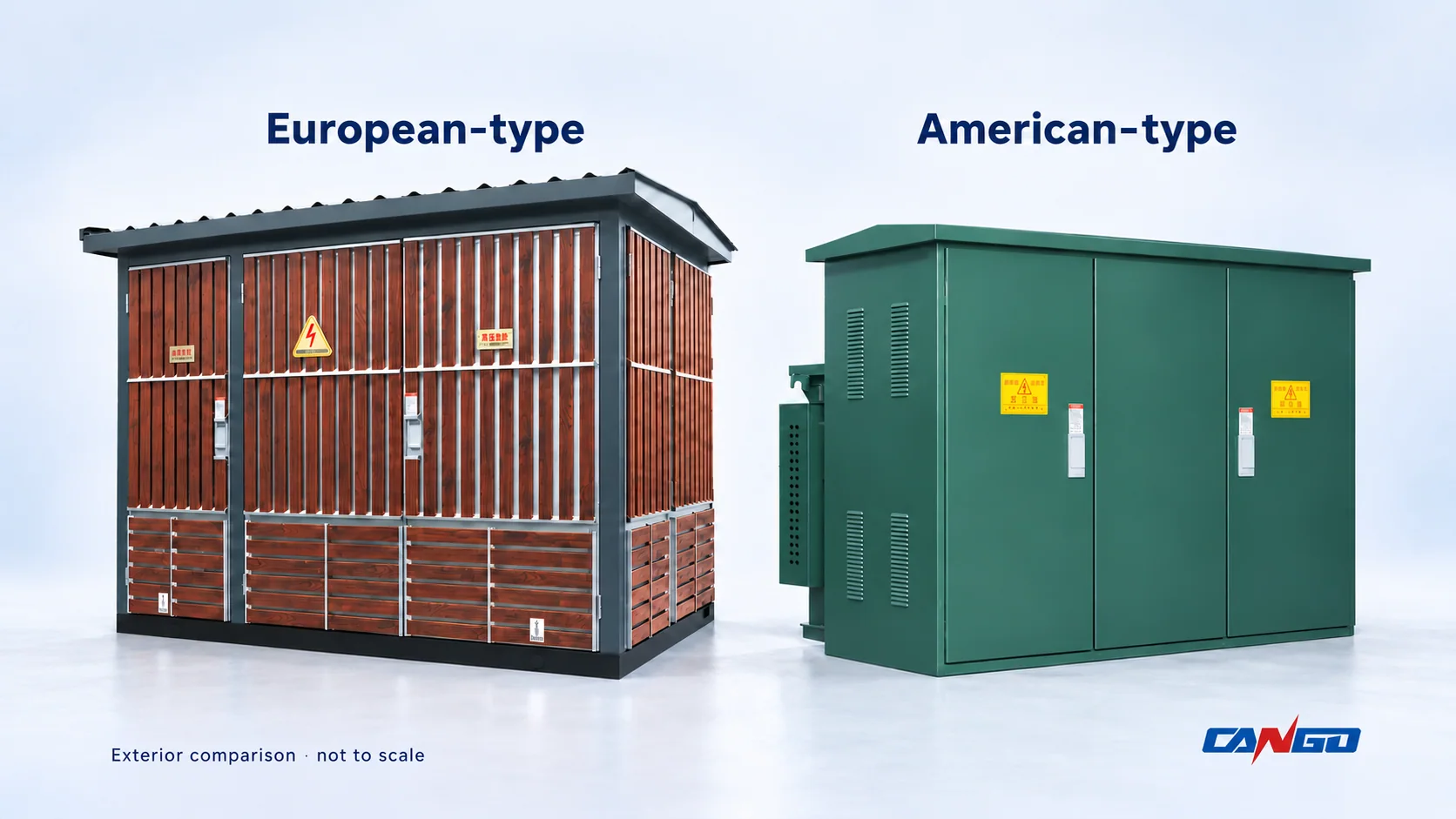
Start with a European-type arrangement when the project needs separately configured medium-voltage switchgear, a transformer and low-voltage distribution within a coordinated enclosure. Consider an American-type combined-transformer arrangement when its integrated construction, switching scheme and low-voltage equipment scope fit the required duty and site.
The deciding factor is what each offer includes and how it will be operated, maintained and replaced. A smaller transformer enclosure is not necessarily a smaller complete installation; a separate compartment does not automatically permit maintenance while adjacent equipment remains energized.
“European-type” and “American-type” are market descriptions used in box-substation procurement. They do not by themselves establish a standard, frequency, network topology or approval for a particular country. For the broader naming distinctions, see the prefabricated, packaged and compact substation terminology guide.
European vs American box substations: compare the equipment boundary
The table compares the separated-equipment arrangement with the combined-transformer arrangement offered in CANGO’s YB0 and ZGS11 families. Final layouts and functions depend on the selected configuration.
| Decision point | European-type separated arrangement | American-type combined arrangement |
|---|---|---|
| Main architecture | MV equipment, transformer and LV equipment occupy distinct functional spaces within a prefabricated enclosure | The combined-transformer unit is the central assembly, with switching, connection and feeder provisions defined by its design |
| MV switching and protection | Specify the required switchgear scheme and its interfaces to the transformer | Confirm the main-switch type, protection devices, cable interfaces and operating mechanism offered with the unit |
| LV distribution | An LV compartment can accommodate the scheduled main and outgoing equipment | Verify the actual feeder-room equipment; a transformer terminal compartment alone is not a complete LV switchboard |
| Network arrangement | Ring or terminal supply can be specified, subject to the chosen scheme | Ring, terminal or other supported arrangements must be confirmed; the style name does not define the network |
| Maintenance and replacement | Review access to each assembly and the transformer removal route | Review which items are separately serviceable and which require intervention on the combined unit |
| Installed footprint | Include the complete enclosure, access, cooling and replacement space | Include the combined unit plus any external LV board, switching equipment and associated site space |
| Commercial comparison | Price the full scheduled equipment and site interfaces | Normalize the same scope before accepting a lower price or smaller footprint |
What is physically different?
European-type: separate equipment within a station enclosure
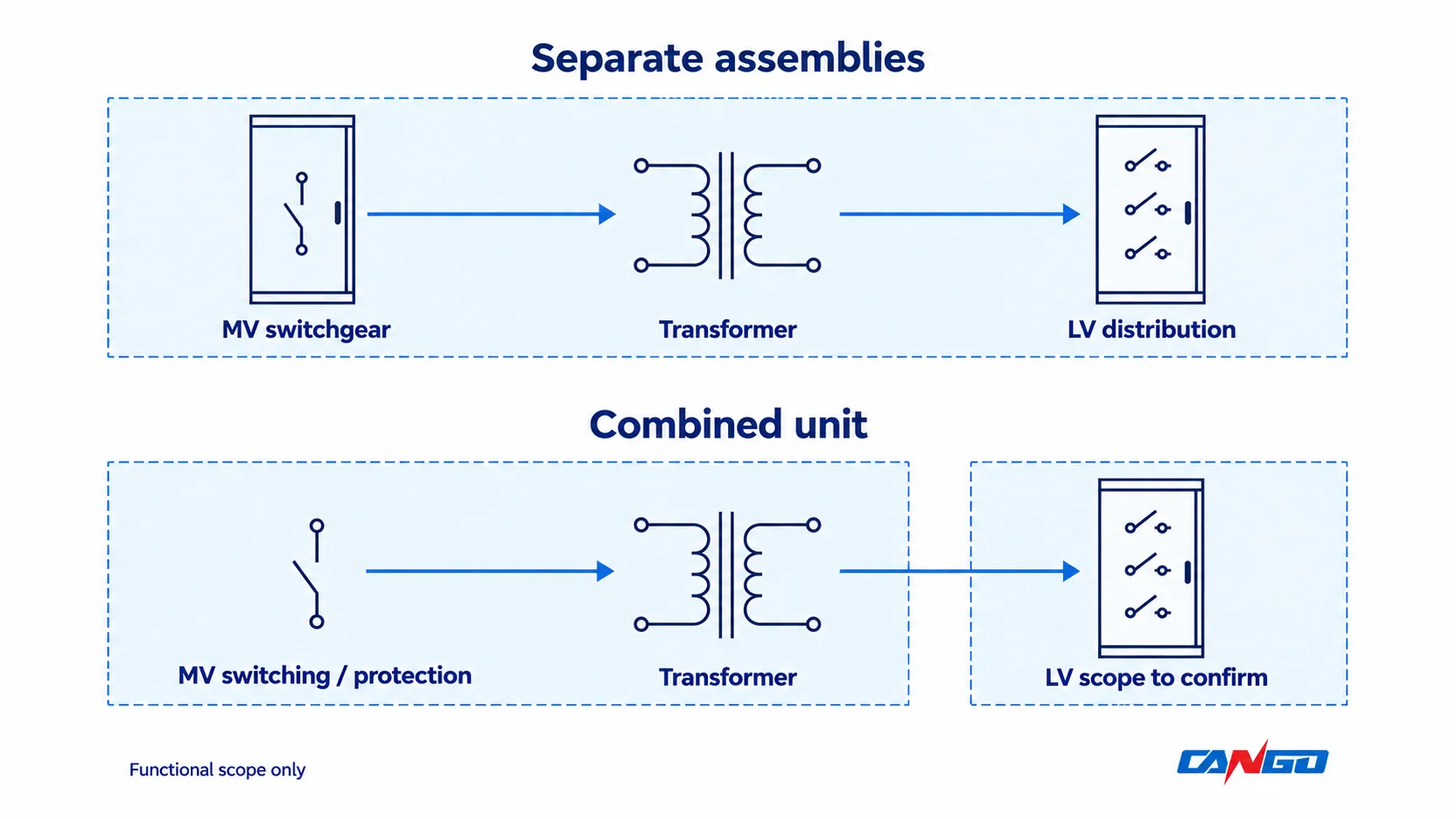
The useful distinction is the arrangement of the assemblies. The MV switching equipment, transformer and LV distribution have separate spaces and defined interconnections. That provides a basis for selecting and arranging these functions individually, subject to the enclosure design and its verified limits.
CANGO describes the YB0-12/0.4 compact prefabricated substation as combining MV equipment, a transformer and LV distribution in a prefabricated enclosure. Its product information supports ring-network or terminal supply, while its catalogue structure illustration identifies the three equipment rooms.
This arrangement is a starting point when the project requires a particular MV protection scheme, a specified LV feeder schedule or defined access to individual assemblies. It does not establish that every transformer technology, cabinet combination or future extension will fit. Confirm the offered equipment, ventilation and removal arrangement on the general arrangement drawing.
American-type: a combined-transformer assembly
CANGO’s ZGS11-12 box-type transformer substation is presented as an American-style combined prefabricated substation. Its product documentation calls for selection of the MV main switch and operating mechanism, and its layout drawing identifies a transformer position, a high-voltage room and a feeder room.
The procurement question is therefore how the combined unit implements the required functions. Ask which switching and protective devices are included, what the feeder room contains, and whether the offered package supplies all required LV outgoing circuits. Do not assume that an LV terminal space includes a main breaker, metering, multiple protected feeders or reactive-power compensation.
The ZGS11 product page documents oil-immersed transformer series. If the project requires a dry-type transformer or a particular insulating liquid, state that requirement before selecting the family and request a matching offered design. A European-type label alone does not confirm a dry-type configuration, and an exterior photograph does not establish the internal location of switches or fuses.
A pad-mounted transformer and a complete MV/LV substation can have different supply boundaries. Regional practice also varies: EPRI’s technical comparison describes examples of European secondary substations and North American arrangements using separate pad-mounted switching equipment and transformers. Those examples help explain the terminology, but they do not define every product sold under either style name.
Which project requirements change the choice?
Network and protection: specify the scheme before the enclosure
Both CANGO families are described for ring-network or terminal applications; ZGS11 information also identifies dual-source applications. A ring connection, a radial supply and an automatic transfer system are different requirements. A dual-source description alone does not establish automatic transfer, interlocking or permission to parallel sources.
The single-line diagram should identify the incoming and outgoing MV ways, the transformer branch, isolation and earthing provisions, and the required protection. Then compare the offered devices against fault duty, transformer characteristics, upstream protection and the utility’s operating philosophy.
If fuse protection and circuit-breaker protection are both under consideration, use the RMU transformer-protection comparison to develop that decision. The box-substation style cannot replace it.
Access and replacement: identify the actual intervention
Separate assemblies can be useful when the owner wants to replace or modify a particular function, but physical separation alone does not establish the safe work boundary. Confirm the isolation arrangement and approved procedures for the offered design.
Ask the supplier to show how a transformer, MV device or LV feeder component would be reached and removed. For a combined unit, clarify whether a particular intervention involves only an accessible device or also the transformer assembly, liquid system or enclosure. The answer needs the actual design and instructions, not a generic claim of “easy maintenance.”
Check these points against the owner’s available outage window, handling equipment, spares strategy and staff competence. Neither architecture provides a universal maintenance-time advantage.
Footprint and cost: compare the complete installed arrangement
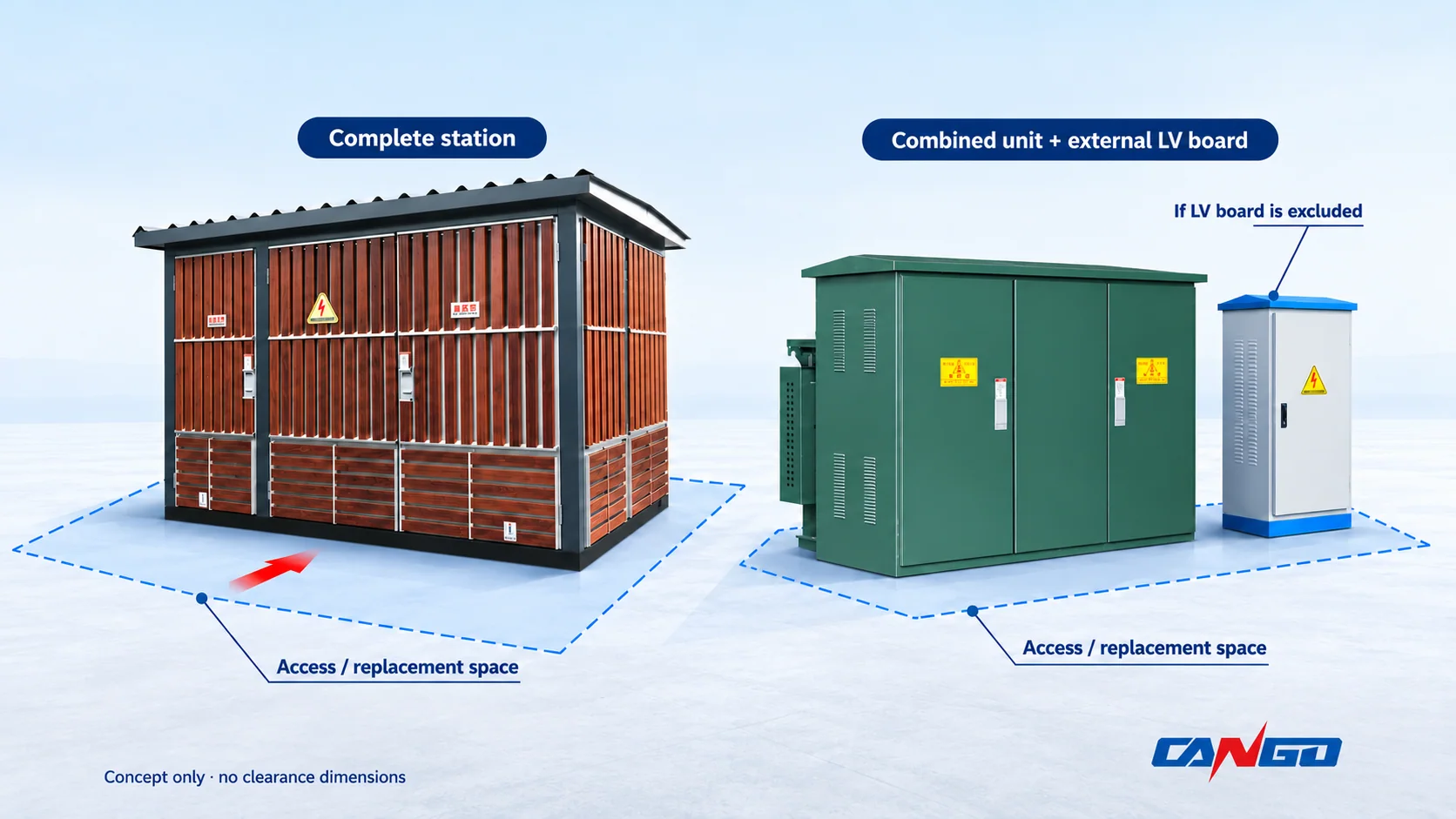
Enclosure length and width are only part of the site requirement. Review the foundation and cable entries, door opening and operating access, cooling arrangements, transformer removal route and the interfaces to any separate equipment. Apply project-specific fire, liquid-containment and environmental requirements where relevant.
For a combined-transformer offer, add the footprint and cost of any LV board or MV equipment supplied separately. For a separated arrangement, check that the enclosure contains the required assemblies without compromising the access and thermal arrangement offered by the supplier.
Compare cost at the same transformer duty, switching scheme, LV feeder schedule, documentation and site boundary. Neither style name establishes lower transformer losses, a better protection system or a fixed percentage saving.
Compare two offers on the same duty
Suppose a project requires one transformer, a defined MV switching/protection scheme, an LV main device and six protected LV outgoing feeders. This is an example of bid comparison, not a standard configuration or sizing recommendation.
One bidder offers a separated MV/transformer/LV station containing all scheduled functions. Another offers a combined transformer with MV devices and LV terminals, with the downstream feeder board excluded. The second offer has not yet priced the same installation.
Before comparing the totals, complete the missing scope:
| Item to normalize | Evidence or response needed from both bidders |
|---|---|
| Transformer duty | Same capacity, voltage ratio, frequency, impedance, connection group and declared losses at stated conditions |
| MV function | Same number of ways, switching/protection duty, cable interfaces and operating requirements |
| LV function | Main device, feeder quantities and ratings, metering and any specified compensation; identify external equipment |
| Installed arrangement | General arrangement, cable entries, access, replacement route and separately located equipment |
| Responsibility | Internal connections, external cables, foundation, earthing, unloading, site testing and commissioning clearly allocated |
Once the second offer includes the missing board, interconnections and site requirements, either architecture may remain competitive. The comparison is now between two ways of delivering the same electrical function.
Specify standards separately from style names
Use the project country and utility requirements to identify the applicable standards and acceptance process. The following references address different equipment boundaries:
| Reference | Relevant scope | What it does not establish by itself |
|---|---|---|
| IEC 62271-202:2022 | Enclosed AC prefabricated substations above 1 kV through 52 kV; its published scope covers cable-connected outdoor installations with public accessibility, including walk-in and non-walk-in types | That every product called European-type complies, or that component evidence covers the whole station |
| IEC 60076-1:2011 | General requirements for power transformers within its scope | Approval of the complete enclosure, switchgear or site installation |
| IEC 61439-2:2020 | Power switchgear and controlgear assemblies; relevant to an applicable LV assembly alongside the general rules of Part 1 | Qualification of the transformer or complete MV/LV station |
| IEEE C57.12.34-2022 | Specified three-phase, 60 Hz, liquid-immersed, self-cooled pad-mounted compartmental transformers, including radial or loop-feed connection arrangements | Automatic compliance of a product called American-type, or complete requirements for accessory devices or an entire substation |
These are scope summaries from the official publication pages. Request the exact standards and editions proposed for the offered assembly and components, the supporting verification documents and any deviations. Neither the table nor a catalogue statement is evidence of project-specific certification or utility acceptance.
For internal-arc performance, enclosure protection or service-continuity requirements, specify the required scope and ask for evidence covering the offered configuration. Separate rooms and closed metal doors are not proof of a particular tested classification.
Match the requirement to a CANGO configuration
Use YB0 as a starting family when separately arranged MV equipment, transformer and LV distribution fit the specification. Use ZGS11 as a starting family when a combined-transformer arrangement fits the required switching, feeder and site scope. The CANGO prefabricated-substation range provides the product routes; final selection depends on the offered configuration.
Send the project country and utility requirements, single-line diagram, transformer duty, MV switching/protection schedule, LV feeder schedule and site layout. Identify the access/replacement expectations and required standards and verification documents. The prefabricated-substation inquiry checklist covers the wider inquiry inputs.
Ask CANGO to review the configuration and quotation scope so that the comparison addresses the complete installation, including equipment supplied by others.
References
- CANGO product information — YB0-12/0.4 Compact Prefabricated Substation and ZGS11-12 Box Type Transformer Substation, including their linked catalogue and layout information.
- EPRI — Technical Comparison of North American and International Distribution Systems, Technical Update 3002011005, December 2017, pp. 1-24–1-26.
- IEC — IEC 62271-202:2022, official scope summary; the publication page identifies inclusion of the August 2023 corrigendum.
- IEC — IEC 60076-1:2011: Power transformers — Part 1: General, official scope summary.
- IEC — IEC 61439-2:2020: Power switchgear and controlgear assemblies, official scope summary.
- IEEE SA — IEEE C57.12.34-2022, official scope summary for three-phase pad-mounted compartmental distribution transformers.