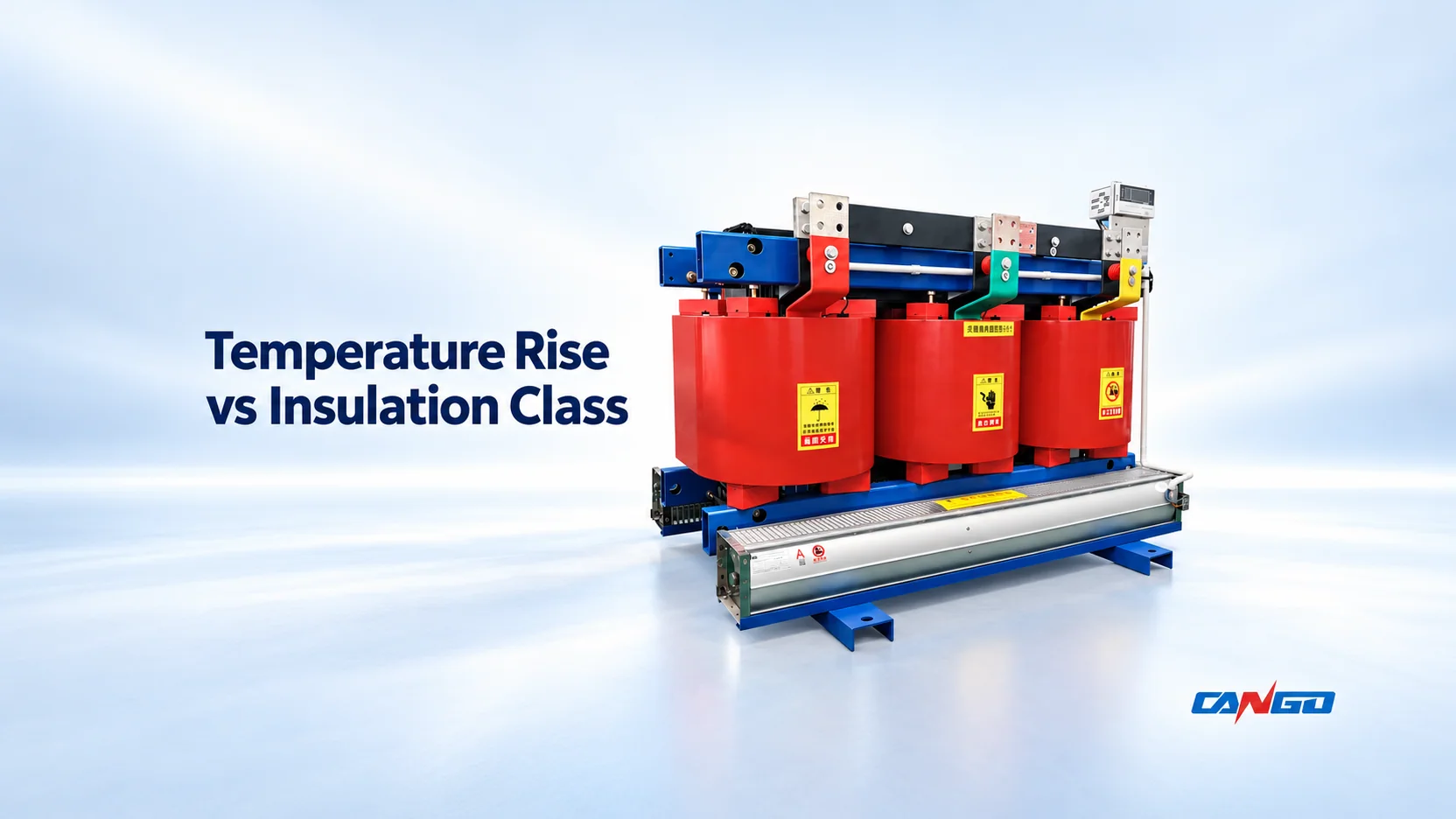
Temperature rise describes how much warmer a winding becomes than its reference cooling air under stated conditions. Insulation class describes the thermal endurance classification of the electrical insulation system. A Class F designation does not mean a 155 K temperature rise, a 155°C room rating or a prescribed controller setting.
For an engineering or procurement review, read the insulation class and guaranteed winding temperature rise as separate fields. Then check the ambient, loading, cooling and measurement basis that makes the rise meaningful.
| Parameter | What it describes | How to read the number |
|---|---|---|
| Cooling-air ambient temperature | The air temperature used as the thermal reference | An absolute temperature, in °C |
| Average winding temperature rise | Average winding temperature above that reference | A temperature difference, normally in K |
| Average winding temperature | Reference ambient plus the corresponding average rise | An absolute temperature, in °C |
| Winding hot-spot temperature | The highest local temperature within the winding | Not determined by the average alone |
| Insulation thermal class | The endurance designation of the insulation system | A class designation, not the measured operating temperature |
The Sandia/DOE transformer guide, section 3.4.1.2, distinguishes average winding rise and ambient conditions. Its historical rating examples are not current limits for a new project.
Read insulation class as a system designation
IEC 60085:2007 distinguishes thermal classification of an electrical insulation system from classification of an individual insulating material. A resin or wire’s material rating alone therefore does not establish the thermal class of the complete winding insulation system.
For familiar letter designations, the UL electrical-insulation-system brochure, page 4, gives these correspondences:
| Letter designation | Numerical thermal class |
|---|---|
| B | 130 |
| F | 155 |
| H | 180 |
These are thermal-class designations, associated with temperatures in °C. The table deliberately does not assign a universal winding rise to each class. The applicable transformer standard and offered design must provide that separate value.
UL also describes an electrical insulation system as a compatible combination of materials. Ask for the offered system’s declared class and applicable evidence, rather than accepting one material datasheet as the complete answer. Citing UL’s terminology does not establish UL certification of a CANGO transformer.
Convert average rise into average winding temperature
For corresponding reference conditions:
Average winding temperature (°C) = cooling-air ambient (°C) + average winding rise (K)
A difference of 1 K has the same magnitude as a difference of 1°C, as the BIPM SI Brochure explains. Do not add 273.15 when adding a rise to a Celsius ambient.
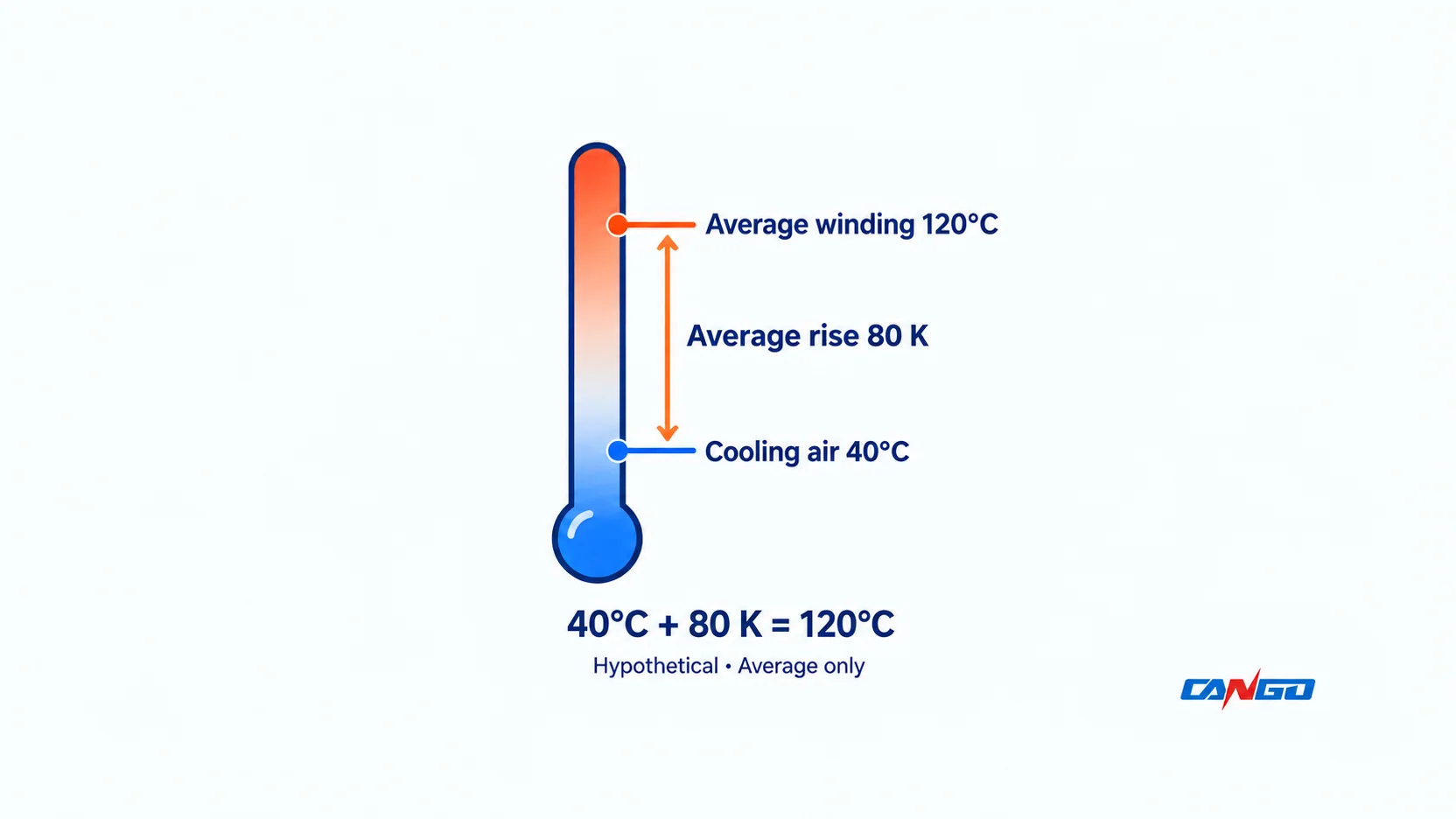
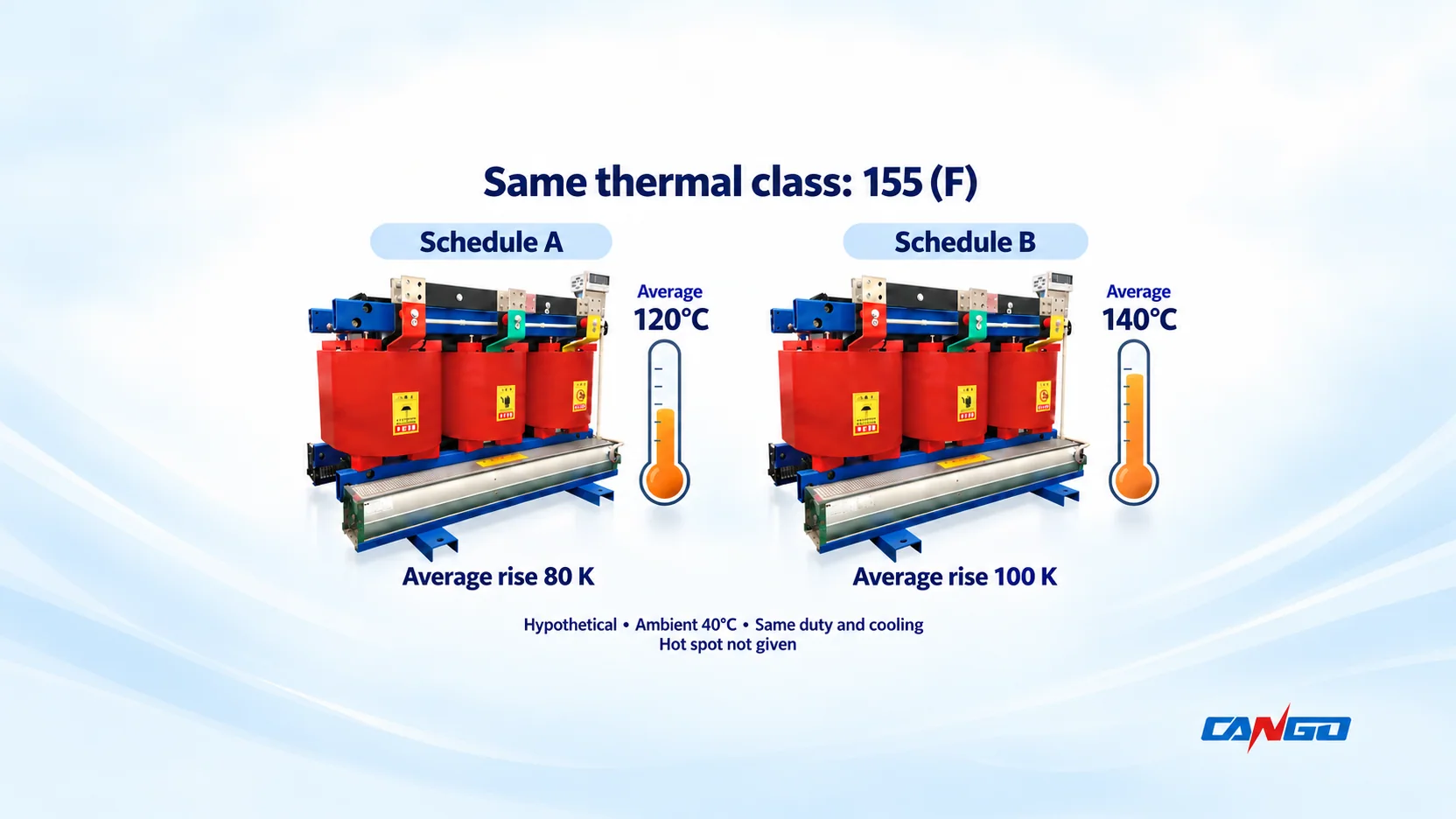
Consider two hypothetical thermal schedules, both specifying numerical class 155 (F), the same rated duty and cooling basis, and a 40°C reference ambient. Their independently specified average rises are different:
| Hypothetical schedule | Thermal class | Reference ambient | Average winding rise | Calculated average winding temperature |
|---|---|---|---|---|
| A | 155 (F) | 40°C | 80 K | 40 + 80 = 120°C |
| B | 155 (F) | 40°C | 100 K | 40 + 100 = 140°C |
These numbers are chosen to explain the arithmetic. They are not CANGO ratings, test results or a declaration that either schedule satisfies a particular standard. The common class does not tell the buyer which rise was offered.
At the stated comparison point, A has a 20 K lower average winding temperature. That alone does not establish its losses, price, lifetime or permissible overload. Compare those separately; the distribution-transformer losses article explains why loss data and operating profiles need their own basis.
If the actual cooling air is hotter than specified, obtain the manufacturer’s assessment for the new conditions. Reusing the same rise without confirming the thermal behaviour is not a site-rating calculation.
An average does not identify the winding hot spot
Temperature is not uniform throughout a winding. The original IEEE paper Hottest spot temperatures in ventilated dry type transformers reports measured thermal gradients in tested ventilated windings. Its 1994 abstract supports the distinction between average and local maximum; it does not validate a hot-spot allowance for a different cast-resin design.
A 120°C average therefore leaves the maximum local temperature unresolved. Subtracting that average from class 155 does not produce a bank of usable overload or a guaranteed protection margin. A controller’s sensor reading also needs its documented location and relationship to the winding temperature; do not assume a displayed value is the global hot spot.
Alarm, fan-control and trip settings need the offered transformer’s instructions, sensor arrangement and protection philosophy. Do not derive them by copying the insulation-class number. Likewise, a higher class alone does not establish longer service life. The scope of IEC 60076-12:2008 links insulation ageing to operating temperature, time and loading; its public abstract supplies no universal life-doubling rule.
Keep the cooling and installation basis with the rating
The Sandia guide’s dry-type discussion describes natural circulation and fan-assisted cooling. When both ratings are offered, require the kVA and guaranteed rise for each mode; do not assume one rise applies to both or invent a fan-assisted capacity increase.
For dry-type power transformers within its stated equipment and voltage scope, IEC 60076-11:2018 addresses dry-type transformer requirements. Its official abstract identifies enclosure performance and altitude-related thermal considerations among the edition’s subjects. It does not make every dry-type transformer suitable for every enclosure or site.
Keep the actual enclosure, cooling-air conditions and ventilation arrangement in the agreed thermal schedule. A bare-unit figure should not silently become an enclosed installation guarantee. Route the wider capacity decision to transformer kVA sizing; compare construction choices in the separate oil-immersed versus dry-type article.
Ask for one complete thermal schedule
Use the following as an offer-review aid, not a substitute for a test standard or an instruction to test energized equipment.
| Schedule field | Clarification to request |
|---|---|
| Offered unit and duty | Exact model, voltage, frequency, tap and kVA associated with the thermal declaration |
| Insulation system | Numerical thermal class and the evidence applicable to that system |
| Average winding rise | Guaranteed value for each winding, stated in K, with test method and acceptance basis |
| Ambient | Maximum and relevant averaging conditions; where the cooling-air reference is defined |
| Cooling mode | Separate duty and rise for each declared mode, including fan availability assumptions |
| Installation boundary | Enclosure, altitude and ventilation conditions covered by the declaration |
| Hot spot and sensing | Applicable assessment or evidence, sensor locations and what the displayed readings represent |
| Controls and records | Manufacturer-approved control/protection schedule and relevant thermal test documentation |
For example, an offer stating only “Class F, 1,000 kVA” leaves the rise, cooling mode and installation basis unresolved. Adding those fields makes the offer assessable; it does not by itself establish compliance or acceptance.
Reading the CANGO catalogue entry
CANGO’s SC(B)12 dry-type transformer page includes separate B-class, F-class and H-class load-loss columns in W. Those headings are not temperature-rise guarantees or controller setpoints. The visible table does not state the complete thermal schedule discussed here; request the offered configuration’s insulation class, guaranteed rise and applicable conditions explicitly.
For a focused review, send the required kVA and voltage combination, load/cooling modes, ambient and altitude, enclosure arrangement, requested insulation class/rise and the required test basis. Use the power-transformer project-information guide for the wider inquiry, then ask CANGO to review the dry-type thermal schedule.
References
- Sandia National Laboratories / U.S. DOE — SAND93-7068, Aging Management Guideline: Power and Distribution Transformers, May 1994, sections 3.4.1.1–3.4.1.2; historical technical background, not current limits.
- IEC — IEC 60085:2007, Electrical insulation — Thermal evaluation and designation, official scope/abstract.
- UL — Compliance Options for UL 1446 Electrical Insulation Systems, 2016 brochure, thermal-class table on page 4.
- UL Solutions — Electrical Insulation Systems (EIS) Product Standards, overview of material-system compatibility.
- BIPM — The International System of Units (SI Brochure), ninth edition, section 2.3.1, kelvin and Celsius temperature intervals.
- IEEE Transactions on Power Delivery — Hottest spot temperatures in ventilated dry type transformers, 9(1), 1994, pages 257–264, DOI 10.1109/61.277697; abstract only.
- IEC — IEC 60076-12:2008, Loading guide for dry-type power transformers, official scope/abstract.
- IEC — IEC 60076-11:2018, Dry-type transformers, official scope/abstract; apply within its stated equipment and voltage scope.
- CANGO first-party product information — SC(B)12 Dry-Type Power Transformer, public loss-table headings and inquiry information.