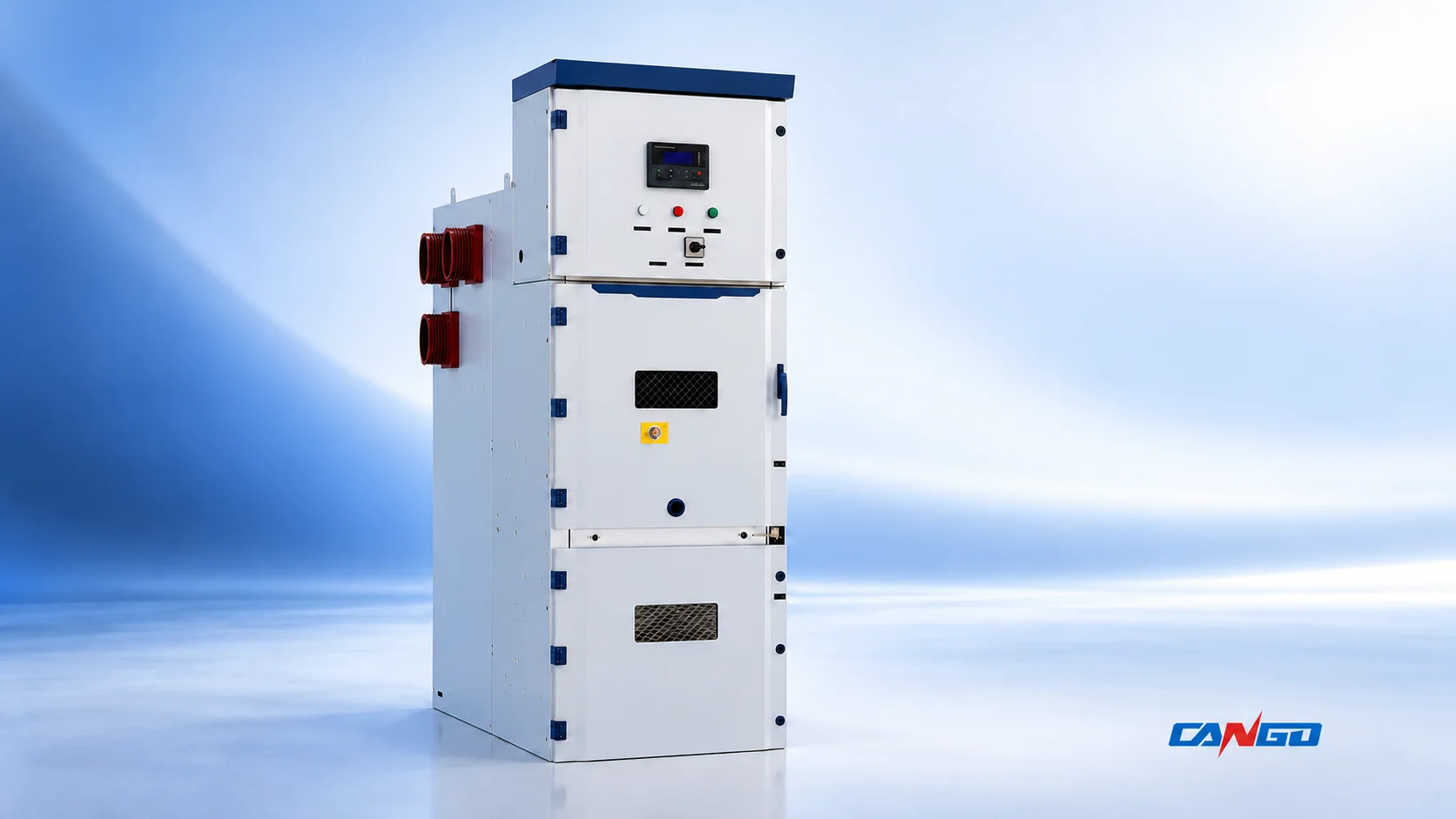
Select 12 kV KYN28 switchgear by matching the offered assembly to the system voltage, load, fault duty, access requirements and installation drawings. The KYN28-12 model name identifies an equipment family; the configuration schedule establishes what a particular panel can do.
CANGO describes its KYN28-12 as indoor, removable AC metal-enclosed switchgear for receiving and distributing power, with control, monitoring and protection functions. Its product page lists several current and fault-rating options. Those options need confirmation as a complete configuration before an order is approved. CANGO KYN28-12 product information
For project screening, keep three checks separate:
- Match the electrical duties, including fault-current magnitude and duration.
- Confirm the compartment arrangement, access conditions and declared classifications.
- Fit the selected panel into a reviewed room, cable and equipment-handling layout.
What does KYN28-12 identify?
In CANGO’s model explanation, K refers to the armored cabinet construction, Y to the removable arrangement, N to indoor installation, 28 to the design series and 12 to the rated-voltage class. The same ordering information calls for the breaker, mechanism, current, short-circuit rating and primary scheme to be identified separately. The model designation therefore leaves important engineering choices open. CANGO product information
The 12 kV equipment rating and the nominal system voltage are different entries. An 11 kV project may call for 12 kV-class equipment, but approval still requires the maximum system voltage, insulation requirements and service conditions to match the offered assembly. A nominal-voltage label alone is insufficient.
Use this article for the KYN28-12 configuration review. The broader medium-voltage switchgear selection guide covers the choice between equipment families.
Read the ratings as a coordinated schedule
Start with the project requirements, then obtain the corresponding values for the offered panel and breaker. A catalogue range helps identify candidates; it does not establish that every listed option can be combined.
| Selection item | Project input | Evidence to request for the offered configuration |
|---|---|---|
| Voltage and frequency | Nominal and maximum system voltage, frequency, earthing and insulation basis | Rated voltage, frequency and insulation schedule |
| Continuous current | Normal load, foreseeable operating configurations, growth and site conditions | Assembly, busbar and feeder current ratings under the specified conditions |
| Short-time withstand | Prospective RMS fault current and required withstand time | Assembly current rating with its duration |
| Peak withstand | Prospective peak fault current | Assembly peak withstand rating |
| Breaker switching duty | Required making, breaking and operating duties | Exact breaker ratings and their applicability in the panel |
| Access and classification | Required continuity of service, partitions and internal-arc specification | Declared classes, applicable evidence and access conditions |
| Physical installation | Panel functions, room, cable entries and handling route | Approved general arrangement and installation requirements |
The current consolidated publication is IEC 62271-200:2021+AMD1:2024, covering AC metal-enclosed assemblies above 1 kV through 52 kV. Its public preview identifies voltage, insulation, continuous current, short-time withstand, peak withstand and duration as separate rating fields. Agree the contractual editions and applicable national requirements in the purchase specification. A reference to the standard does not establish that a particular CANGO configuration has passed every relevant test. IEC publication information
What the CANGO page establishes—and what remains open
CANGO’s KYN28-12 page lists 50 Hz and cabinet/breaker current options from 630 A to 3150 A. It also lists short-time withstand options with an explicit 4 s duration. These are first-party catalogue declarations, subject to confirmation for the selected arrangement. The checked page does not establish a 60 Hz offering.
There is a detail to resolve before ordering: the page lists 31.5 kA in the short-time withstand row and 31.6 kA in the breaking-current row. Request a controlled rating schedule for the proposed breaker and assembly rather than treating these values as interchangeable. The insulation table also presents several values without clearly pairing every value to a voltage option; obtain the specific 12 kV insulation schedule. CANGO technical specifications
How the four compartments affect the project layout
CANGO’s published KYN28-12 structure drawing identifies four functional compartments. In its side view, the busbar compartment is toward the upper rear, the instrument compartment is at the upper front, the circuit-breaker compartment is at the front middle, and the cable compartment occupies the lower section. The drawing explains the arrangement; it does not provide installation dimensions or prove that every ordered panel includes every illustrated component. CANGO structure drawing and product information
| Compartment | Project decision it affects | Item to confirm on the order drawing |
|---|---|---|
| Busbar | Lineup continuity, section coupling and future extension | Busbar arrangement, ratings, joint/interface details and access requirements |
| Circuit breaker | Switching duty, removable-unit interface and maintenance planning | Breaker identity, truck compatibility, position indications and interlocks |
| Cable | Cable entry, termination and earthing interfaces | Cable quantity and size, termination arrangement, supports and access |
| Instrument | Protection, metering and auxiliary controls | Relay/meter functions, terminal schedule, CT/VT interfaces and control supplies |
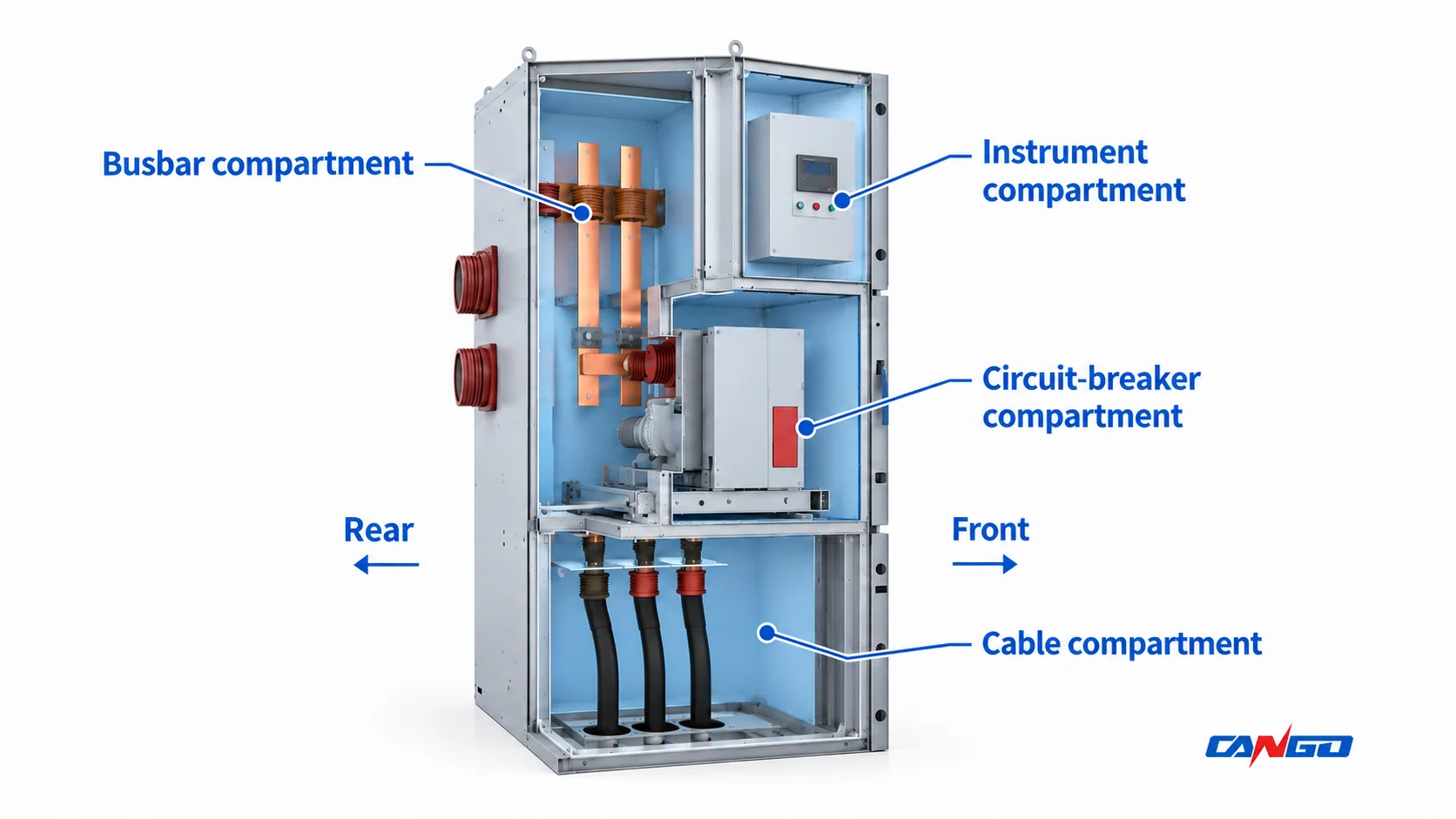
A removable breaker supports a particular service arrangement, but a truck from another KYN28 panel is not automatically interchangeable. Mechanical fit, primary contacts, secondary connections, earthing and interlocking all need compatibility review. HSE guidance on switchgear replacement and retrofit identifies these interfaces as assessment items. Its guidance is written for Great Britain; it is useful engineering context rather than a global approval rule. HSE HSG230, replacement and retrofit guidance
Likewise, the drawing’s instrument-transformer symbols do not specify a CT ratio, a VT winding arrangement or a protection function. Those decisions belong in the project schedule. Use the separate guides for current-transformer selection and voltage-transformer selection when defining those interfaces.
Separate fault withstand, breaker interruption and internal arc
An assembly’s short-time withstand rating addresses current carried for a stated duration. Its peak withstand rating addresses a different current condition. The breaker’s making and breaking capabilities are further entries. One short-circuit number cannot describe all of them.
Obtain the fault study at the switchgear location, including permitted network configurations and relevant contributions from generators and large rotating machines. Changes such as parallel transformer operation can change the duty. HSE’s assessment guidance specifically addresses these system conditions. HSE HSG230, paragraphs 21–22 and 48–52
Also keep the following classifications distinct:
| Entry | What the buyer is checking | What does not establish it |
|---|---|---|
| LSC | Continuity-of-service conditions associated with compartment access | The presence of a withdrawable breaker alone |
| PM / PI | The applicable partition and shutter construction classification | The general phrase metal-enclosed alone |
| IAC, where required | Internal-arc classification, including accessibility, classified sides, arc current and duration | The short-time withstand current and time |
| IP | The declared enclosure/access-state protection designation | An internal-arc or continuity-of-service claim |
JEMA’s original technical Q&A explains that fixed/withdrawable construction does not by itself assign an LSC category and distinguishes LSC, partition class and internal-arc requirements. Its explanation concerns the Japanese JIS adoption, which it identifies as modified from IEC; confirm the actual contracted classification and evidence for the export project. JEMA switchgear Q&A
For an IAC requirement, obtain the full declaration and the applicable report scope, including the installation arrangement. IEC’s public preview lists accessibility, classified sides, current and duration separately. Neither an IP entry nor a general description such as armored establishes an internal-arc classification. IEC 62271-200 publication and preview information
Check room fit before freezing the lineup
Cabinet width and depth are only part of the installation footprint. Review the front operating/service space, any required rear access, removable-unit handling, cable entry, door movement, equipment transport and the manufacturer’s pressure-relief or exhaust requirements. Obtain the actual arrangements rather than copying dimensions from a different KYN28 supplier or rating.
Assembly and installation scopes are distinct. IEC 61936-1 addresses power-installation design and erection above 1 kV while excluding the design of prefabricated type-tested switchgear itself. The practical implication is that an assembly declaration cannot settle the room layout. The equipment instructions, installation design and local rules must be coordinated. IEC 61936-1:2021 scope
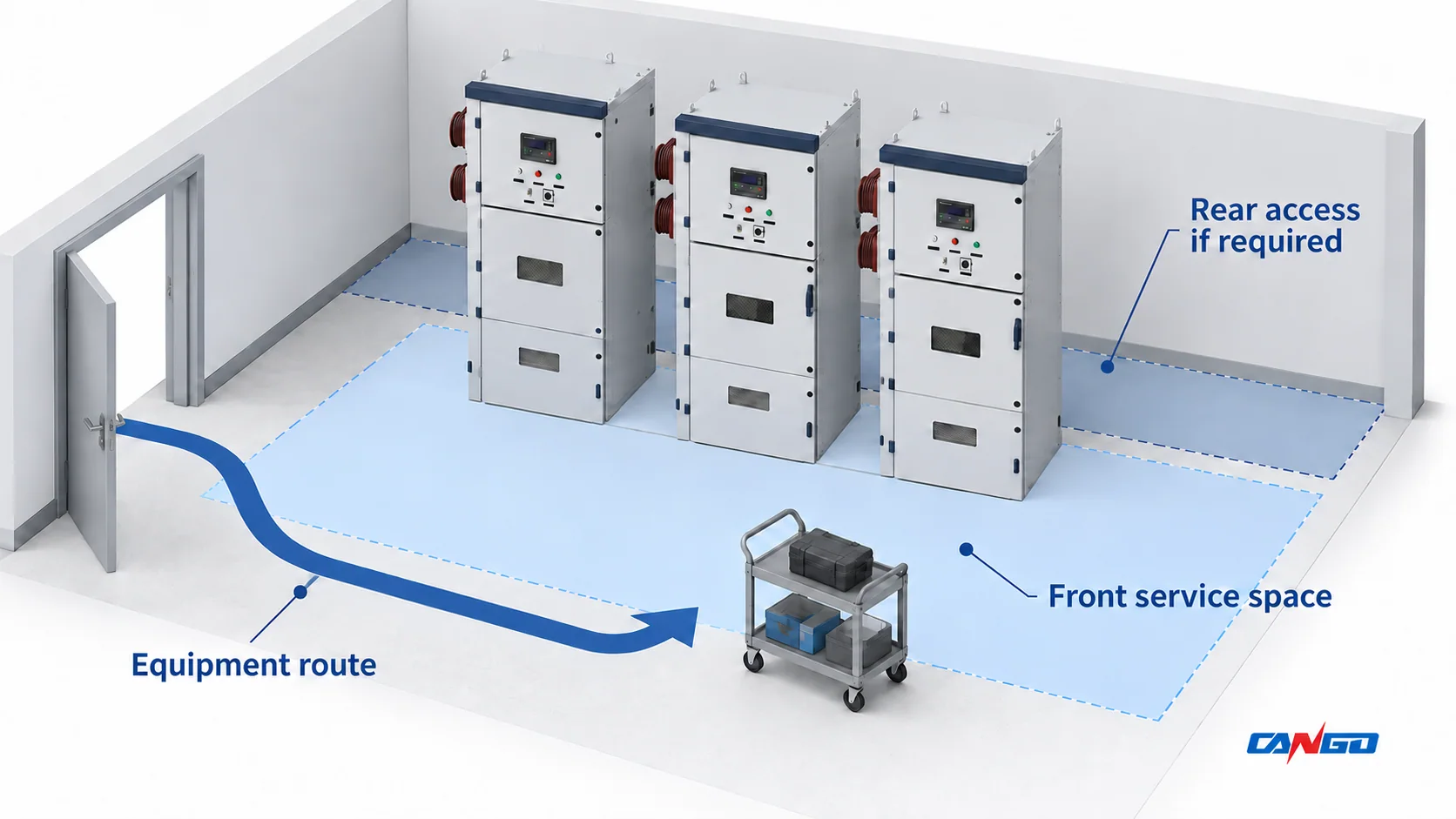
Include altitude, temperature, humidity, condensation, contamination and enclosure location in the inquiry. Ask for the current and insulation ratings applicable to those conditions; do not apply an assumed universal derating percentage. Where expansion is planned, define the physical end arrangement and busbar interface early.
Worked screening example: an 11 kV feeder
Consider an assumed balanced three-phase feeder carrying 6 MVA at 11 kV, on a 50 Hz system. Assume the project engineer has specified a 12 kV equipment class, a 20 kA RMS fault duty for 1 s, and a 52 kA peak duty at the installation point. These are example inputs, not CANGO test results or a real project.
The nominal load-current calculation is:
I = S / (√3 × V) = 6,000,000 / (√3 × 11,000) ≈ 315 A
Now suppose an offer proposes 630 A, 25 kA for 4 s assembly withstand, 63 kA peak withstand, and a breaker declared for 25 kA breaking and 63 kA making. The proposed combination is hypothetical and still requires configuration-specific confirmation.
| Screening item | Example comparison | Result at this stage |
|---|---|---|
| Nominal load | 315 A calculated versus proposed 630 A | Preliminary current screen only; verify load envelope and site-condition rating |
| Short-time duty | Required 20 kA for 1 s versus proposed 25 kA for 4 s | Magnitude and duration fit the stated example; confirm applicable assembly evidence |
| Peak duty | Required 52 kA versus proposed 63 kA | Preliminary numerical screen; verify the study and offered rating basis |
| Breaker duty | Required duties versus proposed making/breaking data | Review complete breaker application and assembly compatibility |
| Insulation, classification and room | Not established by these current comparisons | Remain open until the relevant schedules, reports and drawings are accepted |
Do not convert a shorter withstand duration into a higher permitted fault current unless the manufacturer and responsible engineer establish that application. This example uses direct comparisons of declared magnitudes and durations; it does not use an I²t extrapolation.
The 315 A calculation also leaves load growth, contingency operation, minimum operating voltage, load characteristics and site conditions unresolved. A 630 A catalogue entry is a candidate for review, not the output of a complete selection study.
What to include in the KYN28-12 selection request
Send one coordinated project package so that the commercial offer, electrical schedule and physical drawings describe the same equipment.
| Submit | Request in return |
|---|---|
| Single-line diagram and panel function list | Panel-by-panel primary scheme and offered component schedule |
| System voltage, frequency and insulation basis | Configuration-specific rated and insulation values |
| Normal/contingency load and fault study | Continuous, short-time, peak and breaker-duty schedules |
| Required access/service continuity and internal-arc specification | Explicit declarations and supporting evidence applicable to the offered arrangement |
| CT/VT, protection, metering and communications requirements | Instrument schedules, relay functions, control/auxiliary supplies and terminal interfaces |
| Room plan, cable information, environment and extension needs | General arrangement, cable-entry/termination drawings and installation requirements |
| Operating philosophy and restricted configurations | Interlock matrix, position indications and approved access conditions |
Distinguish the offered ratings, applicable assembly type-test evidence, breaker documents, unit routine-test records and site acceptance requirements. A component document does not by itself establish the qualification of the complete assembly. Interlocks also remain part of an approved operating and isolation system; this selection review is not a switching or racking procedure.
For a CANGO KYN28-12 review, submit the single-line diagram, rating schedule and room/cable drawings, identifying unresolved items explicitly. The medium-voltage switchgear quotation checklist helps organize the inquiry package. Final approval should reference the offered configuration and accepted evidence rather than the family name alone.
References
- CANGO — KYN28-12 12kV Metal-Clad Switchgear, first-party product information and structure drawing, checked 30 October 2026.
- IEC — IEC 62271-200:2021+AMD1:2024 CSV, edition 3.1; public scope and preview information.
- UK Health and Safety Executive — Keeping electrical switchgear safe, HSG230, second edition, 2015; Great Britain guidance.
- Japan Electrical Manufacturers’ Association — Technical Q&A on JIS C 62271-200, classification explanations in the Japanese national-adoption context.
- IEC — IEC 61936-1:2021, public installation-scope information.