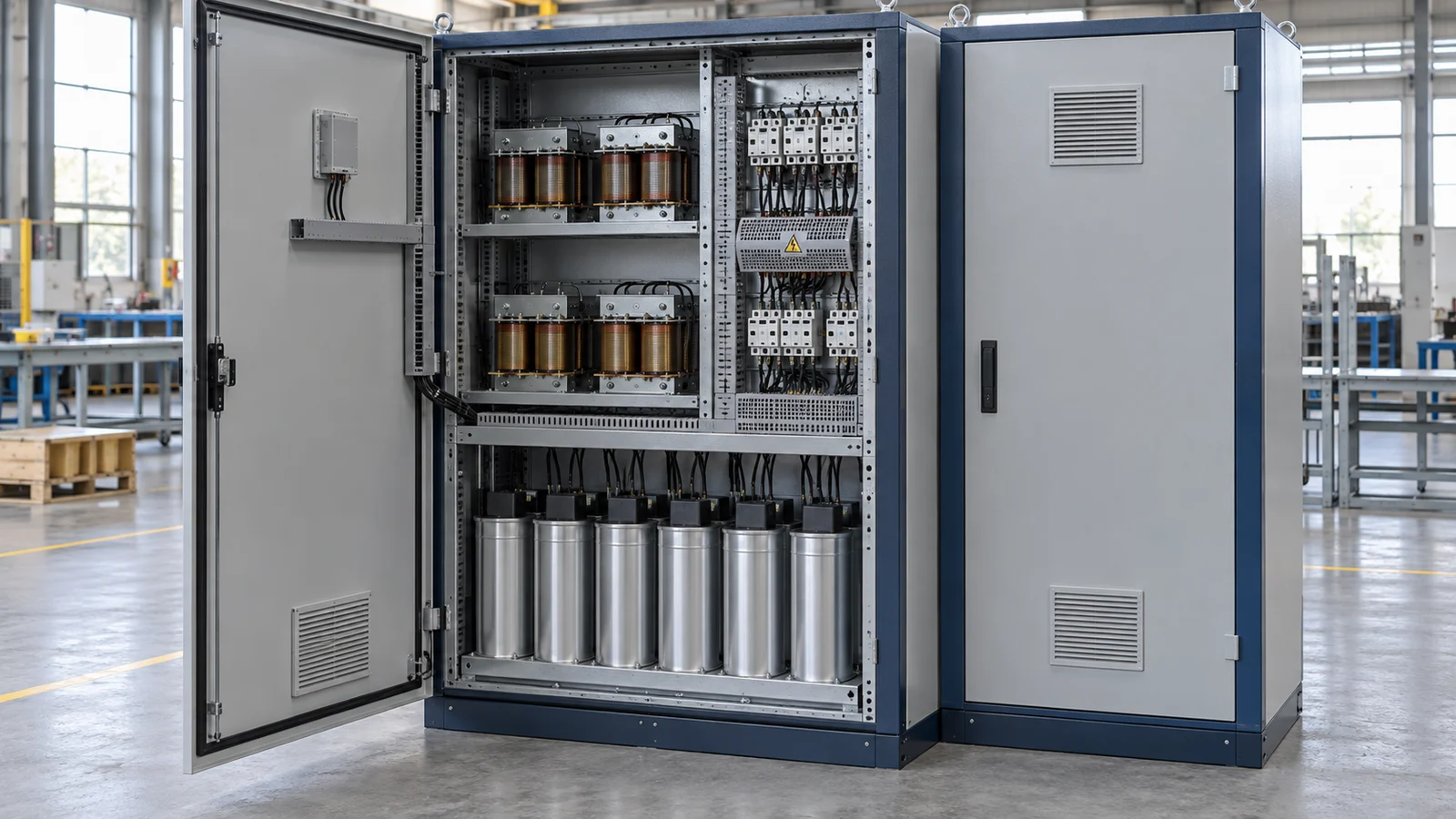
Power factor correction and harmonic mitigation address different aspects of an electrical system. Capacitor banks can supply reactive power to compensate inductive loads, but adding capacitors does not automatically solve harmonic distortion. Where nonlinear loads are present, the interaction between the network and the proposed correction equipment needs to be assessed before selection.
Understand what a capacitor bank changes
Inductive equipment draws reactive power as well as active power. Appropriately selected compensation supplies some of that reactive demand locally. Where demand varies, a stepped bank can adjust the connected compensation instead of leaving one fixed amount connected under every load condition.
This does not mean that the same bank size is suitable throughout the day. The load profile and operating pattern matter. A proposal based on a single power-factor reading can miss light-load periods or changes between production shifts.
Describe the compensation objective in terms of the installation operating conditions and the utility or project requirement. A capacitor bank can provide reactive power locally for inductive demand, but the equipment does not change every aspect of the load or supply. The inquiry should distinguish the desired reactive-power result from a separate request concerning current waveform distortion, voltage conditions or other power-quality observations.
Consider how demand varies through the operating cycle. A bank selected from a single snapshot may be inappropriate when major loads stop or production changes. Provide records that represent the relevant conditions and identify whether existing compensation remains in service. Where staged switching is proposed, ask how the control arrangement relates to the observed operating pattern rather than assuming that a particular number of stages is universally suitable.
Keep physical and system boundaries clear. State the proposed connection point, identify the transformer and relevant distribution arrangement, and include the existing capacitor-bank details. These inputs help the engineering review distinguish adding a new bank to an uncompensated system from modifying equipment in a system that already has reactive compensation. The same quoted capacity does not describe both cases adequately.
The comparison below separates the intended function from outcomes that require another review. It is not a performance guarantee for a particular cabinet. Final compensation selection and the acceptance basis must be confirmed for the measured installation and selected manufacturer configuration. Do not interpret a general improvement in power factor as evidence that all harmonic or network-interaction questions have been resolved.
| Question | What compensation addresses | What still needs review |
|---|---|---|
| Inductive reactive demand | Local reactive-power supply toward a defined objective | Actual demand profile and the selected control arrangement. |
| Changing operation | Staged equipment may be reviewed for varying conditions | Light-load behavior and existing compensation interaction. |
| Harmonic distortion | Not automatically corrected by adding a standard bank | Nonlinear loads, measurements and capacitor-network interaction. |
| Project acceptance | A separately stated compensation function | Measurement point, operating case and agreed evaluation criteria. |
Why harmonics need a separate review
Nonlinear loads can distort current waveforms. Capacitors interact with the network impedance, and resonance can amplify particular harmonic components. A standard capacitor bank should therefore not be treated as a universal remedy for poor power quality.
Detuned reactors may be used with capacitor banks to manage this interaction. Dedicated harmonic filtering is a different design decision. The appropriate arrangement depends on the measured conditions and the engineering study; the presence of a reactor alone does not prove that every harmonic issue has been resolved.
Begin with the load inventory and available measurements, not the assumption that poor power factor has only one cause. Identify nonlinear loads and their operating pattern, existing compensation, transformer information and the proposed equipment connection point. Where waveform distortion is part of the concern, provide representative records and explain the operating condition under which they were obtained. A numerical result without its location and context is difficult to apply to equipment selection.
The presence of nonlinear loads or existing capacitors is a reason to assess the relevant interaction; it is not by itself a complete equipment specification. Ask the responsible engineer or supplier what additional information is needed for the assessment. If a detuned bank or active filter is proposed, request the intended function, assumptions and project-specific selection basis. Do not assume that the presence of a reactor establishes compliance with every harmonic requirement.
Changes to the installation should trigger a review of the information basis. Adding drives, changing transformers or altering existing compensation can change the conditions relevant to the decision. Document the proposed changes alongside present measurements so the review does not treat historical records as a complete description of the future system. The outcome may be a request for further study before final equipment is selected.
A decision worksheet can help identify when specialist review is needed without prescribing universal distortion limits. Use the applicable project and network requirements and the selected manufacturer data. Where those criteria are not yet known, mark them pending; do not insert an arbitrary threshold simply to label the installation acceptable or unacceptable.
| Observed situation | Information needed | Appropriate next step |
|---|---|---|
| Nonlinear loads are present | Load inventory and representative harmonic records | Review relevance to the proposed compensation arrangement. |
| Existing capacitor equipment is retained | Bank details, connection point and operating history | Assess interaction rather than selecting new equipment in isolation. |
| The system will change | Planned loads, transformer or compensation changes | Review whether present records represent the future operating case. |
| A limit or objective is unclear | Applicable utility/customer requirement | Confirm the criterion before promising a result. |
Match the question to the information needed
| Project question | Useful information | What to review |
|---|---|---|
| Is reactive compensation required? | Active and reactive demand over representative operating periods, plus the utility’s billing criteria. | The correction objective and its relevance to the site’s tariff and operating conditions. |
| Does the demand change substantially? | Shift patterns, major load switching and light-load operation. | Fixed versus staged compensation and the control arrangement. |
| Are nonlinear loads significant? | Load inventory and representative harmonic measurements at the proposed connection point. | Capacitor-network interaction and whether detuning or filtering needs further study. |
| Is equipment being added to an existing system? | Existing capacitor-bank details, transformer data and an updated single-line diagram. | Compatibility with the present installation rather than isolated selection of a new cabinet. |
Write separate inquiry questions for reactive compensation, harmonic mitigation and control or monitoring needs. Each question should identify the desired outcome, the information already available and the decision expected from the supplier. A general request for a power-quality cabinet can lead to proposals addressing different functions, so the buyer should be able to trace every proposed item back to a defined question.
For reactive compensation, provide active and reactive demand information across representative operation and identify the applicable billing or project objective. For harmonic concerns, identify nonlinear loads and provide the relevant spectrum and measurement context. For integration with existing equipment, include the updated single-line diagram, transformer information and existing compensation details. These are related inputs, but they should not be merged into an unexplained equipment-capacity request.
Keep the requested equipment scope distinguishable from the assessment scope. Ask whether the response is an initial review, an equipment proposal based on provided data, or a recommendation requiring additional system analysis. Record who obtains missing information and who approves the final criteria. This makes the limitations of the quotation clear without weakening the requirement for accurate equipment data.
When comparing offers, use the same operating cases, connection point and objectives. A proposal for reactive compensation should not be directly compared as though it were identical to a harmonic-control proposal. Ask suppliers to itemize functions and exclusions so alternatives can be reviewed on a like-for-like basis where possible, with differences explicitly identified.
| Buyer question | Supporting information | Response to request |
|---|---|---|
| How should reactive demand be compensated? | Active/reactive records and stated objective | Proposed compensation function and selection assumptions. |
| Is harmonic mitigation required? | Nonlinear load inventory and representative spectrum | Assessment scope and information needed for equipment selection. |
| Can existing compensation remain? | Installed bank details and updated system drawing | Compatibility and interaction review. |
| How should equipment be monitored or controlled? | Site interface and operating requirements | Included functions, external interfaces and integration boundaries. |
Provide measurements before requesting a final configuration
For a power-quality equipment inquiry, share the drawing, load description, available power-quality records and details of existing compensation. Qualified personnel should obtain any site measurements using appropriate procedures and equipment.
Ask the proposal to distinguish the intended reactive-power correction from any harmonic-mitigation scope. Define the operating conditions and acceptance criteria for each. This gives the buyer a clearer basis for comparing equipment than a general promise to improve power quality.
Technical references: Schneider Electric’s Electrical Installation Guide on power-factor correction principles and solutions for power-system harmonics.
A measurement package should identify what was measured, where it was measured and what the installation was doing. Include the point on the single-line diagram, major loads in operation and the state of existing compensation. Record the measurement period and relevant switching or production events. This context helps reviewers distinguish a normal operating pattern from an isolated condition or a record taken when key loads were absent.
For demand, provide the relevant load trend rather than only an isolated maximum or average. For harmonics, provide the available spectrum and associated operating information rather than a single unexplained total. Identify whether records describe the present installation or a proposed future arrangement. Where the future case has not been assessed, mark that limitation instead of extrapolating measured results as a guarantee.
Measurements should be obtained by qualified personnel under the site approved procedures using appropriate equipment. This inquiry guide is not an instruction to access live conductors or open energized compartments. If the supplied records are incomplete or the measurement method is unclear, ask the responsible technical party what further survey is required before final selection. Preserve the original records so later review can check the assumptions and measurement context.
Agree the acceptance basis before commissioning. State the function to be evaluated, measurement location and relevant operating conditions, and allocate responsibility for the assessment. A before-and-after comparison needs a comparable basis; changes in loads or existing equipment can otherwise obscure what the new equipment has achieved. Do not invent a performance limit where the project or network requirement has not been confirmed.
| Measurement record | Context to attach | Selection use |
|---|---|---|
| Load/demand trend | Operating period, load states and existing compensation | Assess changing reactive demand and control needs. |
| Harmonic spectrum | Measurement point and representative load condition | Support the harmonic-interaction and mitigation review. |
| System information | Updated drawing, transformer and installed-bank details | Relate measurements to the proposed connection point. |
| Acceptance plan | Function, location, conditions and responsibility | Create a defined basis for evaluating the installed scope. |
Separate the compensation objective from the harmonic study
Write the project objective before choosing an equipment type. State whether the inquiry is about reactive demand, changing power factor, harmonic distortion or a combination of these. Describe where the problem is observed and which operating conditions produce it. This keeps a request for a compensation cabinet from silently becoming a promise to solve every power-quality issue.
Collect representative information rather than relying on a single operating snapshot. Describe major loads, production shifts, existing capacitor stages and planned changes. If harmonic measurements are available, identify the measurement point and operating conditions. Qualified personnel should obtain any additional measurements using suitable equipment and site procedures; this checklist is not a live-testing instruction.
Compare proposals against separate objectives for reactive compensation and harmonic mitigation. A detuned capacitor bank, an active filter and other equipment arrangements should not be treated as interchangeable descriptions. Ask the supplier to identify the function included, the assumptions used and any further system assessment needed before final selection.
Consider an illustrative factory operating different processes at different times. In one operating case, the inquiry records show that the immediate question concerns changing inductive reactive demand. The technical review can focus on the compensation objective and suitable control arrangement, while checking whether the available system information is sufficient. This does not establish that the factory has no harmonic concern; it defines the scope and limits of the current decision.
In another operating case at the same factory, the buyer reports nonlinear loads, retained capacitor equipment and harmonic observations relevant to the proposed connection point. The responsible technical reviewer may require additional harmonic and interaction assessment before selecting a final configuration. An active-filter or detuned-bank proposal should explain the function it addresses and the assumptions supporting that choice. The appropriate conclusion depends on evidence, not on reusing the earlier compensation request.
These examples deliberately contain no equipment capacity, measured distortion figure or performance promise. They show why the same site name and a general complaint about power quality can lead to different information requests and different scopes of work. A useful proposal states its intended function and identifies what has not been assessed rather than presenting every item as a complete solution to all observed problems.
For the actual project, retain an objective register with the source of each requirement, the operating case it applies to and the agreed way to evaluate it. If the installation changes during procurement, update the register and ask whether the recommendation still applies. Manufacturer documentation should confirm the selected equipment data; the project engineering assessment should confirm how it is applied within the complete system.
| Illustrative factory case | Decision focus | What must remain explicit |
|---|---|---|
| Changing inductive demand | Reactive-compensation objective and control review | Operating pattern and limits of the provided information. |
| Harmonic/interacting equipment concerns | Further system assessment and mitigation scope | Existing capacitors, nonlinear loads and relevant evidence. |
| Changed production or equipment | Revisit the information and selection basis | Do not apply a past recommendation to an unreviewed future case. |
| Acceptance of the final scope | Evaluate each stated function separately | Agreed conditions, measurement point and responsible reviewer. |
Inquiry review checklist
| Review area | Information to provide | Decision to confirm |
|---|---|---|
| Reactive demand | Active/reactive records, operating periods and billing criteria | Define the compensation objective. |
| Harmonic conditions | Nonlinear load inventory and representative harmonic records | Assess the need for a separate mitigation review. |
| Existing equipment | Capacitor banks, transformer data and updated diagram | Review interaction with the present installation. |
| Acceptance | Measurement location, operating conditions and agreed criteria | Keep each promised function measurable and defined. |
For an expansion, send the existing equipment details as well as the proposed new loads. Ask whether the recommendation assumes removal, retention or modification of existing compensation. Record commissioning and acceptance responsibilities before purchase. Avoid accepting a broad promise to improve power quality without an agreed scope and a stated basis for evaluating the result.
Related reading
- SVG vs APF: Differences and Selection for Low-Voltage Systems
- Transformer Impedance Explained: How %Z Affects Short-Circuit Current
FAQ
Does power factor correction remove harmonics?
Not automatically. Reactive-power compensation and harmonic mitigation address different aspects of the system. Where nonlinear loads are present, assess capacitor-network interaction and the required mitigation separately.
Is one power-factor reading enough to size a bank?
A single reading can miss changes between production shifts and light-load periods. Provide representative demand information and the operating pattern before confirming a configuration.
Does a detuned reactor solve every harmonic problem?
No. Detuning and dedicated harmonic filtering are different design decisions. The equipment arrangement needs review against the measured conditions and the engineering assessment.
What information should accompany an active-filter inquiry?
Provide the updated drawing, load description, representative power-quality records and existing compensation details. State the intended harmonic-control and reactive-compensation functions separately.
How should acceptance criteria be defined?
Agree the function being assessed, measurement location and operating conditions. Allocate measurement and commissioning responsibilities so the result can be evaluated against the stated equipment scope.
References
- CANGO Power, Power Quality and DC Systems Portfolio (CANGO product category information).