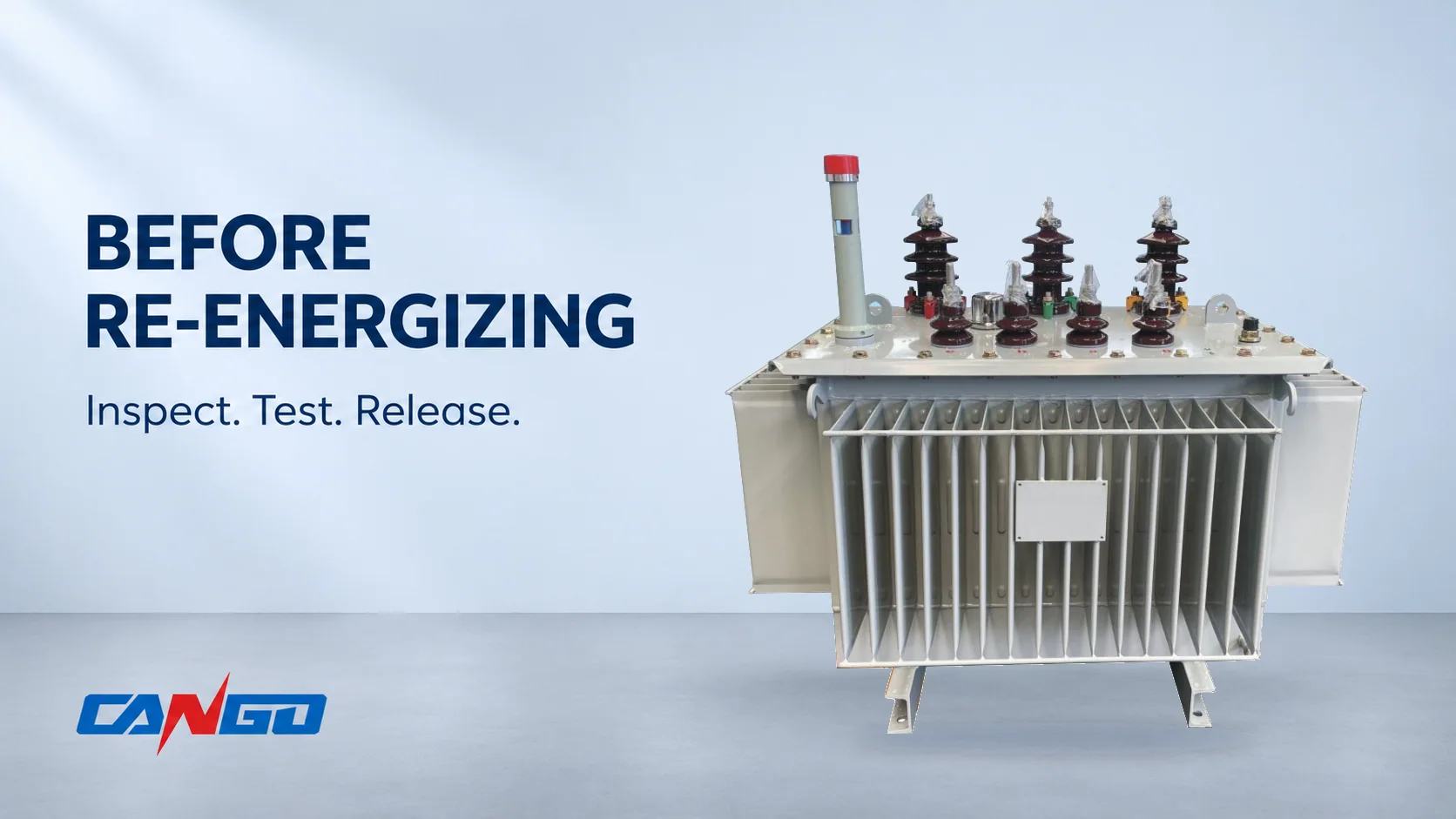
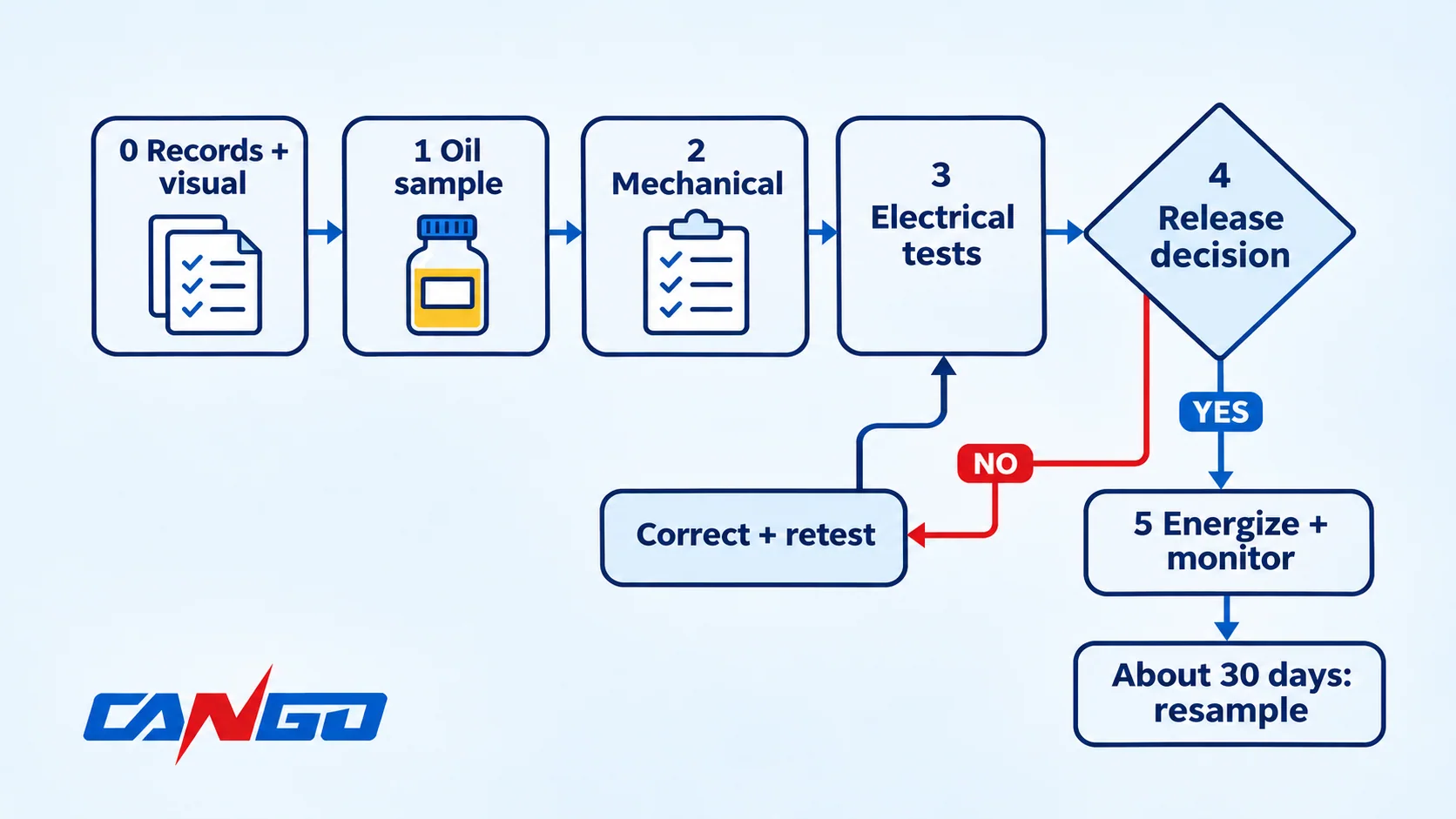
A transformer idle for years needs re-energizing tests in a controlled sequence. For an oil-filled unit, use these hold points:
| Step | Do this | If it does not pass |
|---|---|---|
| 0 | Review records and inspect the exterior | Repair defects; resolve missing information |
| 1 | Sample oil before any energization attempt | Hold for laboratory review |
| 2 | Check mechanical operation and accessories | Repair; repeat affected checks |
| 3 | Complete the electrical test set | Investigate; do not energize |
| 4 | Review results and authorize release | Dry, treat oil or obtain specialist assessment |
| 5 | Energize unloaded, monitor, load gradually; resample oil about 30 days later | Isolate and investigate abnormalities |
Moisture and skipped hold points deserve attention before adding more tests. This is a planning sequence for qualified personnel working under an approved isolation, testing and switching program.
The enemy is moisture
Start by asking whether the insulation has remained dry. An idle transformer produces no operating heat to discourage dampness, and deteriorated seals or an ineffective breather can leave an oil-filled insulation system exposed to moisture. Oil and solid insulation must be considered together: a satisfactory-looking tank is not evidence of dry winding insulation. Storage conditions determine what the first inspection must investigate.
The Eng-Tips discussion about transformers idle for 20 years puts moisture near the center of the problem. Contributors recommend an electrical test set, oil testing and close observation after return to service. Their experiences establish the practical question, not universal acceptance limits.
For the oil-filled route, evaluate oil moisture alongside the insulation assessment, including power factor or dissipation factor where available. For dry-type equipment, look directly for dampness and contamination around the windings and insulation surfaces. The Bureau of Reclamation transformer handbook, particularly its moisture and diagnostic-testing sections, explains why individual readings need context and comparison.
Organize the release file before testing starts. Identify the asset, responsible engineer, laboratory, applicable manufacturer instructions and person authorized to close each hold point. A test contractor can produce measurements without being the person authorized to return the asset to service. Make that responsibility explicit.
Step 0-1: records, eyes, and the oil sample first
Step 0: establish identity and clear visible defects
Match the nameplate and serial number to the installation and old reports. Recover the factory or commissioning test results, last operating condition, reason for removal from service and records of repairs or movement. An unknown shutdown reason must remain an open question until investigated.
For an idle CANGO S11-M oil-immersed transformer, start with that unit’s delivered documentation. The product page identifies the equipment family; it does not supply a field acceptance certificate or establish which accessories are fitted.
Walk around the isolated unit and record:
- Oil level, if an indicator is fitted, and evidence of leakage at seams, valves, gaskets and bushings.
- Cracked, chipped, contaminated or damaged bushings and terminal connections.
- Corrosion, particularly where it affects the tank, supports or sealing surfaces.
- Tap-position indication against the required service position and recorded setting.
- Nitrogen or breather history where that preservation arrangement exists.
- Desiccant condition against the breather manufacturer’s color indication, where fitted.
Go: identity is established, the intended connection is understood and visible defects have been cleared. No-go: broken bushings, severe corrosion or an unconfirmed oil level require investigation before proceeding to electrical tests. Do not assume the level is merely a faulty indicator, and do not restore oil level without finding why it changed.
Missing records do not automatically condemn the transformer. They do remove a comparison point. The responsible specialist must define an acceptable test program and document the uncertainty before any release decision.
Step 1: take oil samples before any energization attempt
Arrange professional sampling for moisture and dielectric breakdown strength, and retain a dissolved gas analysis (DGA) baseline. Record the asset, sampling point, date, oil temperature and any recent oil treatment. Use the laboratory’s sampling procedure so contamination does not create a misleading result.
Maddox’s storage guidance explicitly calls for end-of-storage acceptance and maintenance tests and oil-moisture testing before a spare returns to service. Here that supports the recommissioning hold point, not a storage tutorial.
Keep the DGA purpose narrow. Contributors to the Eng-Tips discussion disagree about its diagnostic value while a unit is de-energized; another contributor explains its value as a pre-energization benchmark. This workflow uses it as a baseline for later comparison, not proof of an active fault during storage.
Go: the samples and results support further assessment under the applicable laboratory and manufacturer criteria. No-go: an adverse moisture or oil-quality finding holds energization and enters Step 4. Obtain the initial samples before any energization or corrective oil processing changes the starting condition.
Step 2-3: mechanical checks and the electrical test set
Step 2: verify movement and connections
Have the maintenance team check accessible fasteners and connections against manufacturer torque requirements and inspect for corrosion, looseness and damaged hardware. Do not turn this into indiscriminate retightening: a corroded connection may need repair, and each joint needs its specified method.
With the transformer isolated, operate the tap changer through its full permitted range, from one end to the other, following the unit instructions. Return it to the intended position and verify the indication. This checks movement and contact condition after inactivity. Oxidation or poor contact can create heating when the transformer carries load; the Eng-Tips discussion specifically recommends full-range operation.
Confirm that installed fans, temperature controls and other relevant accessories operate as intended. Check fitted alarm and trip functions under the approved program. Do not assume the photograph or model name establishes the actual accessory list.
Go: movement, indications, connections and fitted accessories meet the unit instructions. No-go: stiffness, inconsistent positions, damaged connections or failed functions require repair and repeat checks. A mechanism that can be forced to move has not passed.
Step 3: obtain a coherent electrical test report
The following table lists the required assessment set. It is an inventory, not the order for connecting test equipment. The Reclamation handbook warns that DC tests leave residual magnetism that can distort excitation-current results. The test specialist must schedule excitation measurements before DC testing, or resolve magnetic-history effects through an approved procedure.
| Test | What the release review needs to establish | Hold point |
|---|---|---|
| Insulation resistance and polarization index | Whether insulation behavior is acceptable for this design and test conditions | Investigate moisture, contamination or damage; do not release on an unexplained result |
| Turns ratio at every tap position | Agreement with the intended ratio, connections and tap position | Resolve a mismatch before service |
| Winding resistance | Consistency with winding and contact condition, using comparable temperatures | Investigate abnormal winding or tap-contact results |
| Excitation current | Whether the magnetic and winding response is consistent with the applicable reference | Resolve unexplained patterns or differences |
| Insulation power factor / tan delta, where available | Whether the insulation-system assessment supports release | Investigate deterioration or suspected moisture |
For every test, apply the manufacturer’s instructions and the approved test procedure. Compare with factory or commissioning values and suitable previous readings, accounting for temperature, connections and test conditions. This article supplies no universal pass number.
Do not let a favorable insulation-resistance reading overrule an unresolved ratio or winding-resistance result. Conversely, do not condemn a unit from a single unexplained reading without checking the setup and conditions.
Go: the report includes the raw results, reference values, conditions and a reasoned assessment. No-go: any unexplained failure, inconsistency or missing required test returns the unit to investigation. Step 4 closes those findings; the presence of a signed test sheet alone does not.
Go / no-go: what each bad result sends you to
Step 4 is the release decision. Review the oil report, mechanical findings and electrical results together. A repair action must close the finding that triggered it, with relevant repeat tests before release.
| Finding | Route before release | Evidence needed to close the hold |
|---|---|---|
| Suspected or confirmed moisture in the insulation system | Specialist drying; oil-filled options may include approved hot-oil circulation or vacuum processing | Repeat moisture and insulation assessment under the agreed procedure |
| Oil properties do not meet the applicable criteria | Specialist assessment for filtration, replacement or reclamation | Acceptable repeat oil results and investigation of the cause |
| Tap movement or contact-related results are abnormal | Inspect and repair the mechanism or contact path | Correct indication, satisfactory operation and affected electrical retests |
| Electrical results remain abnormal after checks or drying | Manufacturer or independent specialist assessment | Explained results and documented corrective action |
| Old seals, corrosion or uncertain preservation history undermine confidence | Evaluate repair or a workshop assessment | Restored condition and an up-to-date test report |
| Damage cannot be repaired acceptably | Retirement and replacement assessment | Approved replacement plan rather than an energization trial |
These routes are not interchangeable. Filtering oil is not, by itself, evidence that wet solid insulation has dried. A clean replacement oil sample also does not close an unexplained winding test. Specify the required outcome and have the specialist choose a method compatible with the transformer.
If corrective oil processing changes the reference condition, establish the final pre-energization oil and DGA baseline after treatment and before release. Keep the original results in the repair record.
For a liquid-filled unit stored for a decade or more, Maddox recommends considering remanufacture. Treat this as an assessment option, not a compulsory age rule. The relevant work can include renewing degraded gaskets and obtaining current electrical and oil test reports. It is not a CANGO service commitment.
If repair is not justified, use the distribution-transformer sizing guide for the replacement decision. Do not use a brief energization attempt to decide whether the old unit is worth repairing.
Dry-type units: same order, no oil step
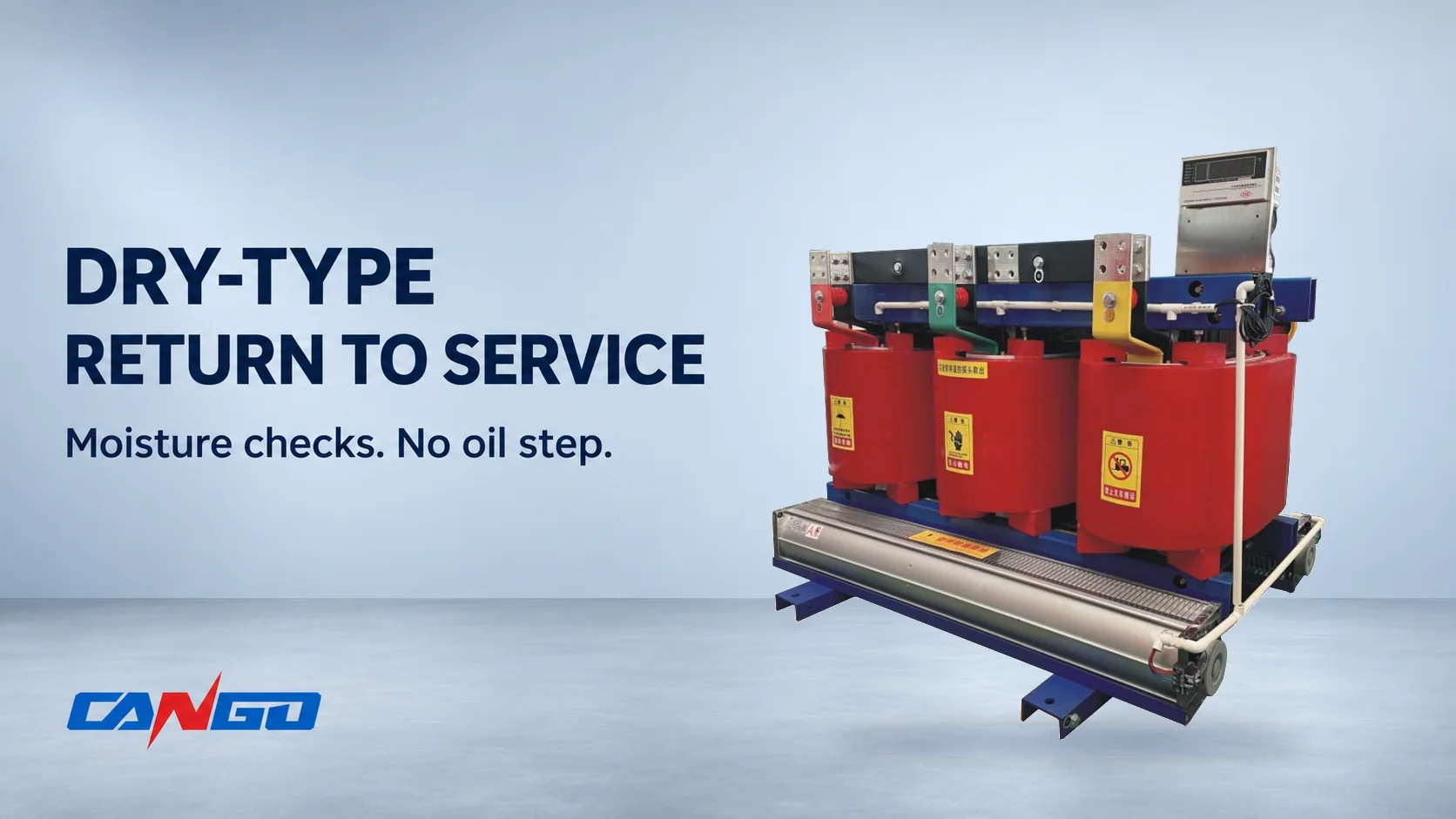
For an idle CANGO SC(B)10 dry-type transformer, use the same review-and-release discipline with a different moisture route. There is no oil sample, oil treatment or oil resample. Keep the broader oil-filled versus dry-type distinction separate from this task.
Start with identity, exterior inspection, removal of contamination and a close check for damp winding surfaces, tracking, damaged insulation and obstructed ventilation. Review any installed space-heater records without assuming the unit includes a heater.
Next assess insulation resistance and polarization index as applicable to the design. If moisture is suspected or the results are unacceptable, stop and use the manufacturer’s drying procedure, then repeat the assessment. Do not invent a drying temperature or improvise heating with an energized winding.
After moisture clearance, complete the remaining mechanical and electrical checks, including tap-position verification, ratio, resistance and excitation measurements. The test specialist must still manage the actual measurement order and residual magnetism. Drying does not replace these checks.
Go: the surfaces and insulation assessment are acceptable, other findings are closed and the responsible person authorizes monitored energization. No-go: persistent poor results, tracking or insulation damage require specialist review. Follow the model documents; insulation class and temperature rise do not create permission to bypass the moisture hold point.
Energize, watch, resample
Step 5 begins only after release. Before the switching window, assemble the test reports, closed defect list, final tap-position record, confirmed service configuration and approved switching program. Confirm that temporary test arrangements are removed and the installation is restored under the authorized procedure. Qualified personnel must perform isolation, testing, earthing and switching under the site’s permit system.
First energization and loading
Use the manufacturer’s commissioning procedure and approved plan for initial no-load energization. Observe the transformer from the designated safe position and review:
- Sound against the expected operating condition, with unexplained noise investigated.
- Temperature indications and their trend rather than a single snapshot.
- Leakage, abnormal odor or other visible evidence of distress.
- Alarm or trip indications, including Buchholz or gas-relay operation where fitted.
- Cooling and temperature-control behavior appropriate to the installed equipment.
Go: no unresolved abnormality appears, and the responsible person permits load to be introduced gradually. No-go: an abnormal sound, gas-relay event, unexpected temperature behavior or other alarm requires action under the site procedure, including isolation where required and investigation before another attempt.
This is monitored commissioning after accepted tests. Energization is not a substitute test for a suspect transformer. Keep the returning unit within its approved loading plan; do not plan to overload it immediately. The transformer overload guide addresses that separate decision.
Put the follow-up sample on the work order
For the oil-filled unit, book a repeat oil sample at about 30 days of service and compare it with the pre-energization baseline. The Eng-Tips recommendation is early follow-up over the first few weeks, including around that point. It is practitioner advice for the recommissioning plan, not a universal statutory interval. The responsible specialist may require earlier sampling.
Record the operating load, temperatures, sampling conditions and any intervening oil work with the repeat sample. Use the DGA results as a comparison for specialist review; this article gives no gas-concentration limits or diagnostic interpretation.
Assign an owner and due date before closing the initial work order. Otherwise, a unit that passed its first switching window can disappear into routine operations without the planned comparison.
During the first month, unexplained noise, gas-relay activity or abnormal temperature trends should prompt investigation under the operating procedure rather than waiting for the scheduled sample. Once the release and early follow-up actions are closed, move the installation into its approved maintenance plan. The switchgear maintenance checklist covers adjacent equipment’s periodic work, not this transformer release sequence.
FAQ
How long out of service counts as “idle for years”?
There is no magic year count that makes a transformer safe or unsafe. Maddox treats a planned unenergized period of six months or more as a reason for a storage plan and calls for testing at the end of long-term storage. For return to service, follow the manufacturer’s instructions and approved test procedure. Longer inactivity, poor preservation and missing records increase the importance of completing every hold point; elapsed time alone is not an acceptance test.
Can I just megger it and switch on?
No. Insulation resistance is one item in Step 3, not a release decision. The sequence also requires records, visible-condition checks, oil sampling for an oil-filled unit, tap-changer operation and the remaining electrical assessment. A favorable reading cannot clear a broken bushing, an unresolved oil result or a ratio mismatch. Complete the program and close the findings before the authorized person permits monitored energization.
What if the insulation test fails?
Hold energization and first verify the test conditions and setup. Investigate moisture and contamination, then use the manufacturer’s drying procedure or an appropriate specialist treatment where justified. Repeat the affected assessment after correction. A poor reading is not an automatic scrap verdict, but drying is not an automatic pass either. Persistent abnormal results or evidence of insulation damage require the specialist review described in the go/no-go section before release.
Does a dry-type transformer need the same routine?
It needs the same ordered decision process, with the oil branch removed. Inspect and clean the unit, investigate winding moisture, perform the applicable insulation assessment, and dry and retest if required. Then complete the other mechanical and electrical checks under the approved procedure before monitored energization. A dry-type unit does not need oil sampling or an oil follow-up report. Its manufacturer documents govern drying and acceptance; oil-filled treatment methods do not transfer.
The tests passed. Is it back to normal service immediately?
No. Accepted tests allow the approved commissioning stage to begin: no-load energization, observation and gradual loading when conditions remain satisfactory. An oil-filled unit also needs its planned early oil resample, at about 30 days in this workflow, for comparison with the baseline. Assign first-month monitoring and follow-up responsibilities explicitly. Abnormal noise, gas-relay activity or temperature behavior calls for prompt investigation under the operating procedure rather than waiting for the next visit.
Sources
- Eng-Tips, discussion of recommissioning oil-filled transformers after 20 years. Practitioner discussion used for the problem, assessment sequence and early resampling recommendation, not numerical acceptance limits.
- U.S. Bureau of Reclamation, Transformers: Basics, Maintenance, and Diagnostics, April 2005. Moisture and diagnostic-testing sections, including the excitation-current/DC-test sequencing caution.
- Maddox, How to Store Transformers, April 4, 2024. Only end-of-storage testing, pre-service oil moisture, the six-month planning context and optional decade-plus remanufacture assessment are used.
- CANGO product information: S11-M Oil-Immersed Distribution Transformer and SC(B)10 Dry-Type Power Transformer, linked at their respective equipment sections. Product identity and exterior photographs only; no field acceptance limits or recommissioning service commitment.