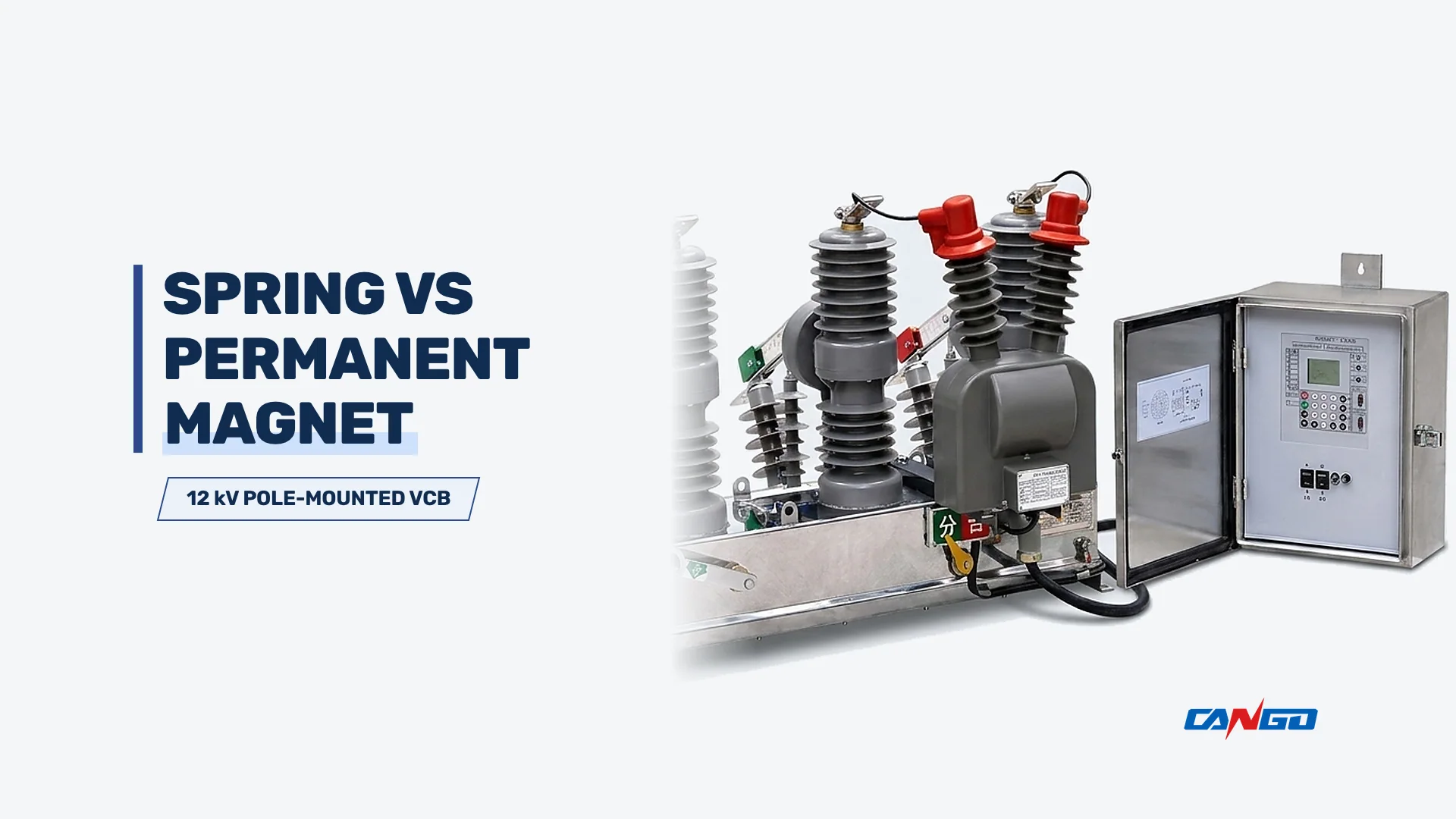
Choosing between a spring operating mechanism and a permanent magnet pole mounted vacuum circuit breaker on a 12 kV overhead feeder is a trade-off between mechanical hand-crank independence and low-wear electromagnetic simplicity. A spring-operated breaker stores closing energy in coiled steel and retains full manual charging during total auxiliary-power loss, whereas a bistable permanent-magnet actuator eliminates multi-part mechanical latches and charging motors—cutting moving-part wear on automated, frequently switched feeders while making auxiliary PT power and capacitor-bank health critical to every close command.
Energy-Storage and Holding Physics: Mechanical Springs vs. Bistable Permanent Magnets
Both actuator families drive the exact same 12 kV vacuum interrupter contacts under IEC 62271-100, yet they store energy and hold the closed or open state through fundamentally different physical mechanisms. Understanding that mechanical-versus-electromagnetic split explains why each design exhibits opposite strengths on remote overhead poles.
In a spring operating mechanism, a motor (or manual operating handle) winds a helical closing spring and locks it behind a mechanical latch. Triggering the closing coil releases the latch, snapping the vacuum contacts closed while simultaneously compressing an opening spring that stays latched until a trip command arrives. Holding the breaker closed depends entirely on mechanical pawls, rollers, cams, and lubricated pivot pins.
In a bistable permanent-magnet actuator, a permanent-magnet ring embedded inside a steel magnetic yoke holds the moving iron armature firmly at either the closed or open end-stop with zero continuous holding coil current. To switch states, the controller discharges a stored pulse from an electrolytic or film capacitor bank into either the closing coil or the opening coil, momentarily overcoming the magnetic holding force and driving the central shaft directly to the opposite end-stop.
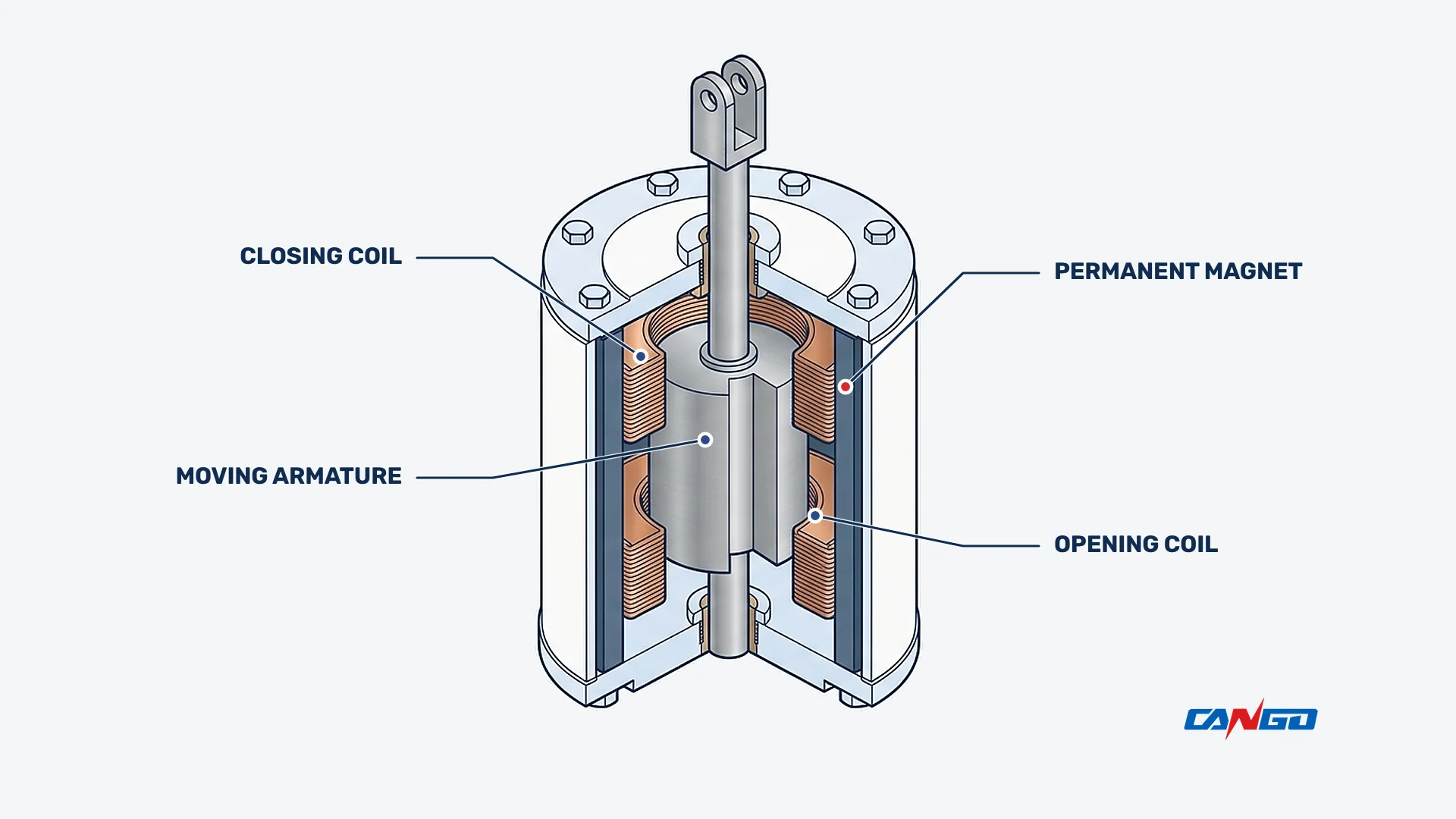
| Actuator Characteristic | Spring Operating Mechanism | Bistable Permanent-Magnet Actuator |
|---|---|---|
| Primary Energy Storage | Helical steel closing and opening springs | Capacitor bank charged by auxiliary PT / battery supply |
| Closed-State Holding Method | Mechanical latch, pawls, and linkage cams | Permanent-magnet holding flux (zero continuous coil power) |
| Mechanical Part Count | High (motor, gearbox, ratchets, springs, latches, dampers) | Low (single moving armature, shaft, and minimal linkage) |
| Lubrication & Cold-Grease Sensitivity | Sensitive to hardened grease and linkage friction in cold/dusty climates | Minimal sliding friction; no multi-stage latch train to bind |
| Total Auxiliary-Power Blackout Behavior | Can be manually charged and closed on the pole via operating handle | Manual emergency trip handle available; electrical close requires charged capacitor/auxiliary supply |
Select a permanent-magnet actuator when high switching frequency, feeder automation, and minimal mechanical linkage maintenance drive the pole specification; select a spring mechanism whenever line crews must be able to manually charge and close the breaker on an unpowered pole without external DC or PT power.
Auxiliary Power Loss, Capacitor Health, and Failure-Mode Asymmetry
Engineers comparing 12 kV pole-mounted breakers often focus exclusively on mechanical endurance while overlooking how each actuator fails in the field. Replacing a spring mechanism with a permanent-magnet drive does not eliminate failure modes—it shifts them from mechanical wear to electrical energy storage and control electronics.
On a spring-operated breaker, the most common field issues after years of outdoor exposure are mechanical: charging-motor burnout, worn ratchet teeth, hardened lubricant slowing latch release during winter freezes, or drifted auxiliary-switch linkages. When auxiliary AC/DC control power disappears completely, however, a qualified line crew can still wind the closing spring manually with the pole-mounted lever and restore the feeder once the fault is cleared.
On a permanent magnet pole mounted vacuum circuit breaker, eliminating the charging motor and latch train removes most mechanical wear points, making it well suited for automated distribution nodes that switch or reclose frequently. The trade-off sits inside the stainless control cabinet: the actuator depends on healthy capacitor banks, reliable drive electronics, and stable auxiliary power (typically supplied by a pole-mounted voltage transformer / PT plus backup battery). If the auxiliary PT fails and the backup battery depletes during an extended upstream outage, the crew can still execute a manual emergency trip via the mechanical pull ring, but re-closing requires restoring control power or connecting a portable external power pack to recharge the capacitor bank.
Comparing Real 12 kV Pole-Mounted Hardware: ZW32-12G vs. ZW32-12MG/630
On CANGO’s 12 kV outdoor product line, the architectural difference between spring and permanent-magnet actuation shows up immediately on the pole assembly itself—especially in how auxiliary power, visible isolation, and control cabinets are packaged.
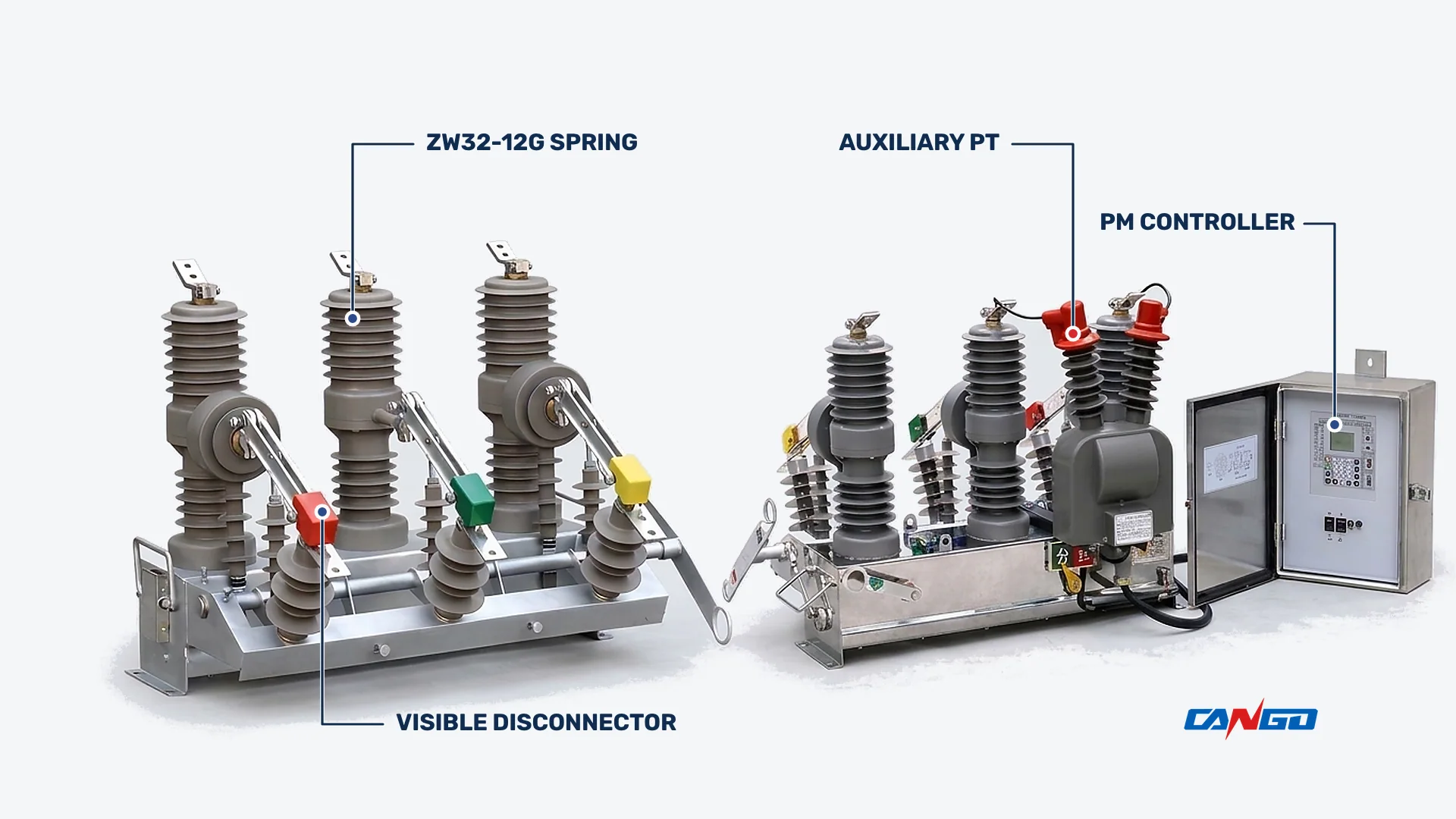
- CANGO ZW32-12G 12kV Outdoor Vacuum Circuit Breaker: Rated 12 kV and 630 A with a spring operating mechanism (configurable for manual or motorized spring operation), an integrated visible disconnector (G), and an optional distribution-automation controller for rural grids, industrial taps, and substation exits.
- CANGO ZW32-12MG/630 12kV Permanent-Magnet Outdoor Vacuum Circuit Breaker: Rated 12 kV and 630 A using a permanent-magnet operating mechanism (M), paired with permanent-magnet control, protection, measurement, communication, and auxiliary-power provisions for automated 12 kV overhead distribution nodes.
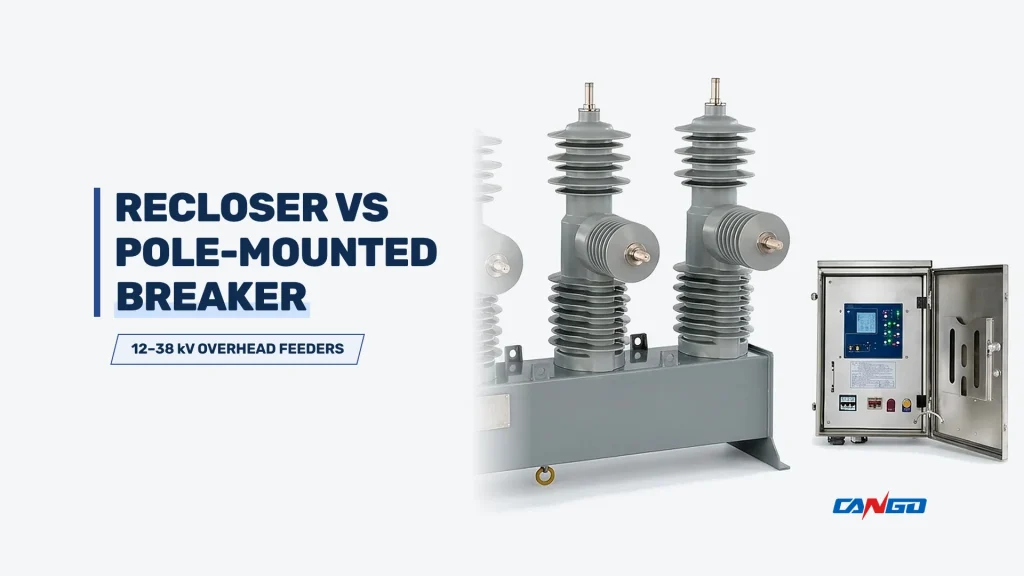
(When the overhead feeder spans 15.5–38 kV or requires an integrated IEC 62271-111 / IEEE C37.60 multi-shot auto-reclosing system rather than a 12 kV pole-mounted breaker, see automatic circuit recloser vs pole-mounted vacuum circuit breaker and the KGVZ 15-38kV Automatic Circuit Recloser.)
Field Selection Matrix by Feeder Duty, Climate, and Maintenance Crew Capability
Matching the actuator to the utility’s real operating environment prevents specification mismatches that only surface during storm restoration or winter cold snaps.
| 12 kV Overhead Feeder Scenario | Primary Operational Stressor | Recommended Actuator | Practical Engineering Rationale |
|---|---|---|---|
| Automated distribution-automation (DA) tie or sectionalizing node | Frequent remote SCADA switching and automated fault isolation | Permanent-Magnet Actuator (ZW32-12MG/630) | Fewer moving parts reduce linkage drift and lubrication maintenance under repetitive switching cycles |
| Remote rural spur or unpowered industrial tap with manual patrol crews | Extended upstream blackouts with no external DC supply on pole | Spring Operating Mechanism (ZW32-12G) | Manual lever charging enables local mechanical close after fault clearance without portable power packs |
| Cold, coastal, or high-dust outdoor corridor | Thickened mechanical grease and corrosion on exposed linkages | Permanent-Magnet Actuator (with sealed stainless cabinet & heater) | Eliminates complex multi-latch mechanical trains prone to cold-weather sluggishness |
| Maintenance-heavy boundary requiring simple local visual isolation | Frequent line-crew grounding and visible open-gap verification | Spring or PM Breaker with Integrated Disconnector (G) | Mechanically interlocked external disconnector blades establish a visible air gap on the pole |
If your overhead network relies on remote SCADA automation and reliable PT auxiliary power, standardize on the permanent-magnet actuator to minimize mechanical servicing; if field crews routinely operate manually during black-start outages without auxiliary power, the spring mechanism remains the safer operational baseline.
Maintenance and RFQ Specification Checklist
Preventive maintenance differs sharply between the two designs. Spring-operated pole-mounted breakers require periodic checks of spring-charging motor current, latch engagement, linkage lubrication, and mechanical operation counters, whereas permanent-magnet breakers shift routine inspection inside the control cabinet—checking capacitor-bank charging voltage and retention, backup battery health, PT fuse integrity, door-gasket sealing against condensation, and manual emergency-trip linkage freedom.
Before requesting configuration review across CANGO’s Pole-Mounted Circuit Breakers portfolio via CANGO Contact, prepare the following project inputs:
– Electrical duty: 12 kV system rating, 50/60 Hz frequency, 630 A continuous current (or project-required rating), and required short-circuit breaking current from the feeder study.
– Actuator and isolation choice: Spring mechanism (manual vs. motorized) or permanent-magnet actuator, plus whether an integrated visible disconnector (G) is mandatory under utility work rules.
– Auxiliary power and automation: Source of auxiliary power (pole-mounted PT, external AC/DC), backup battery autonomy requirement, protection functions, and SCADA communication protocol (field pole erection, protection settings sign-off, and utility grid commissioning remain within the EPC or utility scope).
Frequently Asked Questions
Can a permanent-magnet pole-mounted vacuum circuit breaker be opened without auxiliary power?
Yes—standard 12 kV permanent-magnet outdoor vacuum circuit breakers include a mechanical emergency manual trip ring/handle so crews can open the breaker safely even if auxiliary power and capacitors are depleted. However, closing the breaker electrically requires a charged capacitor bank or portable auxiliary power supply.
Does a permanent-magnet actuator draw continuous power to stay closed?
No—a bistable permanent-magnet actuator uses permanent-magnet holding flux to keep the vacuum interrupter closed or open with zero continuous holding coil current. Electrical power is drawn only during the brief millisecond-scale capacitor discharge pulse that switches the breaker state (plus standby power for the controller electronics).
Which actuator lasts longer on an automated 12 kV feeder?
Mechanically, a permanent-magnet actuator has far fewer wearing linkages, cams, and latches than a spring mechanism, making it well suited for high-operation automated nodes—provided the control cabinet’s capacitors, backup battery, and moisture seals are inspected on schedule. For broader arc-interruption technology context across medium-voltage networks, see vacuum circuit breaker vs SF6 circuit breaker.
References
- International Electrotechnical Commission (IEC), IEC 62271-100: High-voltage switchgear and controlgear – Part 100: Alternating-current circuit-breakers (AC circuit-breaker and mechanical operating duty scope referenced).
- CANGO Power (Zhejiang Kangge Electric Co., Ltd.), Pole-Mounted Circuit Breakers, ZW32-12G 12kV Outdoor Vacuum Circuit Breaker, ZW32-12MG/630 12kV Permanent-Magnet Outdoor Vacuum Circuit Breaker, and KGVZ 15-38kV Solid-Dielectric Automatic Circuit Recloser (CANGO product information for declared ratings and operating-mechanism options).
- CANGO Power, Automatic Circuit Recloser vs Pole-Mounted Vacuum Circuit Breaker and Vacuum Circuit Breaker vs SF6 Circuit Breaker (verified internal references).