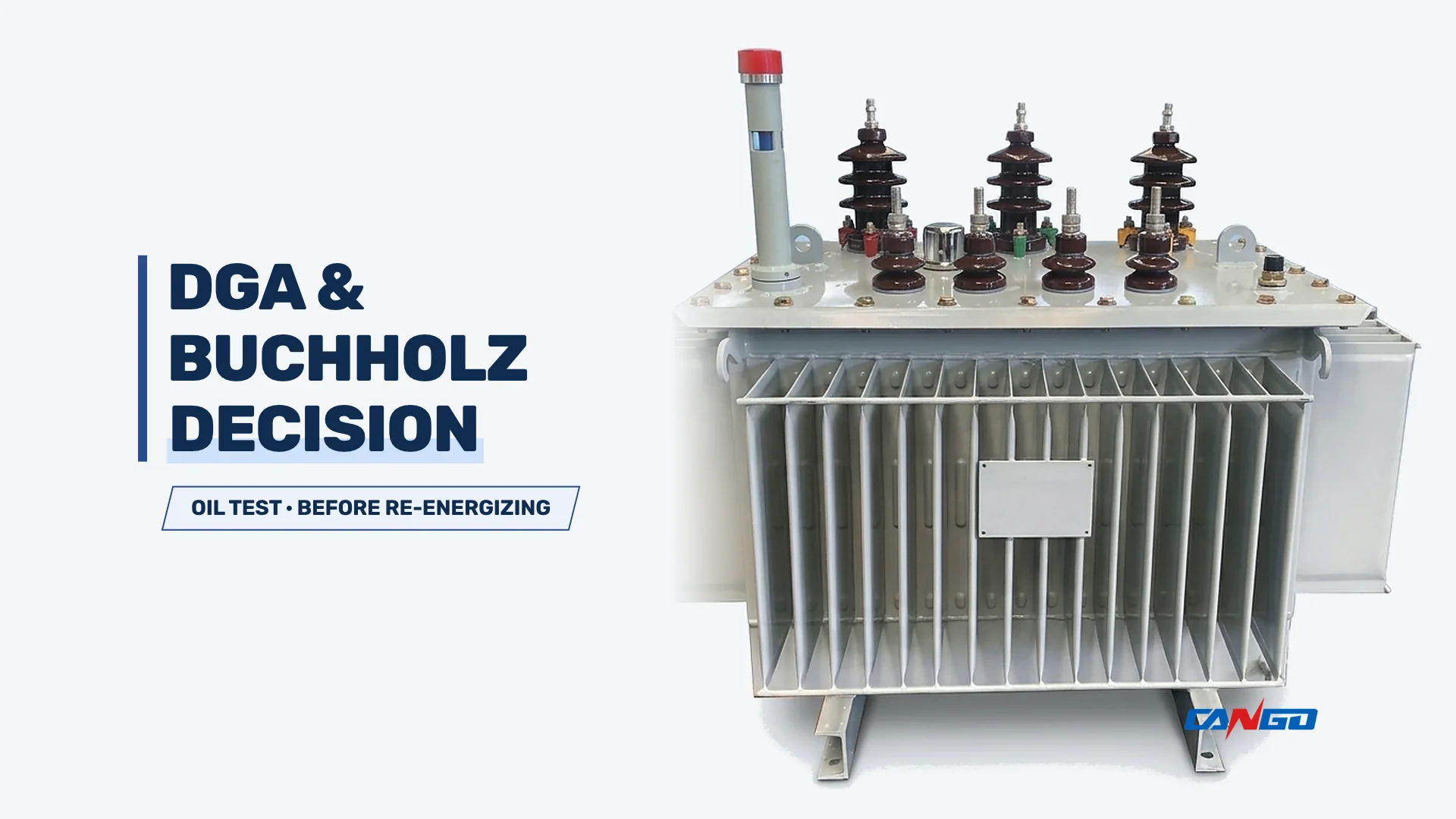
A dissolved gas analysis transformer report is read in three passes: identify which gases are present, map them to their fault family, and check how fast they are rising between samples. If a Buchholz relay has tripped the unit, one absolute rule overrides everything else: never re-energize the transformer until the root cause is found and cleared. This guide prints no universal ppm limit table because published action thresholds depend on transformer design, age, loading, and the laboratory framework applied. It applies to oil-immersed transformers fitted with a conservator; dry-type transformers contain no oil, so neither DGA nor a Buchholz relay applies.
What the Laboratory Measured in a Dissolved Gas Analysis Transformer Report
A dissolved gas analysis transformer test measures trace gases dissolved in the insulating oil to detect internal electrical or thermal stress before a failure becomes visible outside the tank. Field crews draw an oil sample using airtight syringes or cylinders under IEC 60567 sampling guidance, and a laboratory extracts and separates the gases by gas chromatography, reporting each gas concentration in parts per million (ppm).
When mineral oil and solid cellulose paper insulation experience electrical discharges or abnormal heating inside an energized unit, chemical bonds break down and release characteristic hydrocarbon, hydrogen, and carbon oxide gases into the surrounding oil. Because those gases dissolve in the liquid insulation, a routine oil sample carries a chemical record of internal activity that external terminal measurements cannot see.
To interpret those concentrations, laboratories and diagnostic engineers apply established frameworks—primarily IEC 60599 for mineral oil-filled electrical equipment in service and IEEE C57.104 for mineral oil-immersed transformers. Those frameworks evaluate gas ratios, statistical norms, and generation rates against equipment history rather than relying on a single isolated number.
Before filing or reviewing any DGA sheet, pair the laboratory report with the unit’s exact nameplate identity and operating history—see how to read a transformer nameplate to lock down serial numbers, cooling class, and rated impedance in the asset file. If the transformer is returning from storage rather than continuous load, collect the baseline oil sample before energization using the pre-service sequence in testing a transformer idle for years before re-energizing, then use this guide to interpret what the laboratory sends back.
Reading Fault Gases by Fault Family Instead of Guesswork
Reading a DGA sheet starts with grouping the reported gases by the physical stress that creates them, rather than scanning a column of ppm figures in isolation. Different fault mechanisms—partial discharge, arcing, oil overheating, paper degradation, or simple air leaks—leave distinct chemical signatures in the oil sample.
| Gas Reported | Chemical Formula | Primary Mechanism in Oil or Cellulose | Fault Family / Diagnostic Signal |
|---|---|---|---|
| Hydrogen | H2 | Low-energy ionization and corona in oil | Partial discharge / low-energy discharge activity |
| Acetylene | C2H2 | Extreme energy density in an electric arc | High-energy arcing (non-ageing signal; treat as active fault until excluded) |
| Ethylene | C2H4 | Severe thermal decomposition of mineral oil | High-temperature thermal fault in oil |
| Methane and Ethane | CH4, C2H6 | Moderate thermal decomposition of mineral oil | Lower-temperature thermal faults |
| Carbon Monoxide and Carbon Dioxide | CO, CO2 | Thermal or electrical degradation of paper insulation | Cellulose involvement (read alongside hydrocarbons by a specialist) |
| Oxygen and Nitrogen | O2, N2 | Atmospheric air entering the tank or conservator | Air ingress / breathing path leak (non-fault false alarm family) |
Deterministic Selection Rule: Treat any presence or upward trend of acetylene as a high-energy arcing signal requiring immediate out-of-service holding, whereas shifts limited to oxygen and nitrogen without rising hydrocarbon gases point to an air-ingress check before condemning the active part.
Acetylene: The Non-Negotiable Arcing Signal
Acetylene occupies a category of its own on every dissolved gas analysis transformer report because normal thermal ageing of oil and paper does not produce it. Forming acetylene requires the extreme energy density of an electric arc inside the tank—such as flashover between turns, a failing selector contact, or arcing at a loose internal connection.
Because it is not a normal ageing byproduct, the appearance of acetylene—especially when rising across consecutive samples—is treated as an active arcing signal until proven otherwise by confirmation sampling and specialist review. Even when other hydrocarbon gases appear modest, acetylene removes any justification for a wait-and-see return to service.
Thermal Gases and Cellulose Involvement
Ethylene points to high-temperature thermal faults in mineral oil, while methane and ethane point to lower-temperature thermal decomposition. When heating remains confined to bare metal or oil paths, hydrocarbon gases rise while carbon oxides stay comparatively steady. For context on how sustained loading drives winding and oil temperatures, review can you overload a distribution transformer alongside the unit’s load log.
When carbon monoxide and carbon dioxide rise alongside hydrocarbon gases, solid cellulose paper insulation around the windings is involved in the thermal or electrical stress. Because paper ageing cannot be reversed once embrittled, reading carbon oxides together with methane, ethane, and ethylene—and judging their ratio and trend—requires a specialist evaluating the unit’s full history rather than a simplified field rule.
Air Ingress: The False-Alarm Family
Oxygen and nitrogen appear on most laboratory sheets and serve as a critical reality check before anyone condemns a transformer. Unusual shifts in oxygen and nitrogen—especially when hydrocarbon fault gases remain absent or flat—commonly point to atmospheric air entering through a breather path, gasket, or recent oil-handling work rather than an internal electrical fault.
Excluding air ingress first prevents unnecessary outages and teardown decisions triggered by a breathing leak or a poorly purged sample line. Only after confirming that the gas signature belongs to internal oil or paper breakdown should operational restrictions be escalated.
Why Gas Generation Trend Beats Any Single Snapshot
A single DGA report with no prior baseline is weak evidence because it cannot tell an engineer whether a gas concentration accumulated slowly over years of normal service or formed rapidly over days. The three decisive variables in dissolved gas analysis are which gases are present, whether their concentrations are rising between consecutive samples, and how fast that generation rate is climbing.
Two transformers with nearly identical absolute ppm readings on a single laboratory sheet can require opposite operational decisions. A unit with a stable, flat, unchanging gas profile over repeated samples reflects historical stress that may no longer be active, whereas a unit showing a fast-rising generation rate signals an active fault consuming insulation in real time.
At the same time, engineers must recognize what DGA cannot do. Dissolved gas analysis cannot pinpoint the exact physical location of a fault inside the core or windings, and it cannot detect purely mechanical problems—such as loose clamping bolts or structural vibration—until those defects begin generating heat or electrical discharges.
Sampling errors also distort single snapshots: air bubbles drawn during collection, contaminated syringes, or improper valve flushing under IEC 60567 procedures can inject misleading gas readings into a clean transformer. For that reason, an unexpected jump on an isolated report—when no Buchholz trip has occurred and no acetylene is present—is answered first with a careful confirmation resample rather than immediate dismissal or an invasive strip-down.
Why This Guide Prints No Universal ppm Limit Table
Published DGA action limits in international standards and utility guides are calibrated for populations of transformers, not as universal pass/fail cutoffs for an individual unit on site. Thresholds depend heavily on transformer construction, tank breathing design, unit age, loading profile, and the specific diagnostic framework a laboratory applies.
IEC 60599 and IEEE C57.104 structure their evaluation criteria differently, using distinct statistical baselines, gas-ratio methods, and condition-classification philosophies. Printing a single simplified ppm table outside those frameworks creates a false sense of precision—encouraging operators either to ignore a fast-rising fault below an arbitrary number or to panic over a stable, older unit whose historical baseline naturally sits higher.
A defensible engineering reading replaces memorized numbers with three disciplined inputs: fault family, gas generation rate across samples, and specialist interpretation applying IEC 60599 or IEEE C57.104 to that transformer’s own service history.
Buchholz Relay Events: Gas Accumulation Alarm vs Oil Surge Trip
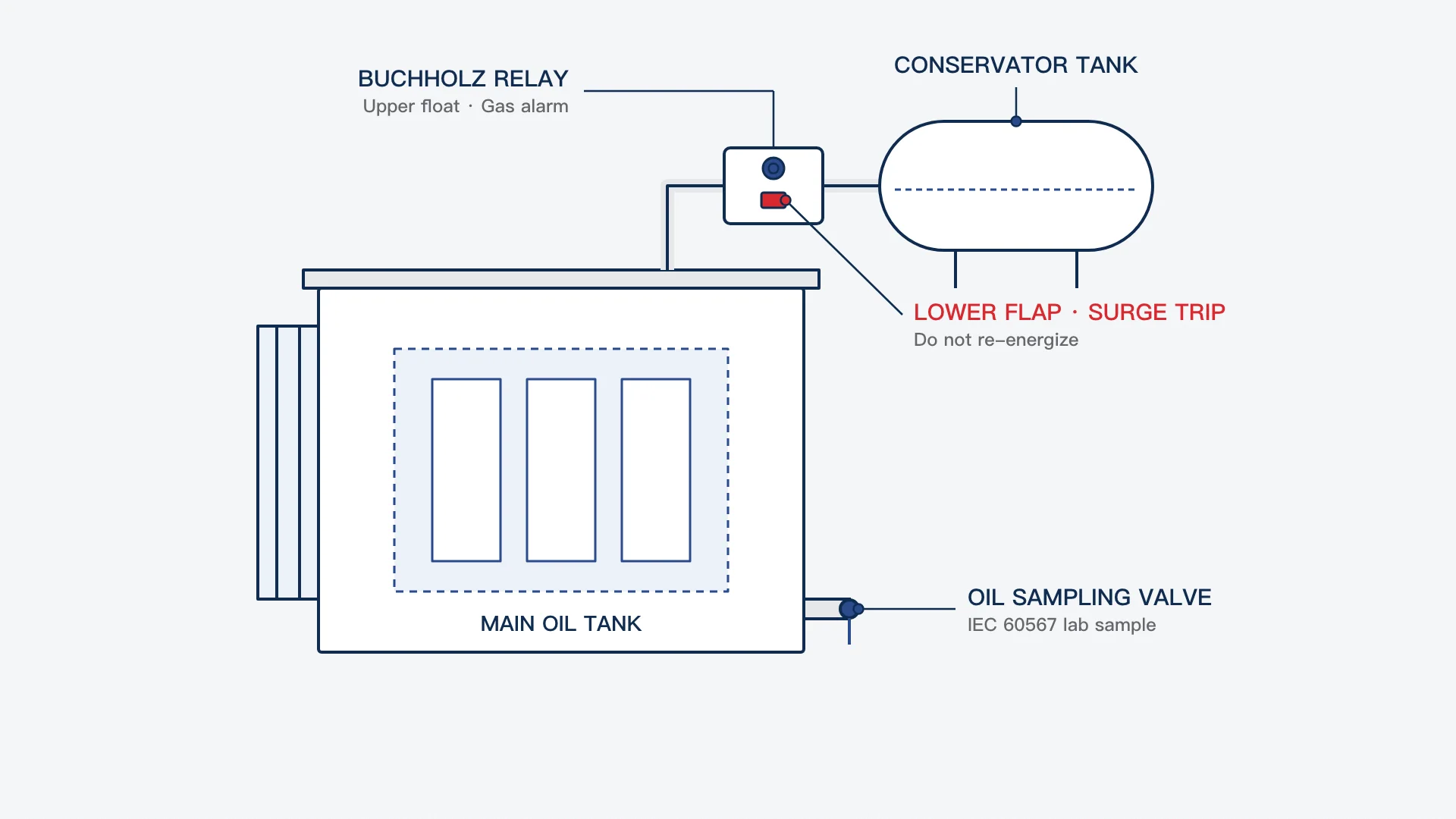
On a conservator-type oil-immersed transformer, the Buchholz relay sits in the sloping pipe connecting the main tank to the overhead conservator, providing mechanical protection against two distinct internal conditions. Understanding which stage operated—gas accumulation alarm or oil surge trip—sets the immediate response discipline before anyone touches the breaker.
Stage 1: Gas Accumulation (Alarm)
Slow gas generation from an incipient fault, or trapped air bubbles migrating upward from the main tank, collects in the upper chamber of the Buchholz relay. As gas displaces oil inside the relay housing, the upper float drops and closes the alarm contact without tripping the transformer offline.
A Buchholz alarm is an early warning that must be answered by sampling—never by resetting the relay and forgetting the event. Operators should collect both the free gas trapped in the relay bleed valve and a fresh main-tank oil sample for laboratory DGA. Legacy field hints such as gas colour or simple combustibility checks are crude approximations at best; laboratory gas chromatography of both the collected relay gas and the dissolved oil gases decides what actually happened. Never perform an open-flame test on Buchholz gas.
When a Buchholz alarm is paired with a clean DGA report showing no rising fault-family gases, the most common culprit is air ingress or trapped air rather than internal arcing or overheating. In that scenario, inspect the silica-gel breather path, upper tank gaskets, pump seals, and any recent oil topping-up or filtration work before clearing the alarm.
Stage 2: Oil Surge (Trip)
A severe internal fault—such as a winding-to-winding short circuit or high-energy arc—vaporizes oil instantaneously, driving a violent surge of oil through the connecting pipe toward the conservator. That sudden flow deflects the lower flap inside the Buchholz relay, closing the trip contact to isolate the transformer immediately.
After a Buchholz trip, the transformer must NOT be re-energized until the cause is found. This rule is absolute, with no exceptions for urgent load restoration or clean-looking external bushings. Reclosing onto an internal fault risks tank rupture, oil fire, and catastrophic loss of adjacent substation switchgear.
The Pre-Re-Energizing Decision Ladder
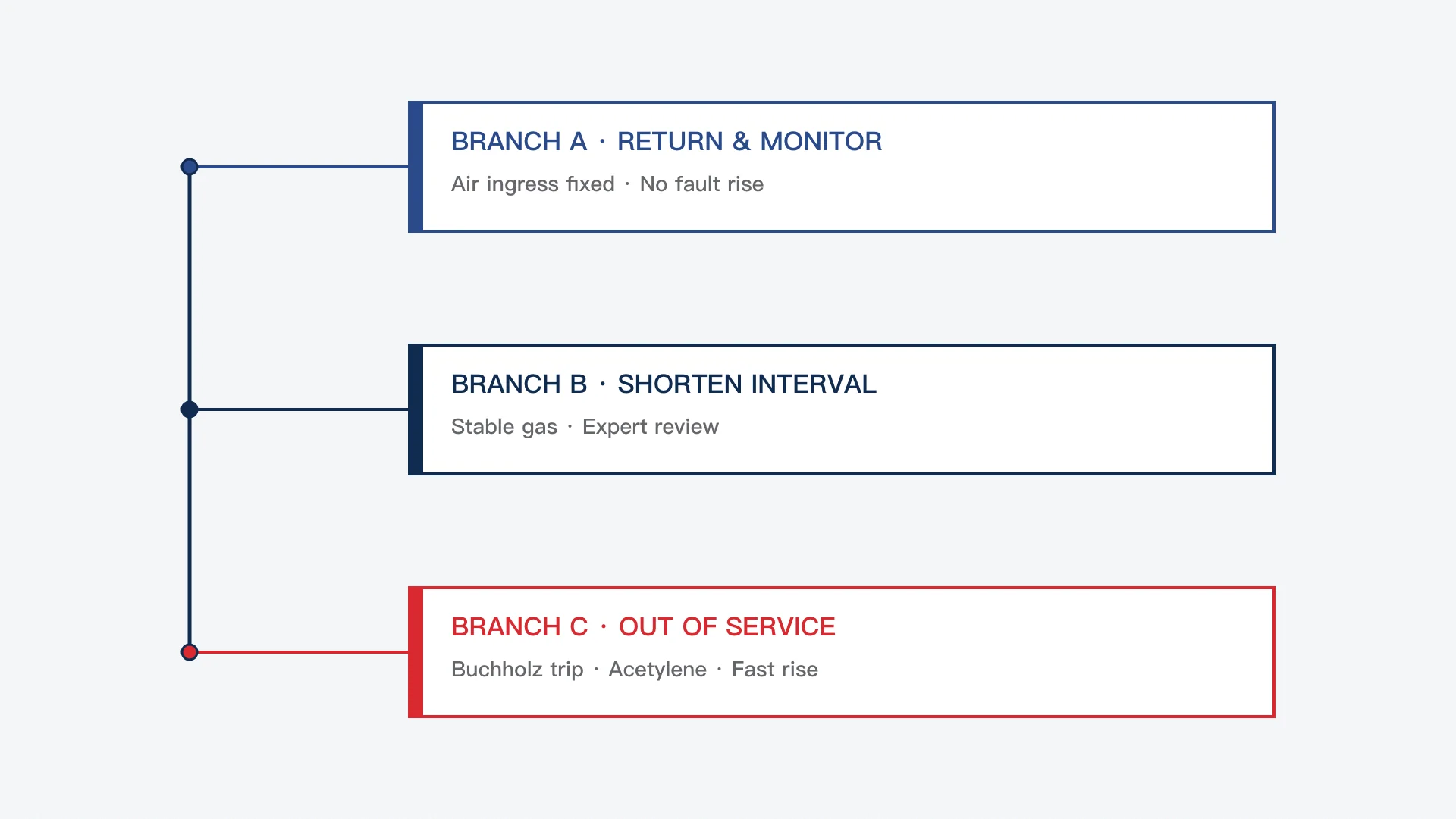
Once a laboratory DGA report or a Buchholz event is on the desk, every operating decision narrows to three clear branches based on fault family, generation trend, and relay stage. Trying to “energize it and watch” after an unexplained trip or active arcing signature is not a valid engineering branch.
| Decision Branch | Observed DGA and Buchholz Evidence | Mandatory Action Before Re-energizing |
|---|---|---|
| Branch A — Return to service with monitoring | Relay gas confirmed as air; ingress path found and corrected; DGA shows no rising fault-family gases | Return unit to service, log the event in the asset file, and keep the next sample on the normal cycle |
| Branch B — Shorten the interval and get expert review | Fault-family gases present but stable across samples; zero acetylene; no Buchholz trip event | Resample on a shortened interval (weeks-to-months, set by the specialist); specialist evaluates trend against unit history under IEC 60599 or IEEE C57.104 |
| Branch C — Keep out of service | Buchholz trip unexplained; acetylene present or rising; or any fault gas rising fast between samples | Do not re-energize; escalate to internal inspection and manufacturer engineering involvement |
Deterministic Selection Rule: Select Branch A only after air ingress is proven and fault gases remain flat; hold in Branch B under specialist-defined shortened sampling whenever stable non-acetylene fault gases appear; and lock out the unit under Branch C whenever a Buchholz trip, acetylene, or a rapid gas rise occurs.
Critical Misread Warning — Breakdown Voltage (BDV) Does Not Clear Fault Gases: Supporting oil tests printed on the same laboratory sheet—such as breakdown voltage (BDV), moisture content, acidity, and interfacial tension—measure the physical and dielectric condition of the oil itself, not internal fault gases. A transformer oil sample can pass its breakdown-voltage test cleanly while still carrying active arcing or thermal fault gases. Never use a passing BDV result as justification to re-energize after a Buchholz trip or abnormal DGA report.
When planning routine asset checks across the wider substation bay, keep periodic switchgear inspection intervals separate from transformer oil diagnostics—see the medium-voltage switchgear maintenance checklist for bay-level preventive tasks. For project engineers evaluating oil-immersed distribution equipment classes, CANGO supplies the S11-M oil-immersed distribution transformer series as a sealed oil-immersed design for 10 kV and 20 kV utility and industrial distribution networks; when specifying or maintaining conservator-type oil-immersed units in the wider substation fleet, confirm protective relay, sampling-valve, and diagnostic documentation requirements directly with the equipment manufacturer.
Tap-Changer Compartment Caveat: On transformers equipped with a separate on-load tap-changer (OLTC) oil compartment, normal load-tap switching generates its own arc and thermal gases inside the diverter chamber. That OLTC oil must be sampled and assessed separately from the main tank so normal switching gases are never confused with a main-winding fault.
Frequently Asked Questions
How often should dissolved gas analysis be done on an oil-immersed transformer?
No universal sampling interval applies to every transformer; the schedule is set by unit criticality, age, loading history, and operating events. DGA is mandatory after any Buchholz alarm or trip, before re-energizing a unit that has been idle or in storage, and on a specialist-defined shortened interval whenever Branch B stable fault gases are being tracked.
The Buchholz relay alarmed, but the DGA came back normal. Is it safe to re-energize?
Do not ignore the alarm simply because the main-tank DGA looks clean. Sample the free gas trapped inside the Buchholz relay itself and inspect the breather, gaskets, and recent oil-handling work for an air-ingress path first; a clean DGA paired with confirmed air in the relay qualifies for Branch A only after the ingress source is explained and corrected.
The oil passed its breakdown-voltage test. Can we re-energize after a trip?
No—breakdown voltage measures the dielectric strength and cleanliness of the oil, not whether internal arcing or overheating is occurring inside the windings. A Buchholz trip is answered exclusively by DGA, relay gas analysis, and root-cause investigation under the decision ladder before any re-energizing is considered.
Do dry-type transformers need dissolved gas analysis or a Buchholz relay?
No—dry-type transformers use solid cast-resin or air insulation with no insulating oil, so neither dissolved gas analysis nor a Buchholz relay applies to them.
One gas on a single DGA report is elevated. Should the transformer come out of service immediately?
A single elevated snapshot without history is weak evidence unless the elevated gas is acetylene or follows a Buchholz trip, which immediately places the unit in Branch C out of service. Otherwise, confirm the reading with a careful resample to rule out sampling error, check the generation trend across consecutive samples, and have a specialist apply IEC 60599 or IEEE C57.104 to the unit’s history.
References
- International Electrotechnical Commission (IEC), IEC 60567: Oil-filled electrical equipment – Sampling of free gases and analysis of free and dissolved gases in mineral oils and other insulating liquids – Guidance (Edition 5.0, 2023 — standard scope and sampling guidance referenced).
- International Electrotechnical Commission (IEC), IEC 60599: Mineral oil-filled electrical equipment in service – Guidance on the interpretation of dissolved and free gases analysis (Edition 4.0, 2022 — standard scope and interpretation framework referenced).
- IEEE Standards Association, IEEE Std C57.104: IEEE Guide for the Interpretation of Gases Generated in Mineral Oil-Immersed Transformers (interpretation framework scope referenced).
- CANGO Power (Zhejiang Kangge Electric Co., Ltd.), S11-M Oil-Immersed Distribution Transformer (CANGO product information for 10 kV and 20 kV sealed oil-immersed distribution transformer class context).