An amorphous-alloy transformer is not automatically the lowest-cost transformer for every project. Its main selection advantage is usually lower energized no-load loss, while the final result also depends on load loss, the number of hours energized, the current profile, the purchase premium and the evidence supplied with the offer.
For a fair comparison, ask both suppliers for the same rated capacity, voltage, impedance, cooling basis, loss reference temperature, tolerances and test method. Then calculate energy and cost from the project load curve. A material label by itself is not enough.
CANGO’s SCBH15 page explicitly describes an amorphous-alloy dry-type transformer. The checked SCB14 and SCB18 pages provide adjacent dry-type product routes but do not explicitly declare silicon-steel core material. They should therefore be treated as configuration options requiring a core-material declaration, rather than as confirmed silicon-steel benchmarks. CANGO SCBH15 product information
What actually changes when the core material changes?
Amorphous metal is rapidly cooled so that a long-range crystalline structure does not form. The resulting thin ribbon can magnetize with low core loss, but its lower saturation flux density changes the design tradeoff. Grain-oriented electrical steel uses controlled crystal orientation so magnetic flux is favored along the rolling direction. “Silicon steel” is therefore a family of grades and thicknesses, not one universal material specification.
The U.S. Department of Energy describes these mechanisms and the related saturation and design considerations in its 2024 distribution-transformer rule. A DOE/PNNL/SRNL project review also presents amorphous metal as a lower-magnetization-loss material while identifying the lower-flux-density and material/size tradeoff. These sources support the engineering boundary; they do not establish a fixed percentage saving or a CANGO product result. DOE 2024 final rule, DOE/PNNL/SRNL transformer-efficiency project
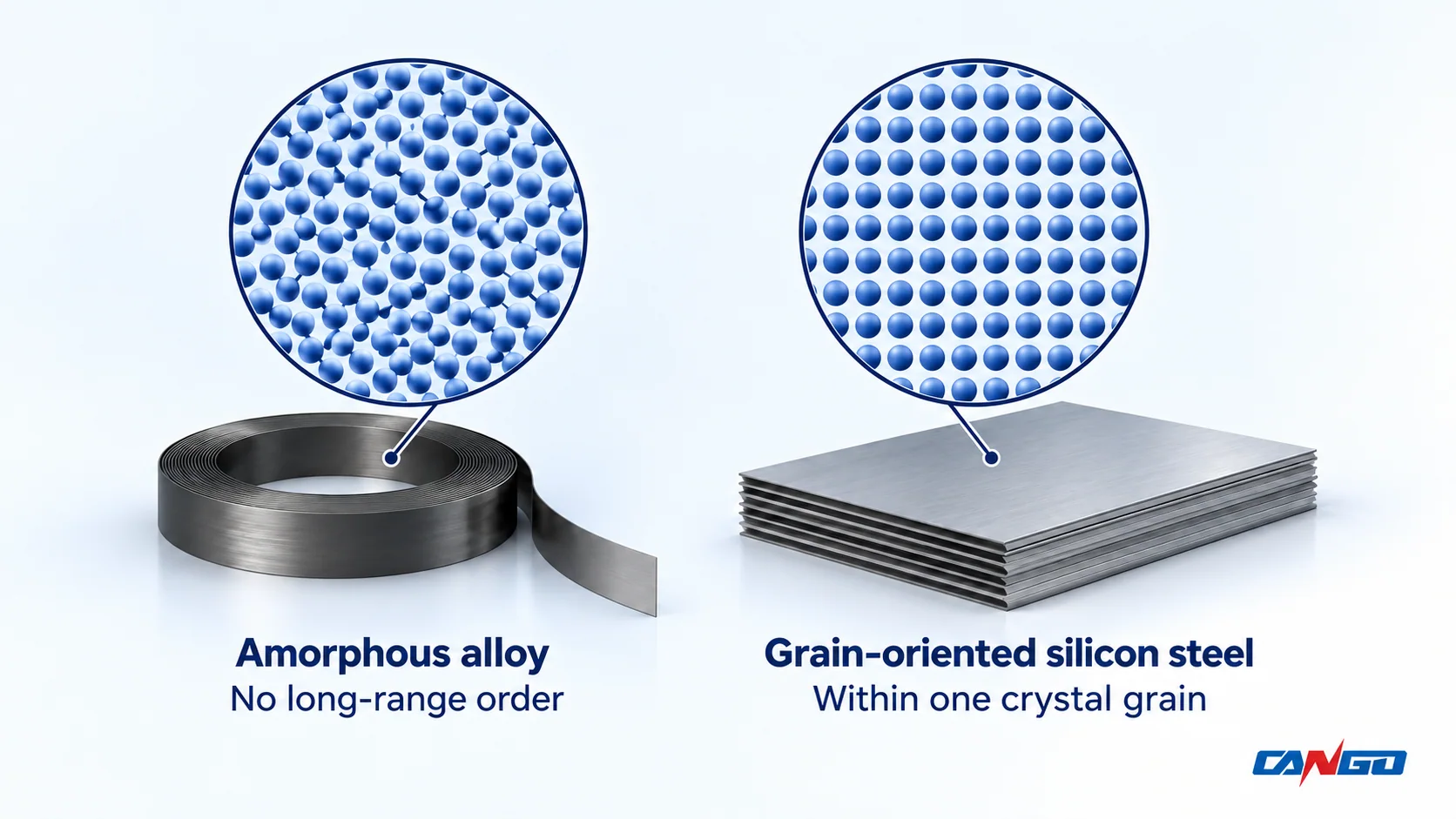
The material choice does not determine every transformer characteristic. Winding conductor, magnetic geometry, operating flux density, temperature, frequency, cooling, enclosure and manufacturing process affect the complete design. Lower core loss also does not mean that load loss disappears. Core material is a separate decision from the insulation and cooling construction covered in the oil-immersed versus dry-type transformer comparison.
Compare no-load loss and load loss on the same basis
For a transformer that remains energized, a useful screening model is:
Ploss(t) ≈ P0 + x(t)2Pk
where P0 is the quoted no-load loss, Pk is the quoted load loss at rated load and the stated reference condition, and x(t) is RMS current as a fraction of rated current. The model needs the offer’s reference temperature and test convention. Waveform distortion, tap position, auxiliary consumption, stray loss and temperature correction may require a more detailed assessment.
| Item | What it represents | Why it matters in the comparison |
|---|---|---|
| No-load loss, P0 | Loss while the transformer is energized, including core-related loss under the stated test condition | It accumulates through energized hours, including lightly loaded periods |
| Load loss, Pk | Loss at rated current under the stated reference condition | It is weighted by the square of RMS current and can dominate at high loading |
| Energized hours | Time the transformer is connected and magnetized | A standby transformer can still accumulate no-load energy cost |
| Load profile | The time sequence of RMS current or per-unit load | The square of average current is not the average of squared current |
| Reference basis | Temperature, frequency, waveform and correction convention | Unequal bases can make a lower number look better without proving a lower loss |
Government transformer procurement guidance commonly separates no-load and load-loss capitalization. BPA’s dry-type report likewise uses energized hours and a load-dependent loss term. Use the method after both offers have been normalized; do not copy a value from one product table into another without checking its conditions. BPA dry-type transformer report
The checked CANGO SCBH15 page lists separate B-, F- and H-class load-loss columns. The checked SCB14 and SCB18 pages list a single load-loss column and do not state the same complete basis in the public table. That prevents an honest model-to-model payback claim from those rows alone. Ask for a controlled schedule with loss reference temperature, cooling mode, tolerances and acceptance method.
A fair comparison needs an input-to-evidence table
Use the following schedule before comparing a quotation:
| Field | Offer A | Offer B | Review question |
|---|---|---|---|
| Core material and grade | Declared material/grade | Declared material/grade | Is the material explicitly declared, or only inferred from a model name? |
| Rated capacity and voltage | Same project basis | Same project basis | Are capacity, HV/LV and frequency aligned? |
| Impedance | Value and tolerance | Value and tolerance | Does the choice preserve the required fault-current and voltage-drop basis? |
| No-load loss | P0, units and reference | P0, units and reference | Is the transformer energized for the assumed hours? |
| Load loss | Pk, temperature and test current | Pk, temperature and test current | Are the two values comparable? |
| Cooling and enclosure | Declared arrangement | Declared arrangement | Does a fan or enclosure condition change the rating or auxiliary load? |
| Mechanical and acoustic evidence | Mass, sound and handling data | Mass, sound and handling data | Are these requirements relevant to the room and installation? |
| Price and acceptance basis | Quoted price and test documents | Quoted price and test documents | Are the premium and guarantees contractual? |
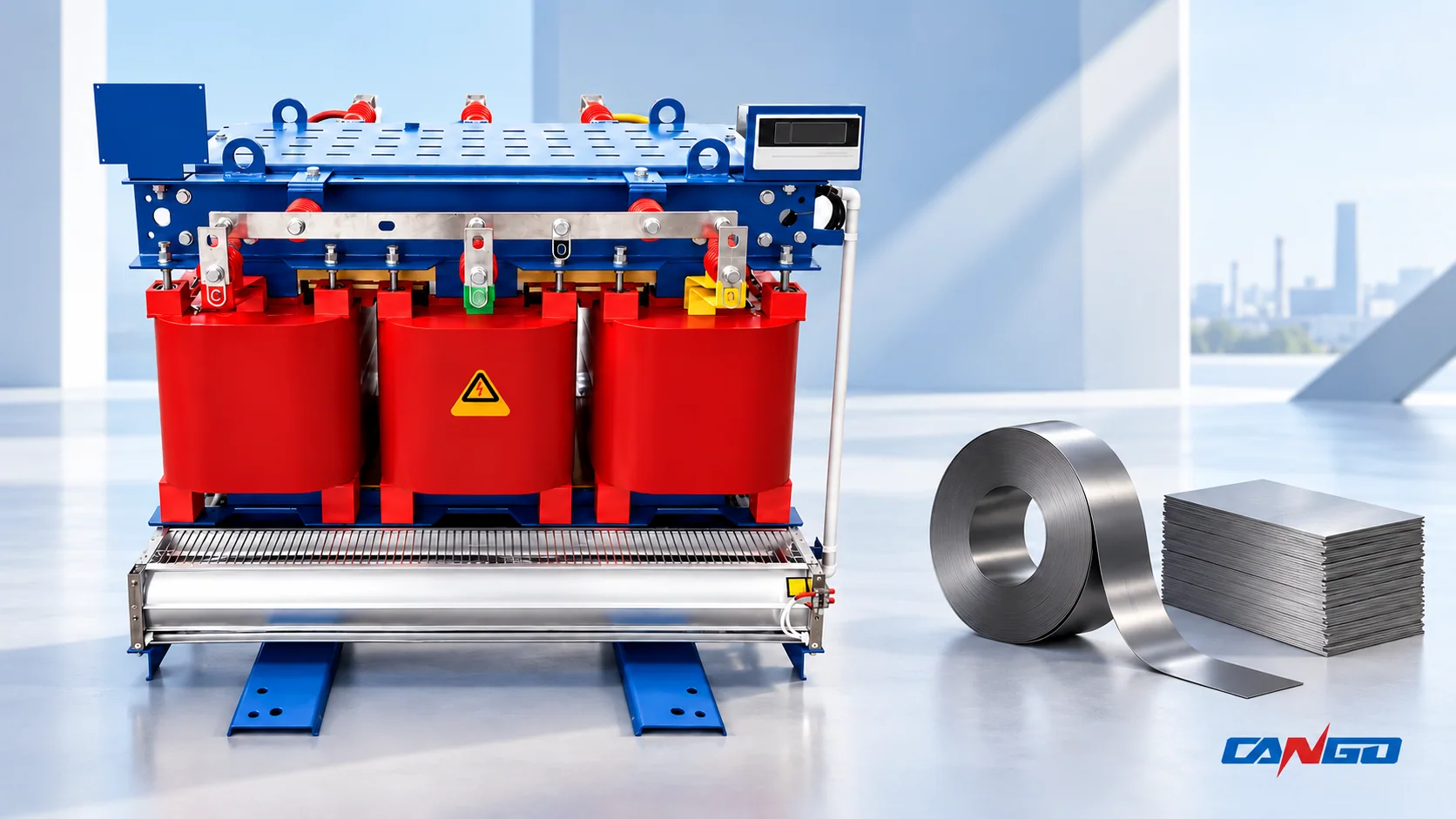
The CANGO power-transformer category and SCBH15 product page are useful starting points for an inquiry. Product photographs show exterior form; they do not prove hidden core material, loss, sound power, dimensions or qualification.
Worked example: when does the lower no-load loss pay back?
The following is a transparent assumption, not a CANGO quotation, test result or market price. Assume two technically acceptable 1,000 kVA offers with the same voltage and installation basis:
| Assumed offer | No-load loss P0 | Rated load loss Pk | Purchase price |
|---|---|---|---|
| Silicon-steel offer | 1.20 kW | 7.00 kW | $20,000 |
| Amorphous offer | 0.40 kW | 8.60 kW | $23,000 |
Assume each unit is energized for 8,760 hours per year, with 4,380 hours at 20% rated current and 4,380 hours at 60% rated current. The average current fraction is 40%, but the mean squared current fraction is 20%:
(0.22 + 0.62) / 2 = 0.20
That distinction matters because load loss follows current squared. The no-load versus load-loss guide covers the underlying loss model. Sum the model over energized intervals only: fully de-energized hours do not carry the P0 term, while separately powered auxiliaries require their own allowance. Here, annual loss energy is:
E = Σ [P0 + xt2Pk] × hourst
The assumed results are:
| Result | Silicon-steel offer | Amorphous offer |
|---|---|---|
| Annual loss energy | 22,776 kWh | 18,571.2 kWh |
| Difference | — | 4,204.8 kWh saved |
| Energy price assumption | — | $0.12/kWh |
| First-year energy-cost saving | — | $504.58 |
| Purchase-price premium | — | $3,000 |
| Simple payback | — | 5.95 years |
The chart below shows the same assumed offers at constant current. Their equal-loss point is x = √[(1.20 − 0.40) / (8.60 − 7.00)] ≈ 0.707, or 70.7% rated current. Here, the lower amorphous no-load loss is offset by its higher assumed rated load loss. The two-interval project example stays below that crossover for its entire profile, so it favors the amorphous offer on energy cost under the stated assumptions. At 80% rated current, the same assumed figures give 5.68 kW for the silicon-steel offer and 5.904 kW for the amorphous offer. That reversal belongs to these two assumed designs; it is not a rule about every amorphous transformer.
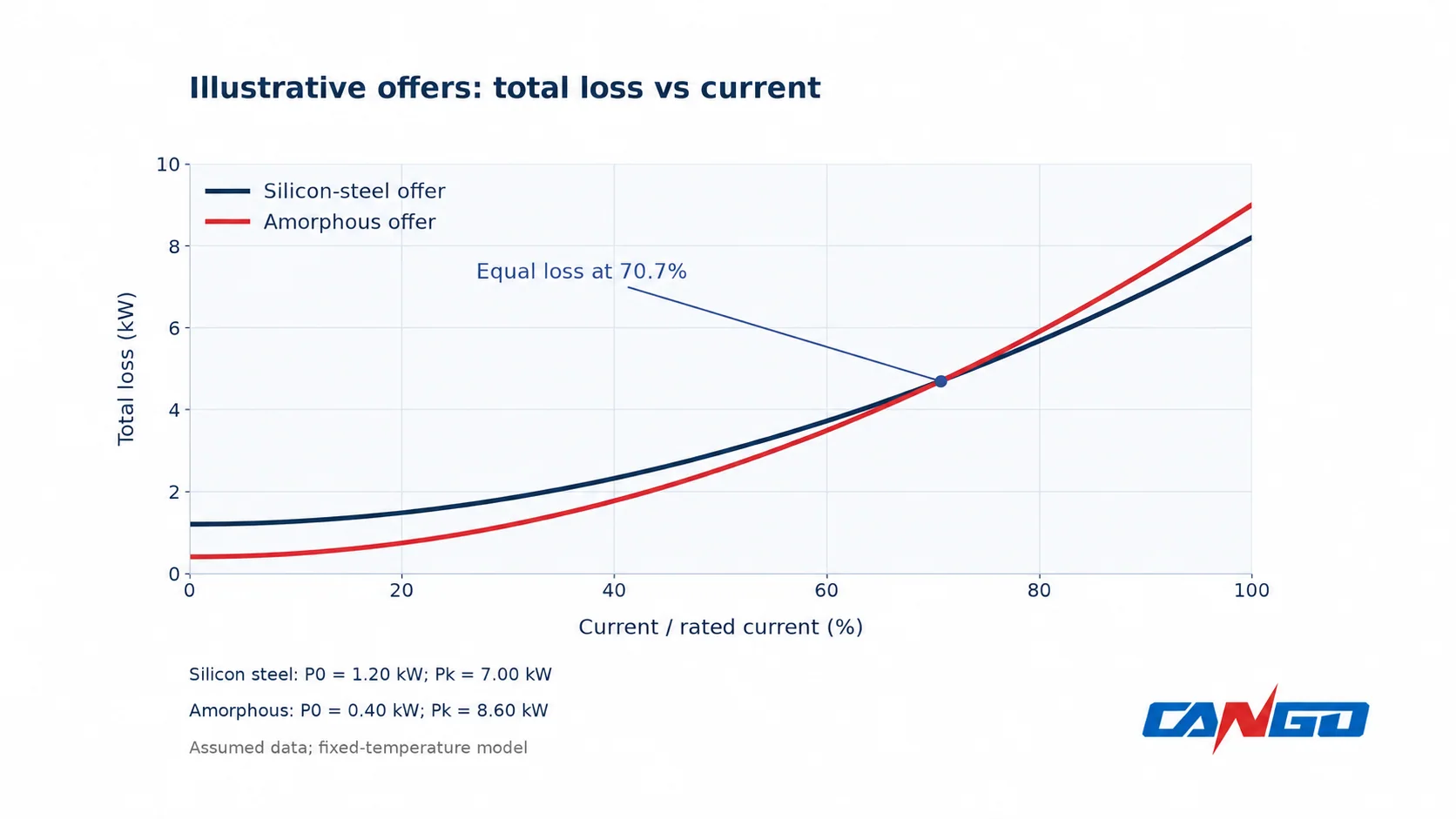
Simple payback = $3,000 / $504.576 ≈ 5.95 years.
Simple payback is only a screening result. Assume identical installation and maintenance costs, no auxiliary or demand-charge differences, constant annual savings and tariff, year-end cash flows, no escalation, taxes or residual-value difference. At a compatible 6% discount rate over a 15-year study period:
Present value of savings = $504.576 × [1 − (1.06)−15] / 0.06 ≈ $4,901.
Net present saving = $4,900.57 − $3,000 ≈ $1,901.
The study period is an economic assumption, not a service-life claim. Changing these inputs can change the decision.
NIST defines life-cycle costing around discounted future cash flows and distinguishes simple payback from time-value-of-money analysis. ENERGY STAR/DOE procurement guidance expresses the same basic structure as purchase price plus capitalized no-load and load-loss costs. Its 2017 guide addresses U.S. medium-voltage liquid-immersed units; the loss-valuation method does not supply a dry-type test temperature or export efficiency requirement. These are methods, not universal project inputs. NIST Handbook 135, ENERGY STAR/DOE transformer buyer guide
Where each material needs closer review
At low and moderate loading with long energized periods, no-load loss can receive a high economic weight. An amorphous design may therefore be attractive when its guaranteed P0, price premium and project load profile support the result.
At high loading, the load-loss term becomes more influential. A lower P0 does not guarantee lower total loss if the competing offer has a sufficiently lower Pk. The crossover must be calculated from the matched offer data; it cannot be inferred from “amorphous” or “silicon steel” alone.
Also review the complete design. DOE and BPA sources describe lower saturation flux density, historical ribbon handling and sound or mechanical questions as design considerations. An open research paper on amorphous transformer core stress studies short-circuit and mechanical behavior for a rail-transit application. These sources justify asking for mass, sound, handling, short-circuit and installation evidence; they do not support a universal claim that amorphous transformers are noisy, fragile or oversized. BPA amorphous-core transformer report, Shao, Xu and Cheng, Core Stress Analysis of Amorphous Alloy Transformer
What to request before selecting SCBH15 or another route
Send the same project basis for every offer:
- Rated capacity, HV/LV voltage, frequency, impedance and tap range.
- Core-material declaration and grade, with the applicable product configuration.
- No-load and load-loss guarantees, reference temperature, tolerances and test method.
- Cooling mode, enclosure, auxiliary-fan consumption and rated operation with the selected cooling arrangement.
- Energized hours, interval load curve, RMS current or measured operating data and tariff assumptions.
- Purchase price, maintenance assumptions, expected study period, discount rate and residual/replacement treatment.
- Mass, sound, handling, short-circuit, environmental and installation evidence required by the project.
For CANGO, the SCBH15 page is a documented amorphous-alloy dry-type route. The checked conventional dry-type pages must be supplemented with the selected core-material and loss evidence before they are used as “silicon steel” comparison offers. Contact CANGO with the project data.
References
- CANGO — SCBH15 Amorphous Alloy Dry-Type Transformer, first-party product information, checked 30 October 2026.
- U.S. Department of Energy — Energy Conservation Standards for Distribution Transformers, final rule, 2024.
- U.S. DOE / PNNL / SRNL — Improving Transformer Efficiency and Lifetime through Product Selection, System Integration and Dynamic Control, 2018.
- Bonneville Power Administration — Dry-Type Transformer Report, 2021.
- CANGO — SC(B)14-NX2 Dry-Type Distribution Transformer and SC(B)18-NX1 Dry-Type Distribution Transformer, first-party product information, checked 30 October 2026; material and loss-basis gaps described in the article.
- NIST — Life Cycle Costing Manual, Handbook 135e2022-upd1, 2022.
- ENERGY STAR / U.S. DOE — Guide to Buying More Energy Efficient Distribution Transformers, 2017; economic method for the guide’s medium-voltage liquid-immersed scope.
- Bonneville Power Administration — Liquid-Immersed Amorphous Core Distribution Transformers, 2022.
- Shao, Xu and Cheng — Core Stress Analysis of Amorphous Alloy Transformer for Rail Transit under Different Working Conditions, Energies 14(1), 164, 2021, DOI 10.3390/en14010164; university repository record.