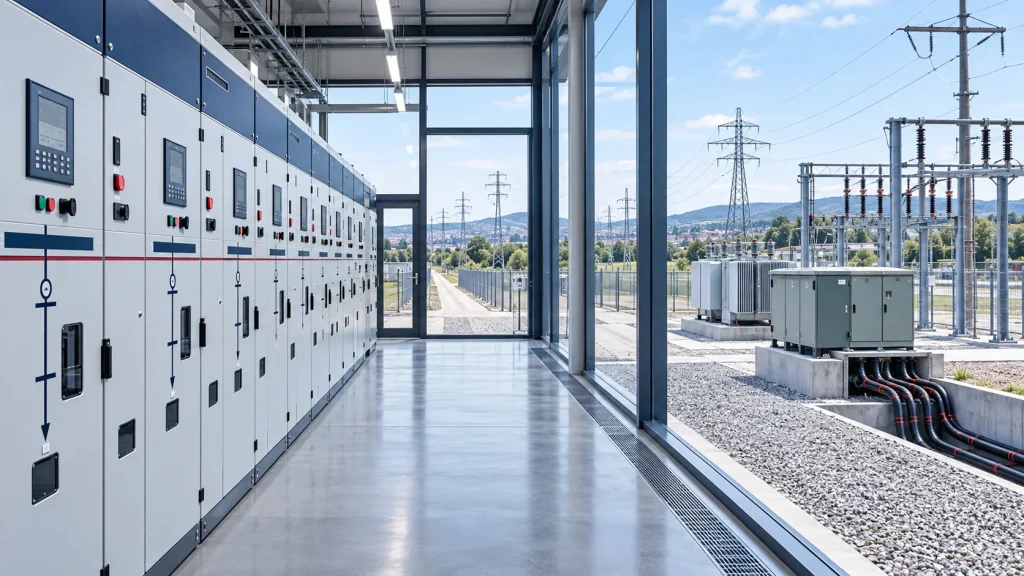
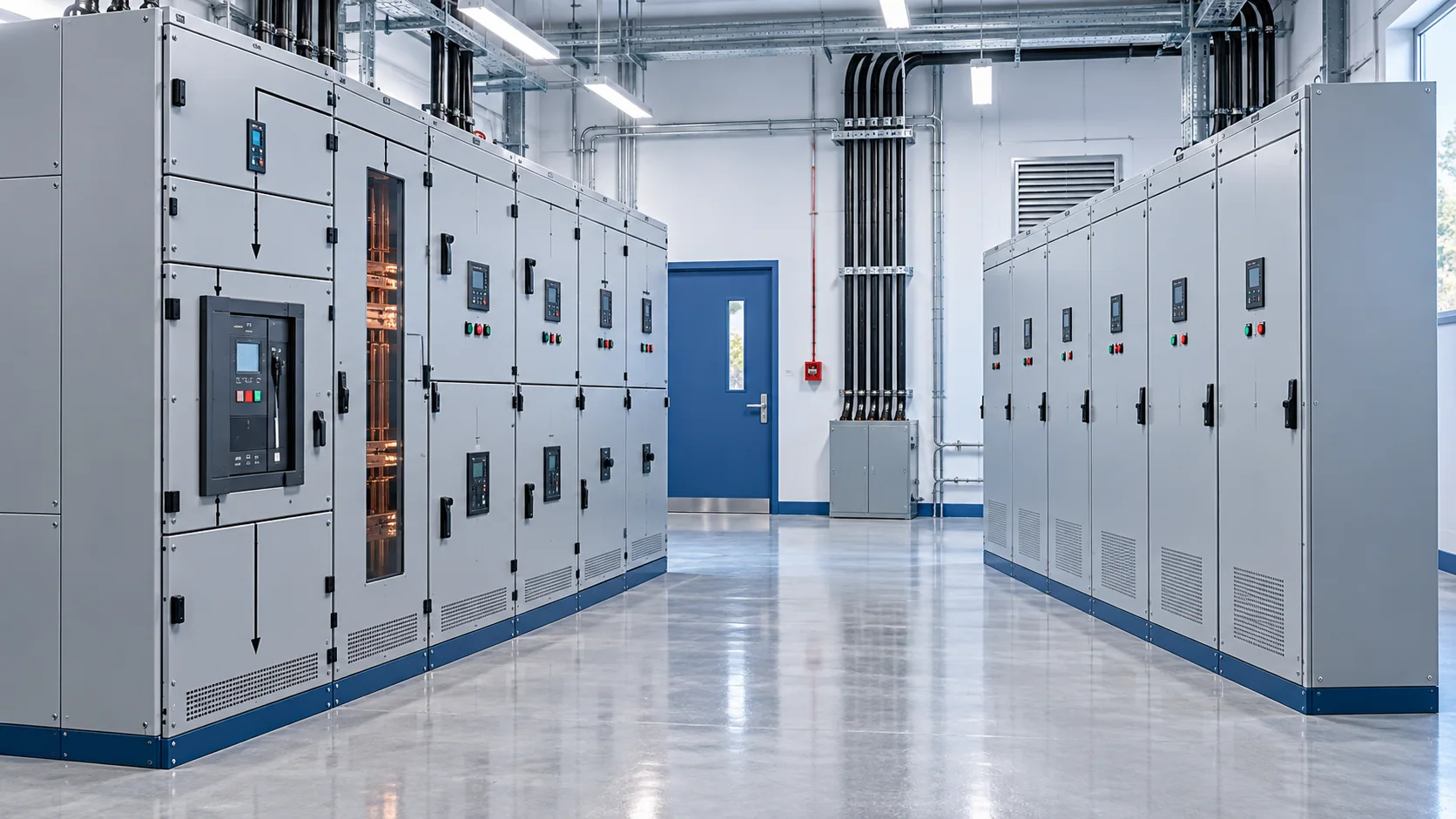
The short answer is that metal-clad and metal-enclosed are not interchangeable procurement labels. Under IEEE/ANSI practice, metal-clad switchgear is a defined compartmentalized class built around drawout electrically operated circuit breakers, while metal-enclosed interrupter switchgear is a separate assembly class that can use interrupter switches, fuses, circuit breakers, and other devices. Under IEC practice, the governing product term is AC metal-enclosed switchgear; buyers should describe the required construction with LSC, partition class, internal arc classification, accessibility, and device arrangement instead of translating “metal-clad” directly.
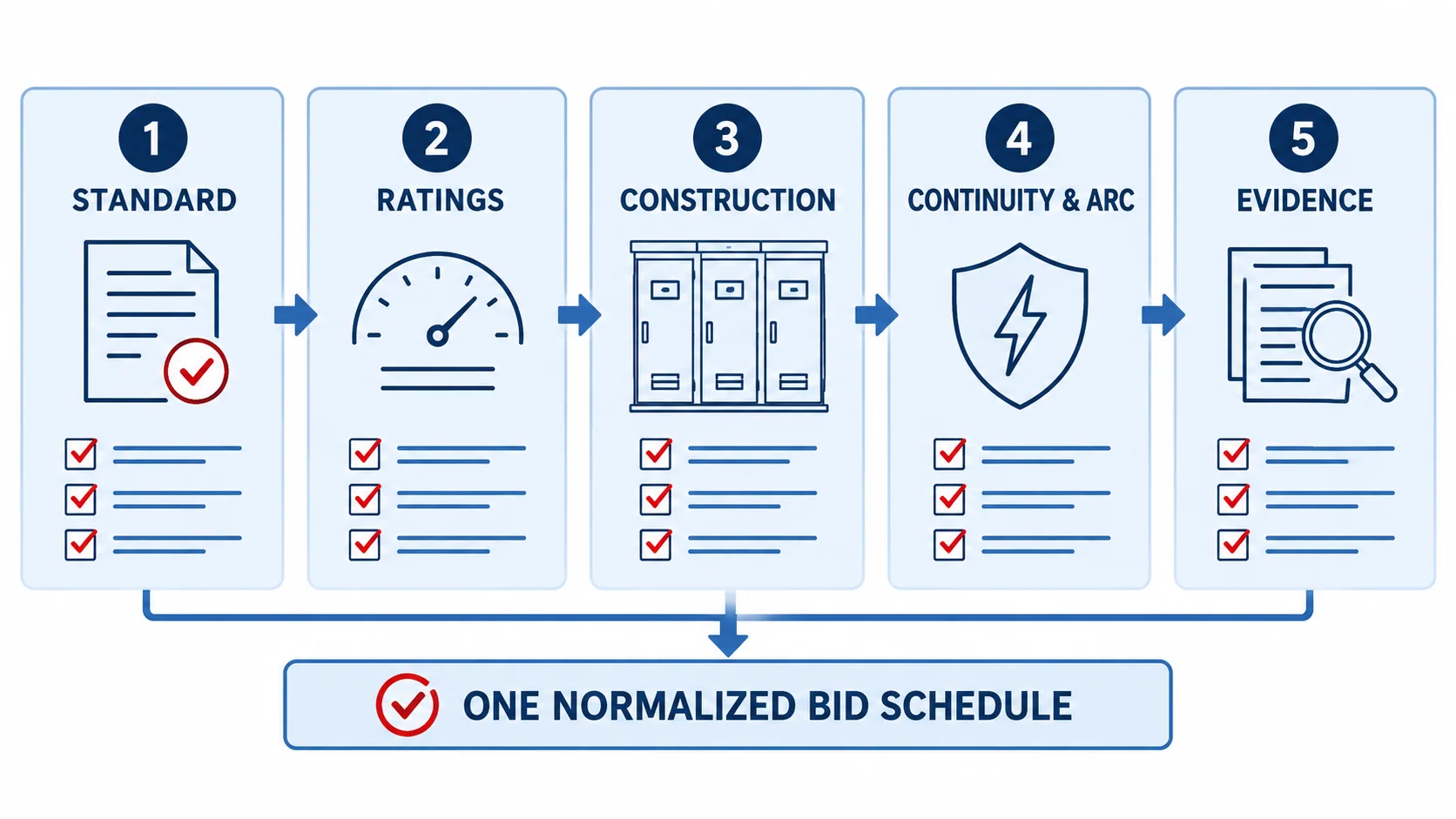
For an EPC team or project buyer, the practical rule is simple: first identify the project’s standards framework. Then compare ratings, compartments, switching devices, service-continuity requirements, arc classification, access, and test evidence on one normalized schedule. A familiar label alone does not prove that two offers are technically equivalent.
Metal-clad vs metal-enclosed at a glance
| Comparison point | IEEE metal-clad switchgear | IEEE metal-enclosed interrupter switchgear | IEC metal-enclosed switchgear |
|---|---|---|---|
| Primary reference | IEEE C37.20.2-2025 | IEEE C37.20.3-2023 | IEC 62271-200:2021+A1:2024 |
| What the label tells you | A defined metal-clad construction class | An assembly class covering interrupter-switchgear arrangements | The broad product-standard scope for prefabricated AC metal-enclosed assemblies |
| Main switching arrangement | Drawout electrically operated circuit breakers | May include interrupter switches, selector switches, fuses, circuit breakers, control and protection equipment | Fixed, removable, or withdrawable arrangements may be specified; verify the offered functional unit |
| Compartment basis | Main components are isolated with grounded metal barriers | Construction varies with the assembly and functional design | Specify accessible compartments, LSC category, and PM or PI partition class |
| Continuity and arc behavior | Do not infer from the name alone; specify project requirements and evidence | Do not infer from the name alone | Specify LSC and IAC separately when required |
| Buyer’s key question | Does the exact lineup comply with the stated IEEE edition and project duty? | Does the device arrangement suit the protection and operating task? | What exact IEC classifications and tested configuration are offered? |
The table is a terminology crosswalk, not a substitution chart. A project specification must still state system voltage, insulation level, frequency, normal current, short-circuit ratings, protection, control, environment, access, and documentation.
Why the standards framework comes first
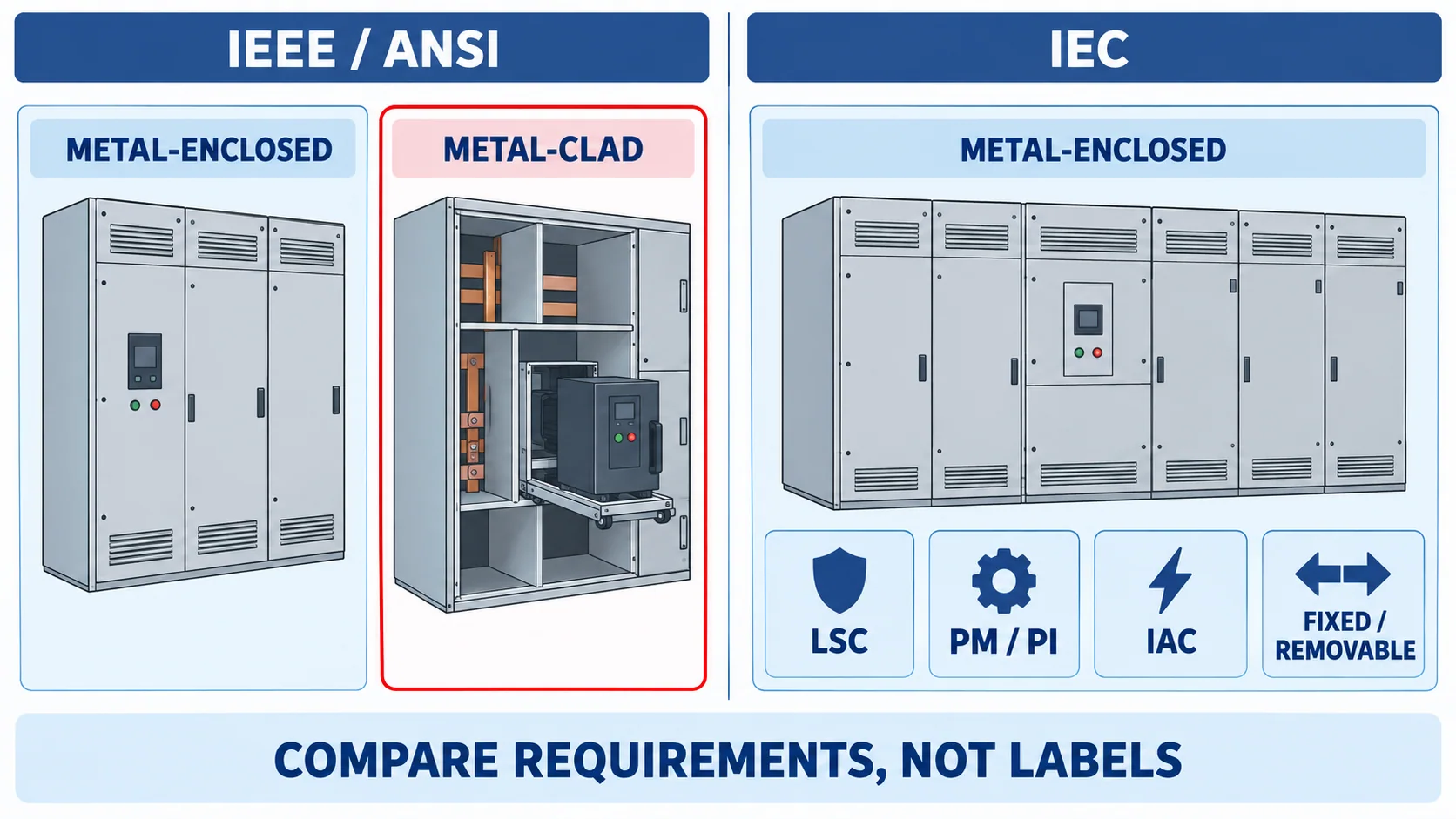
“Metal-enclosed” is a broad physical description in ordinary language, but standards give the term more precise boundaries. The current IEEE metal-clad standard covers medium-voltage switchgear with drawout electrically operated circuit breakers and compartmentalization that isolates components such as instrumentation, main bus, and incoming and outgoing connections with grounded metal barriers. The current IEEE metal-enclosed interrupter-switchgear standard covers assemblies that may contain interrupter switches, selector switches, power fuses, circuit breakers, metering, control, and protective equipment.
IEC 62271-200 takes a different route. Its scope covers prefabricated AC metal-enclosed switchgear and controlgear above 1 kV and up to and including 52 kV, for indoor or outdoor installation, at service frequencies up to 60 Hz. Within that framework, a buyer describes the required operating and construction behavior through classifications and project data rather than selecting an IEEE construction name.
This difference matters in international projects. A specification written around IEEE C37.20.2 should not be converted into an IEC inquiry by replacing the standard number while keeping every construction assumption unstated. Likewise, an IEC assembly should not be advertised as IEEE metal-clad merely because it has metal partitions and a withdrawable breaker. Compliance belongs to the complete offered assembly, applicable edition, ratings, and evidence—not to a visual resemblance.
What metal-clad construction changes
In the IEEE framework, metal-clad construction is intentionally specific. The drawout circuit breaker is only one part of the definition. The arrangement also separates major primary components into grounded metal compartments. This architecture affects isolation, shutters, breaker handling, bus and cable access, interlocking, maintenance planning, and the physical size of the lineup.
That does not make every metal-clad lineup automatically arc-resistant, maintenance-free, or suitable for every continuity requirement. Arc-resistant construction is a separate capability with its own applicable test standard, accessibility type, fault current, duration, and installation conditions. Maintenance outcomes also depend on the bus arrangement, protection design, available spare breaker, cable access, operating procedures, and whether adjacent equipment may remain energized safely under the approved rules.
Project teams usually consider IEEE metal-clad switchgear when they need drawout breaker feeders, extensive protection and metering, defined compartment separation, or a maintenance strategy that benefits from interchangeable breaker elements. The final decision still has to match fault duty, feeder function, footprint, access, lifecycle support, and utility requirements.
What metal-enclosed can include
Metal-enclosed switchgear is not one single low-cost construction. In the IEEE market, metal-enclosed interrupter switchgear may combine load-interrupter switches, power fuses, selector arrangements, circuit breakers, and protective or metering devices. The suitable combination depends on whether the lineup is feeding transformers, sectionalizing a distribution system, providing switching with fuse protection, or performing another defined duty.
This means a buyer should never reduce the comparison to “breaker versus fuse” without reviewing the complete functional unit. The switching device’s normal-current duty, fault-interrupting method, isolation means, earthing arrangement, protection coordination, and visible-disconnect requirements may all affect the choice. Eaton’s medium-voltage design resources, for example, show several distinct metal-enclosed configurations alongside metal-clad products rather than presenting metal-enclosed as one uniform design.
Under IEC, “metal-enclosed” spans a similarly wide range of assemblies. A withdrawable circuit-breaker lineup, a fixed circuit-breaker panel, and a ring-main arrangement can all sit within the broad IEC 62271-200 scope if the standard applies. Buyers therefore need the offered classification and functional-unit data, not just the enclosure label.
The IEC data that replaces a label-only comparison
When the project is specified to IEC 62271-200, use the following fields to express the real requirement.
Device arrangement
State whether the switching device is fixed, removable, or withdrawable and define the required service, test, disconnected, and earthing positions where applicable. Also define how the primary circuit is isolated and how access is controlled. Do not assume that “removable” and “withdrawable” have identical operating consequences in every product.
Loss of service continuity
The LSC category describes the intended continuity of other high-voltage compartments or functional units when access is provided to an accessible high-voltage compartment. It does not guarantee that the whole process remains in service under every maintenance activity. The single-line diagram, bus arrangement, cable compartment, accessible sides, operating procedure, and project risk assessment still matter.
Partition class
Partition class PM or PI identifies whether the partitions and shutters between accessible and live high-voltage parts are metallic or include insulating material under the standard’s definitions. It is a construction classification, not a universal quality ranking. Specify the class required by the maintenance philosophy and verify it on the exact offered assembly.
Internal arc classification
If internal arc classification is required, state the accessible sides, accessibility type, test current, duration, installation arrangement, and exhaust or pressure-relief conditions. “IAC,” “arc resistant,” or a fault-current number by itself is incomplete. The evidence should apply to the offered design and its installation conditions.
Ratings and service conditions
Keep rated voltage, insulation level, rated normal current, short-time withstand current and duration, peak withstand current, and circuit-breaker short-circuit ratings separate. Add frequency, earthing system, altitude, ambient temperature, humidity, dust, corrosion, seismic requirements where applicable, cable interfaces, and indoor or outdoor installation.
Which construction should a project buyer choose?
Choose from the operating task, not from the idea that one label is always superior.
| Project condition | Direction to investigate | What must still be verified |
|---|---|---|
| Complex primary-distribution lineup with drawout breaker policy | IEEE metal-clad, or an IEC withdrawable metal-enclosed assembly with equivalent project-defined functions | Governing standard, breaker ratings, compartments, interlocks, continuity, arc requirement, spare strategy |
| Transformer switching where switch-fuse protection is acceptable | Metal-enclosed interrupter or IEC switch-fuse functional unit | Transformer protection coordination, fuse selection, switching duty, isolation, cable access |
| Compact secondary distribution or ring network | IEC fixed metal-enclosed/RMU arrangement or other project-approved technology | Module functions, extensibility, fault duty, cable test access, earthing, environmental conditions |
| Critical process with limited outage windows | Construction that supports the approved maintenance and redundancy plan | Bus scheme, LSC, access boundaries, protection selectivity, spare devices, operating procedure |
| Retrofit with restricted footprint | The arrangement that meets verified interfaces and access clearances | Existing bus/cable interfaces, room route, pressure relief, foundation, extension side, outage plan |
| International tender with mixed terminology | Performance-based schedule with separate IEEE and IEC compliance columns | Exact editions, deviations, test evidence, ratings, and terminology reconciliation |
A useful conclusion may be “metal-clad,” “another metal-enclosed arrangement,” or two different constructions in different parts of the same system. For example, primary plant distribution may use drawout circuit-breaker switchgear while compact secondary nodes use ring-main functional units. The network architecture determines the answer.
Normalize supplier offers before comparing price
Two quotations are not comparable when one says “metal-clad” and the other says only “metal-enclosed.” Ask each bidder to complete the same schedule:
- Standard and edition: IEC, IEEE/ANSI, national adoption, utility specification, and listed deviations.
- Electrical ratings: voltage class, insulation levels, frequency, bus and feeder normal current, breaker interrupting rating, short-time withstand current and duration, and peak withstand current.
- Construction: fixed/removable/withdrawable device, compartment arrangement, partitions and shutters, cable access, earthing switch, interlocks, busbar insulation, and extension method.
- Continuity and arc requirements: LSC, partition class, IAC or IEEE arc-resistant classification where applicable, accessible sides, current, duration, and installation constraints.
- Protection and control: CT/VT or sensor data, relay functions, trip/close supply, metering, communications, interlocking, and SCADA interfaces.
- Site and layout: indoor/outdoor installation, IP or enclosure requirements, ambient and altitude, dimensions, maintenance clearances, cable entry, transport sections, and pressure-relief route.
- Evidence and documents: compliance schedule, type-test evidence as required, routine-test plan and reports, drawings, schematics, manuals, spare parts, and exclusions.
Common specification mistakes
- Writing “metal-clad per IEC 62271-200” without defining the required IEC classifications. The phrase may communicate an intention, but it does not replace a complete technical schedule.
- Assuming all metal-enclosed equipment has one compartment. Real products include many arrangements; request construction drawings and classifications.
- Treating drawout construction as proof of service continuity. Continuity depends on the assembly classification, bus scheme, access conditions, and operating plan.
- Treating IAC or arc-resistant wording as a general safety guarantee. Confirm the exact classification, tested current and duration, accessible sides, installation conditions, and pressure-relief arrangement.
- Comparing only purchase price. Include room footprint, cable interfaces, protection architecture, outage strategy, spares, maintenance access, documents, and lifecycle support.
- Inferring compliance from a model family. Require a compliance schedule and evidence for the offered configuration.
How CANGO switchgear families fit the decision
CANGO’s medium-voltage switchgear category includes armored removable AC metal-enclosed product families such as KYN28-12, KYN28-24, and KYN61-40.5, together with fixed and ring-main equipment for other duties. These family descriptions help identify a starting point; they do not, by themselves, establish IEEE metal-clad compliance or a particular IEC LSC, PM/PI, or IAC classification.
Use the medium-voltage switchgear selection guide for the broader type-and-rating decision. If the single-line diagram is still being reviewed, the MV switchgear SLD guide explains how the lineup functions should be read. Then use the quotation checklist to package the project data.
Send the governing standard and edition, single-line diagram, system voltage and frequency, fault level and duration, bus and feeder currents, panel schedule, protection and control requirements, classifications, site conditions, layout constraints, quantity, destination, and required documents. CANGO can then review the applicable equipment family and identify the data needed for a technically aligned quotation.