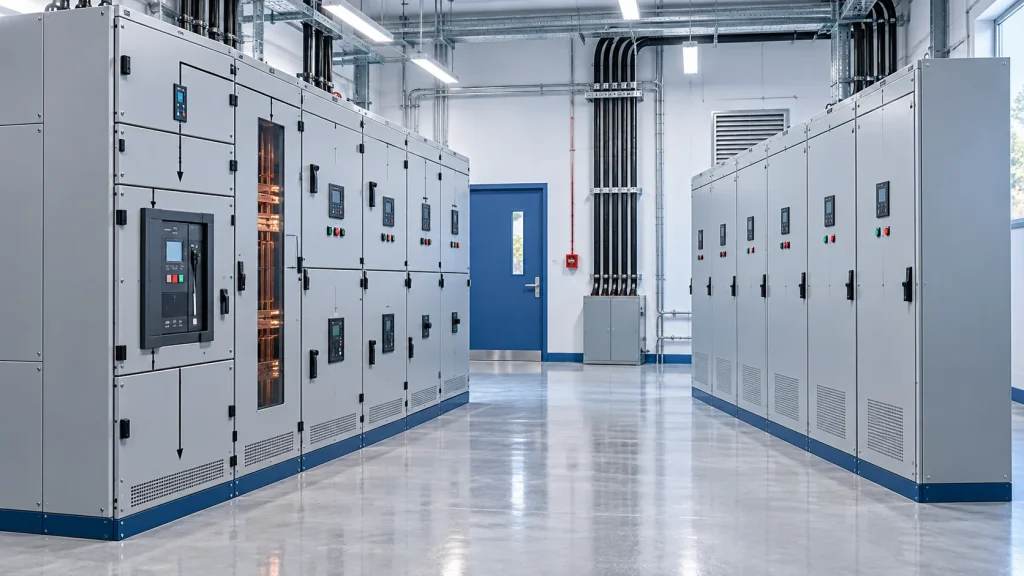
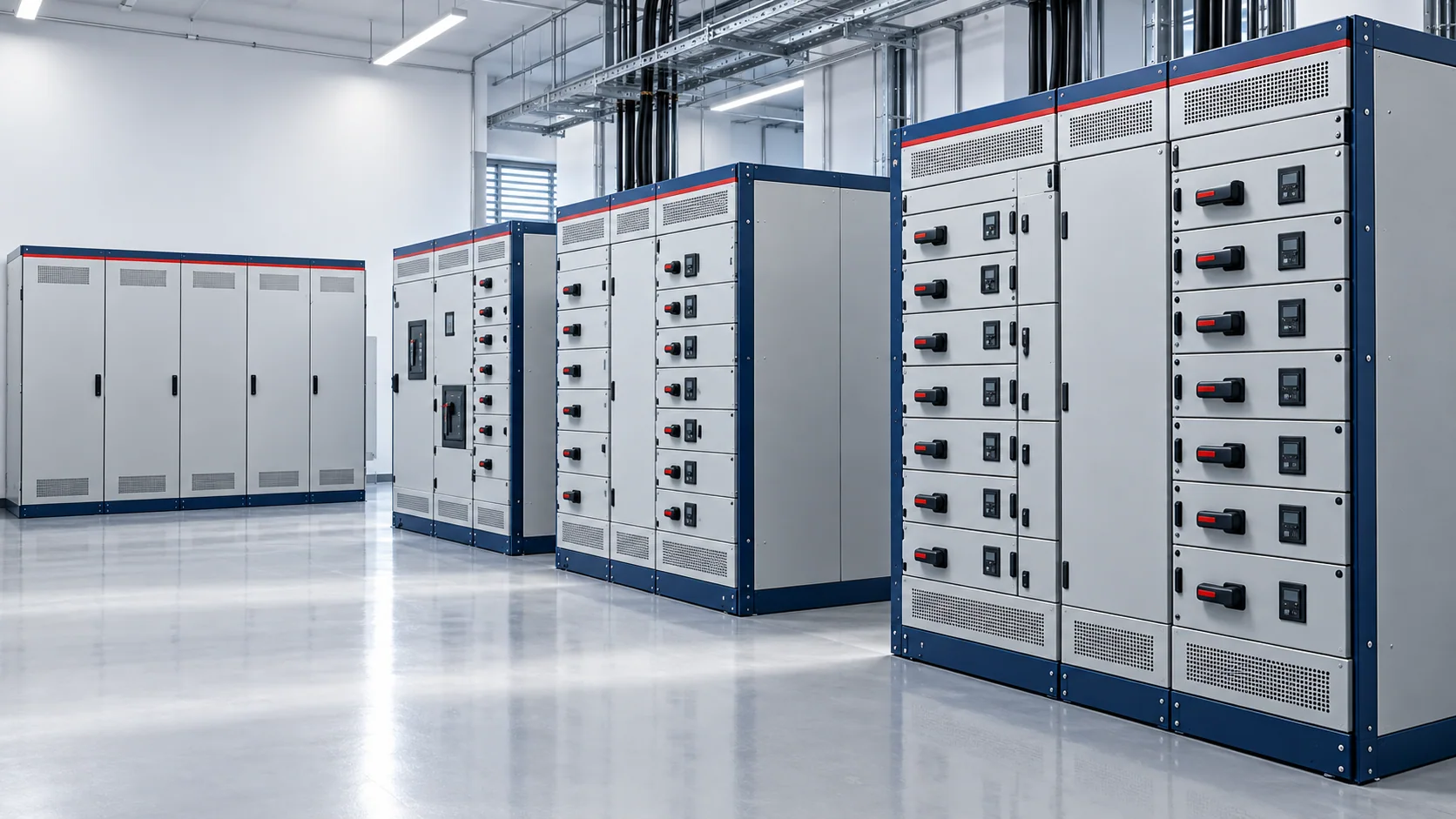
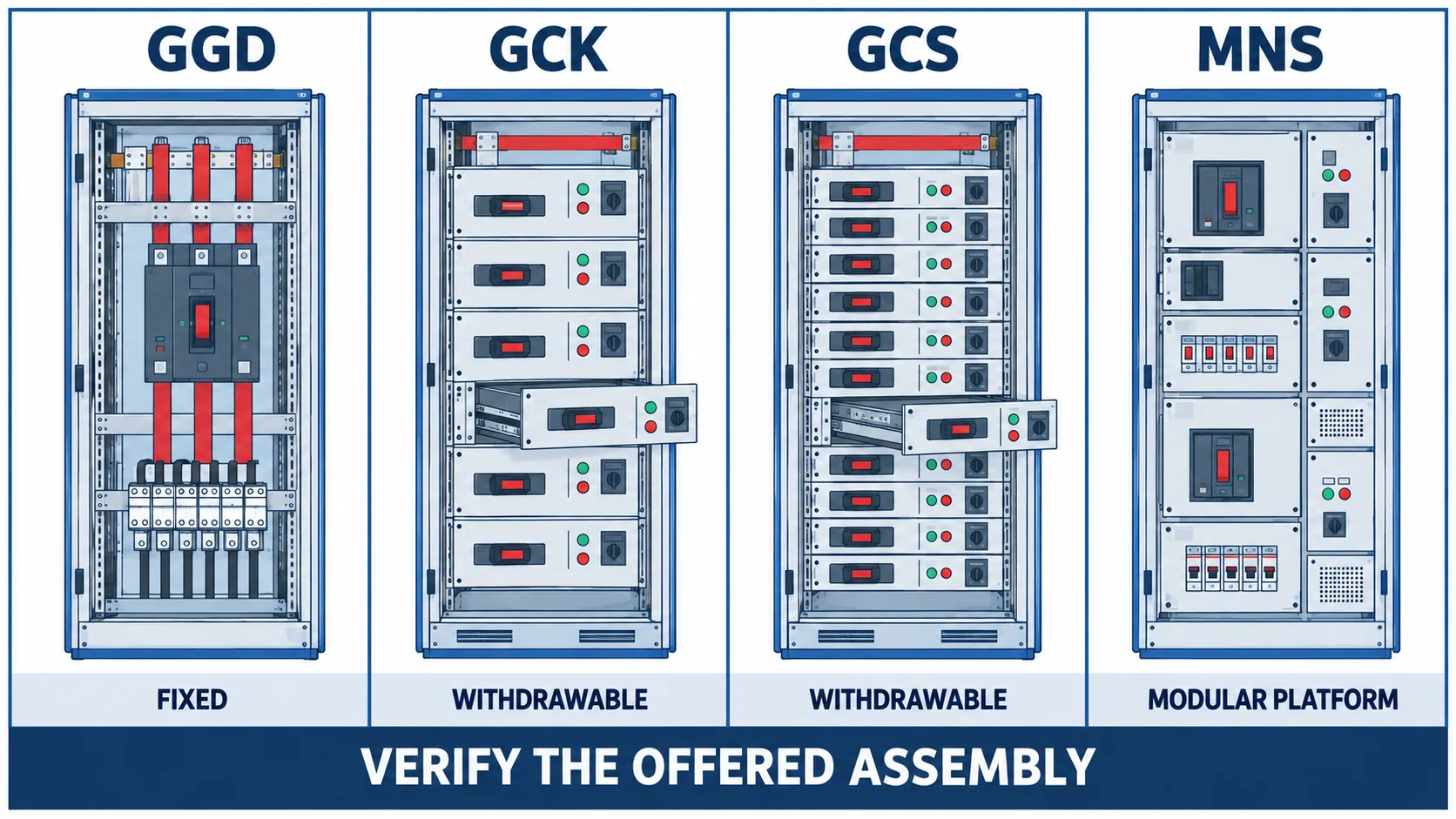
The practical difference is structural: GGD is a fixed low-voltage distribution cabinet, while GCK and GCS are withdrawable switchgear families. MNS is a modular low-voltage switchgear platform that may use withdrawable, plug-in or fixed functional units depending on the actual design.
That distinction affects maintenance workflow, feeder density, expansion and the way functional units are replaced. It does not, by itself, establish an assembly’s current rating, short-circuit withstand, form of separation, IP degree, verification evidence or component brand. Project buyers should shortlist a family by operating needs, then compare technically equivalent offers using the same project schedule.
GGD, GCK, GCS and MNS at a glance
| Family | Typical construction in CANGO’s range | Common project role | Main reason to shortlist | What the name does not prove |
|---|---|---|---|---|
| GGD | Fixed cabinet | General low-voltage power and lighting distribution | Straightforward fixed arrangement where planned outages and fixed functional units are acceptable | Fault rating, form of separation, access arrangement, IP degree or IEC 61439 verification |
| GCK | Withdrawable switchgear; distribution and MCC arrangements | Power distribution and motor control | Drawer-based functional units for projects that value feeder replacement and operational flexibility | Drawer interchangeability, density, busbar rating, separation or permitted maintenance state |
| GCS | Withdrawable switchgear | Industrial distribution, centralized motor control and reactive-power compensation | Modular feeder/MCC arrangements with project-specific circuit organization | Universal dimensional, cost or performance advantage over GCK |
| MNS | Modular platform; the offered design may use withdrawable, plug-in or fixed units | Power distribution and motor control in modular lineups | Flexible functional-unit architecture and a broad range of possible arrangements | That an offer is ABB MNS, authorized, interchangeable or verified to the same design |
The safest conclusion is not “MNS is best” or “GGD is cheapest.” It is: GGD is the fixed-family starting point; GCK, GCS and many MNS arrangements are considered when removable or modular functional units better fit the operating plan. The final choice still depends on the exact assembly offered.
These names are not IEC performance classes
IEC 61439-1:2020 gives general rules for low-voltage switchgear and controlgear assemblies. IEC 61439-2:2020 gives specific requirements for power switchgear and controlgear assemblies. Neither standard defines GGD, GCK, GCS and MNS as four graded performance levels.
The assembly standard and the component standards also have different jobs. IEC 60947-1:2020 applies to low-voltage switchgear and controlgear devices and explicitly distinguishes them from complete assemblies covered by IEC 61439. A circuit breaker carrying an IEC 60947 marking therefore does not, on its own, demonstrate that the completed switchboard has been designed and verified as required for the project.
For a valid comparison, the bid must state the applicable standards and editions, assembly ratings, functional-unit arrangement, internal separation, ingress protection, service conditions, design-verification basis, routine-verification documentation and any deviations.
GGD: the fixed-cabinet option
CANGO’s GGD product family is a fixed AC low-voltage distribution arrangement used for power conversion, distribution and control of power, lighting and distribution equipment. Fixed construction means the functional devices and connections are installed in the cabinet rather than organized as withdrawable feeder drawers.
GGD is a reasonable shortlist when the project has a stable feeder schedule, maintenance can be planned around an outage or isolated section, and the operating team does not require rapid drawer exchange. The engineering review should still cover maintainable access, cable termination space, heat dissipation, spare ways and the replacement path for major components.
“Fixed” is not a synonym for low performance. A fixed assembly can be designed for demanding duties, just as a withdrawable assembly can be unsuitable if its ratings or verification do not match the project. The tradeoff concerns functional-unit construction and maintenance strategy, not an automatic quality ranking.
GCK: withdrawable distribution and motor control
CANGO’s GCK family includes power distribution center and motor control center arrangements in a withdrawable construction. That makes GCK relevant where multiple outgoing feeders or motor circuits benefit from defined drawer positions and a planned module-removal procedure.
For procurement, ask how the offered functional unit moves between connected, test and isolated states; which operations can be performed with the door closed; how shutters, interlocks and auxiliary contacts work; and what remains energized in each state. Do not assume these details from the GCK name.
Also verify drawer sizes, feeder schedule, spare-module strategy and whether a replacement unit is mechanically and electrically compatible with the supplied design. “Withdrawable” does not mean drawers from another project or manufacturer are interchangeable.
GCS: withdrawable industrial distribution and MCC duties
CANGO’s GCS family is also a withdrawable low-voltage switchgear family. The local product scope identifies industrial power distribution, centralized motor control and reactive-power compensation as common applications.
Because both GCS and GCK can serve distribution and motor-control duties, project buyers should not force a universal difference that the model name cannot sustain. Compare the actual feeder density, module increments, main and distribution bus arrangements, cable compartment, permissible access, auxiliary wiring, component selections, dimensions and verification evidence.
A GCS offer can be the stronger technical fit for one lineup and a GCK offer for another, but that conclusion must come from the scheduled configuration. Price comparisons are meaningful only after the two bidders quote the same incomers, feeders, starters, spares, separation, ratings, components, communication scope and documents.
MNS: identify the platform and the offered implementation
MNS requires an extra identity check. ABB describes MNS as its low-voltage switchgear and MCC platform and lists fixed, plug-in and withdrawable functional-unit options. The name is also used more broadly in parts of the market, including offers described as MNS-type or MNS-style switchgear.
Before comparing an MNS-labeled bid, ask the supplier to state whether it is:
- an ABB MNS assembly;
- an authorized or licensed implementation, with the relevant scope identified; or
- the supplier’s own modular assembly using an MNS-type market designation.
Then request the design identity, manufacturer of record, verification evidence, permitted component substitutions, module compatibility and service/support boundary. ABB’s published ratings or test claims apply to ABB’s stated system; they must not be transferred automatically to another manufacturer’s assembly.
CANGO’s MNS product page describes a modular, withdrawable low-voltage switchgear family for distribution applications. The final offer should still define which functional units are fixed, plug-in or withdrawable and what evidence applies to that exact construction.
Compare the four families by project requirement
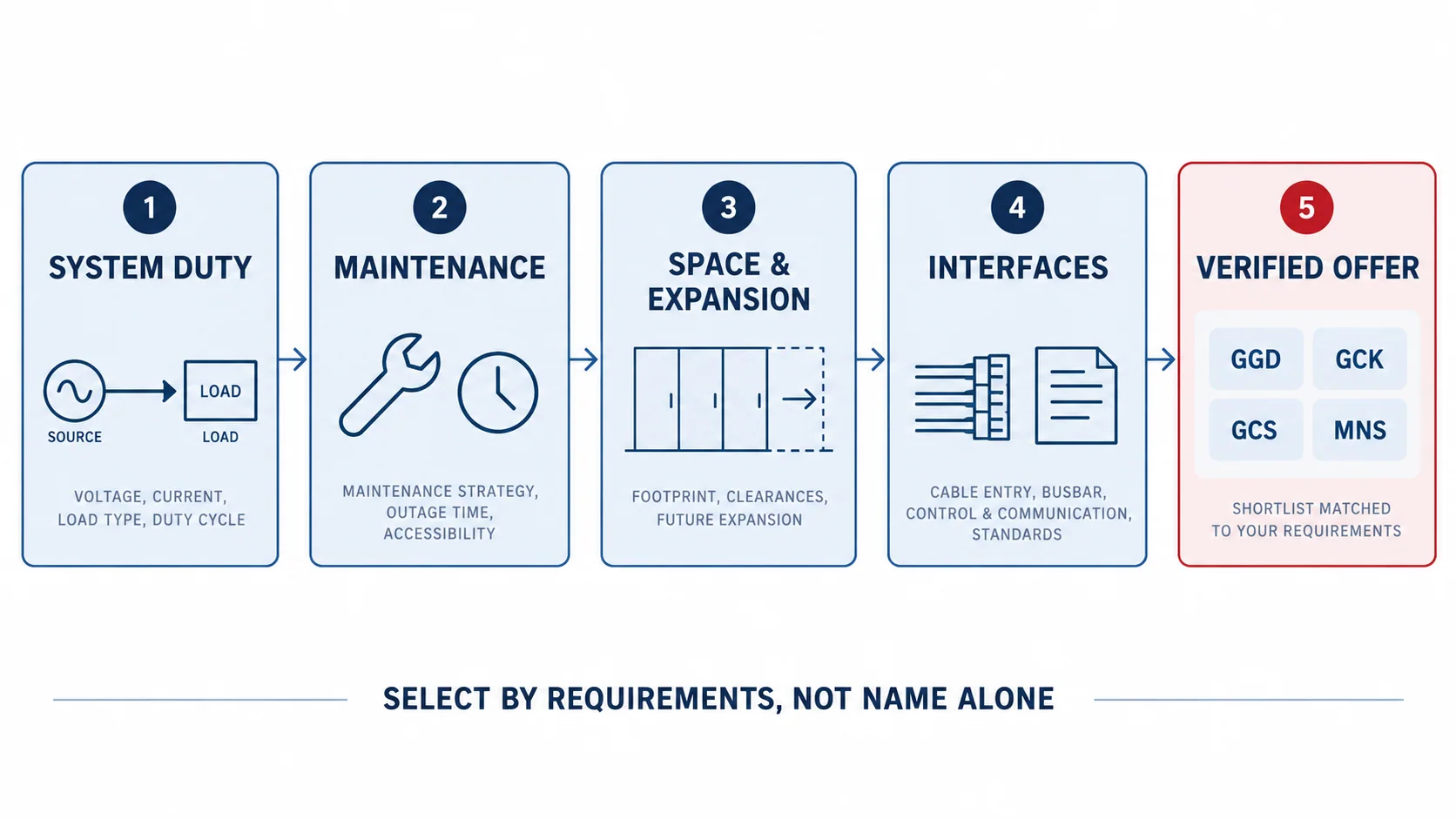
Electrical duty comes first
Start with nominal voltage and frequency, earthing arrangement, calculated prospective short-circuit current, clearing time, busbar and feeder currents, load types, diversity assumptions and any harmonic-producing equipment. These inputs set the duty that every shortlisted family must meet.
Do not compare a catalog maximum from one family with a project-specific rating from another. Require each supplier to state the ratings of the complete offered current path, including incomer, main busbar, distribution busbar, functional unit and protective device where applicable.
Maintenance and continuity define the value of drawers
Withdrawable or plug-in units can support a maintenance strategy based on removing a functional unit, but the allowed work and energized boundaries depend on the design, separation and operating procedure. A drawer is not permission to work on energized equipment.
If the plant permits long planned shutdowns and has few stable feeders, fixed construction may be sufficient. If the process has many motors, repeated feeder changes or a strong spare-module strategy, a withdrawable shortlist may offer operational value. Define the required isolation, test and replacement workflow before asking suppliers to optimize it.
Feeder density and room layout must be measured
Drawer-based systems can place multiple functional units in one vertical section, but usable density depends on feeder ratings, starter components, metering, control devices, heat dissipation, separation and cable space. A compact front elevation can create difficult rear or side access if the room and cable routes are not coordinated.
Compare total lineup length, depth, height, plinth, front/rear access, door swing, aisle, cable bending space, top or bottom entry, heat rejection, transport sections and future extension direction. Use the general-arrangement drawing—not a family reputation—to check the electrical room.
Expansion needs a defined interface
“Expandable” should identify the busbar end, mechanical interface, protection provision, reserved floor area, future cubicles and the conditions under which an extension can be verified. Spare empty compartments are different from fitted spare feeders, and both are different from space reserved for a future section.
For withdrawable systems, define whether the project needs complete spare drawers, spare components or only unused module positions. Record the exact supplied design and revision so future replacements are evaluated against the correct interface.
Verification and documents close the comparison
The buyer should request a compliance schedule against the project standard, evidence relevant to the offered design, and routine-verification records for the delivered assembly. Any design change, component substitution or rating increase should be reviewed for its effect on verification.
At minimum, align the single-line diagram, general arrangement, feeder schedule, component list, schematic diagrams, terminal plans, communication list, nameplate/rating schedule, verification documentation, routine-test records, manuals and recommended spares. A shorter quotation is not necessarily a simpler solution; it may only contain more unstated assumptions.
Which family should a project shortlist?
| Project condition | Practical shortlist direction | Questions that decide the result |
|---|---|---|
| Stable distribution board with planned shutdowns | Start with GGD fixed construction | Are fixed feeders acceptable? What access, spare ways, separation and outage procedure are required? |
| Industrial MCC with many motor feeders | Start with GCK, GCS or a suitable MNS arrangement | What drawer sizes, starter types, test/isolation positions, spares and control interfaces are needed? |
| Mixed power distribution and motor control | Compare scheduled GCK, GCS and MNS configurations; retain GGD for fixed sections if suitable | Can the lineup mix functional-unit types? How are busbars, separation, cable zones and maintenance boundaries arranged? |
| High feeder density or limited lineup length | Compare actual GCK, GCS and MNS general arrangements | Does the denser front layout still provide adequate cable space, ventilation and access? |
| Budget-led project with low change frequency | Compare a compliant GGD offer with normalized withdrawable alternatives | Are lifecycle spares and outage consequences included, and are all offers technically equivalent? |
| Existing lineup extension | Begin with the installed system identity—not a generic family name | Are busbar, dimensions, drawings, design revision, components and verification path compatible? |
This is a shortlist, not an engineering approval. Mixed lineups and application-specific constructions are possible, and the selected manufacturer must confirm the final arrangement against the project’s electrical and environmental conditions.
Make quotations technically comparable
Send every bidder the same base package and require the response in the same structure:
- System duty: single-line diagram, voltage, frequency, earthing, load schedule, calculated fault level and required fault duration.
- Functional schedule: incomers, couplers, feeders, motor starters, capacitor or filter sections, metering, spare units and future spaces.
- Operating requirements: fixed, plug-in or withdrawable units; required positions; interlocks; isolation philosophy; local/remote operation and permitted maintenance state.
- Assembly requirements: internal separation, IP degree, busbar system, cable entry, access, dimensions, color, environment and extension interface.
- Components and controls: breaker/starter requirements, protection, metering, auxiliary supplies, control voltage, communication protocol and terminal boundary.
- Verification and documents: standards and editions, compliance schedule, applicable design-verification evidence, routine-verification records, drawings, manuals, spares and deviations.
- MNS identity where applicable: platform owner, manufacturer of record, authorization or license scope, design reference and module compatibility.
For a fuller project-data checklist, use CANGO’s guide to preparing a low-voltage switchgear inquiry. The industrial power distribution guide provides wider system context.
Review CANGO low-voltage switchgear options
CANGO’s low-voltage switchgear category includes GGD, GCK, GCS and MNS product families. Use the family comparison to form a shortlist, then confirm the selected configuration through the project single-line diagram, feeder schedule, room layout, standards and documentation requirements.
The most useful inquiry does not ask only for “GGD or MNS.” It states the duty and operating outcome, then asks CANGO to identify the proposed family, functional-unit construction, ratings, interfaces, verification basis and deviations.