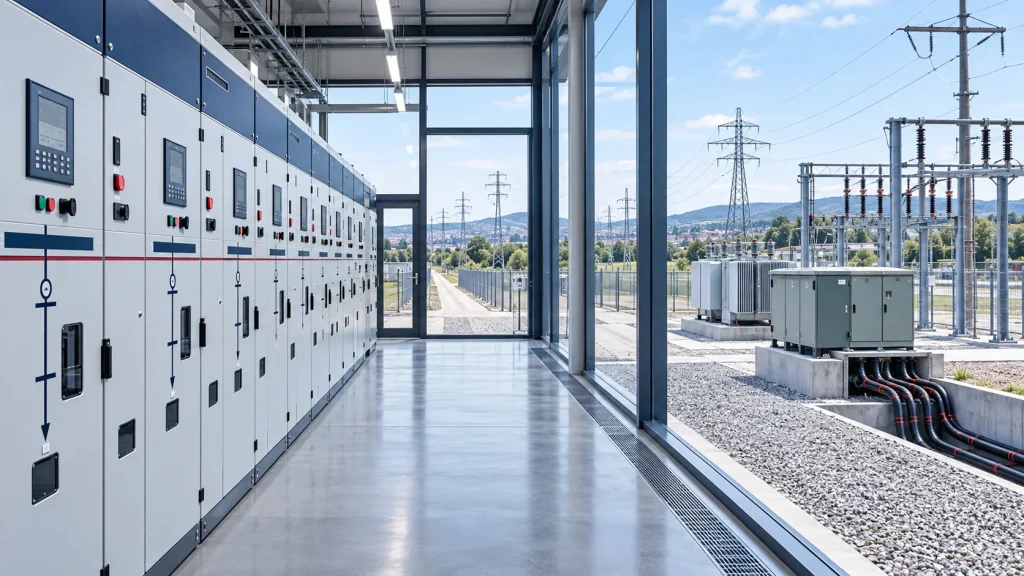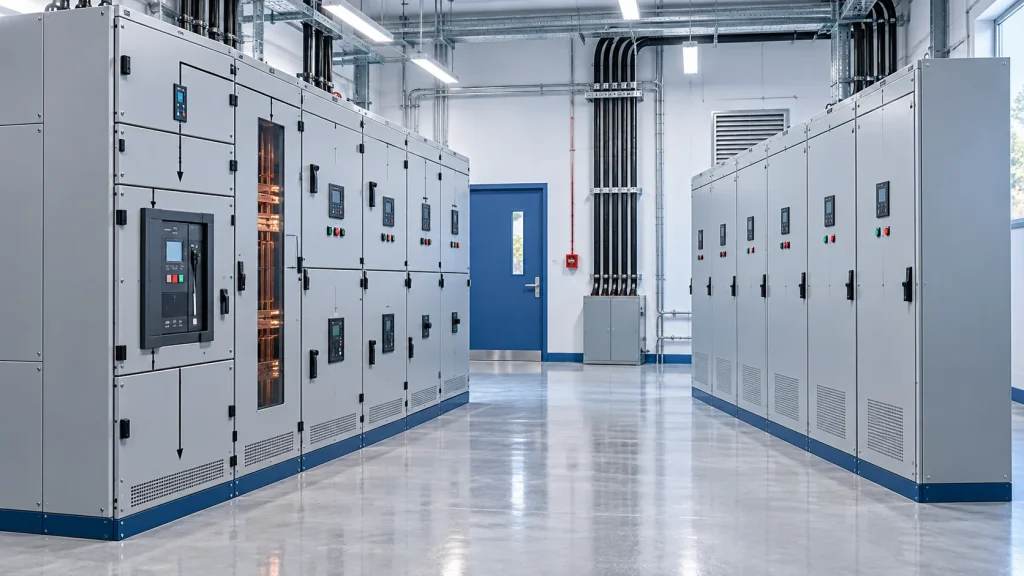
The three terms often overlap, but they emphasize different things:
- Prefabricated substation is the standards-oriented term for a qualifying factory-assembled, enclosed substation. In IEC projects, the key reference is IEC 62271-202.
- Packaged substation is usually a commercial or supply-scope term: multiple substation elements are coordinated and delivered as a package.
- Compact substation emphasizes a small, integrated arrangement, commonly combining medium-voltage equipment, a transformer and low-voltage distribution.
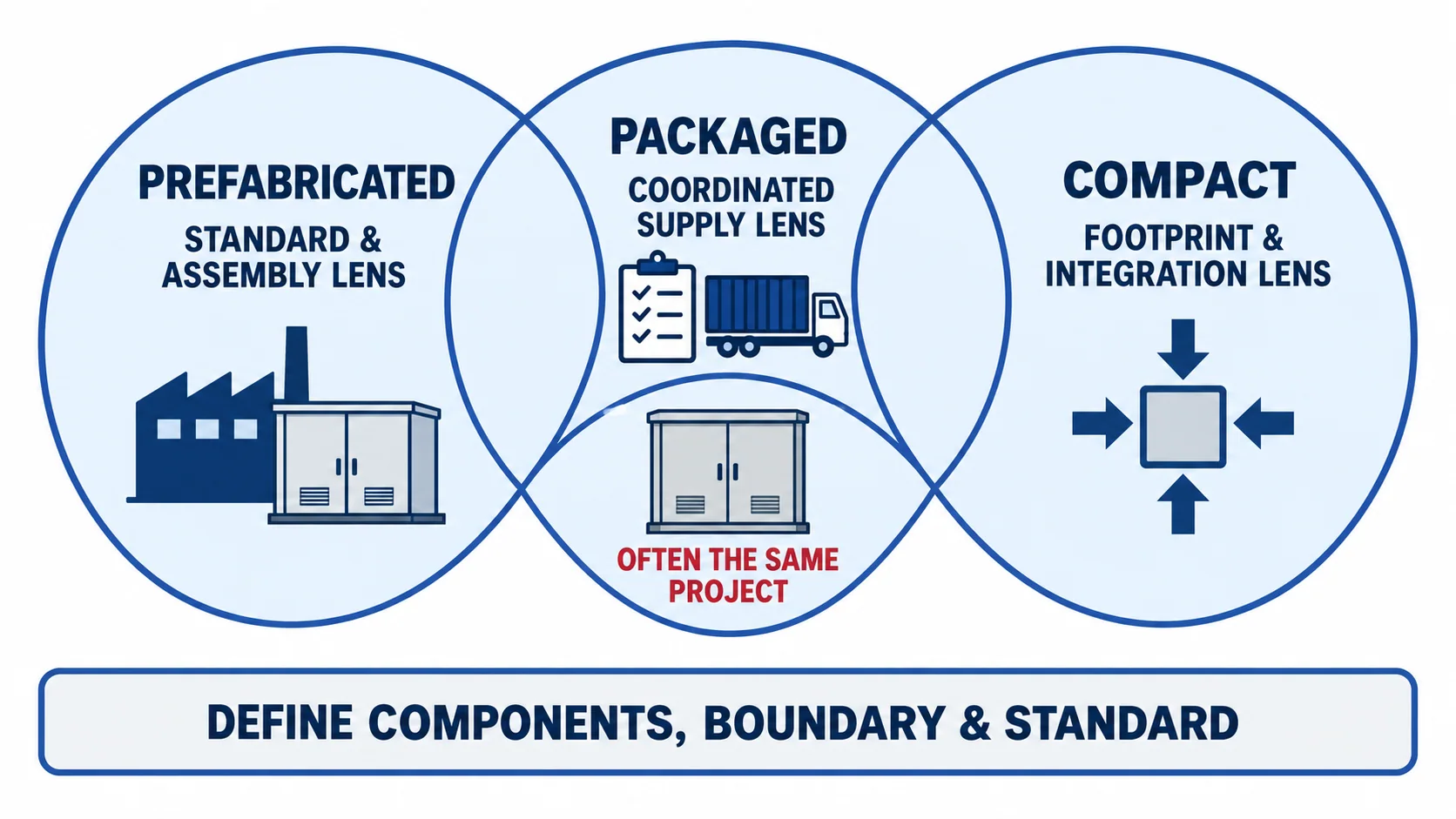
They are not three universal performance classes. One product may legitimately be described as prefabricated, packaged and compact at the same time. Conversely, a package sold under one of these labels may fall outside the scope of IEC 62271-202 because of its voltage, installation, enclosure, accessibility or equipment arrangement.
For procurement, replace the label with a defined single-line diagram, equipment list, enclosure and assembly requirements, interface schedule, applicable standards and verification documents.
Quick terminology comparison
| Term | What it usually emphasizes | Typical contents | Buyer risk if used alone |
|---|---|---|---|
| Prefabricated substation | Standards scope, factory assembly and enclosed substation construction | HV/MV switchgear, transformer, LV switchboard, interconnections, enclosure and auxiliaries as applicable | Assuming every marketed prefab product is within IEC 62271-202 or has the required classification |
| Packaged substation | Coordinated commercial supply and interface responsibility | A selected combination of switchgear, transformer, LV equipment, enclosure/skid and accessories | Different bidders may include different equipment, engineering, testing, site work and commissioning |
| Compact substation | Reduced footprint and integrated layout | Often an enclosed MV/LV secondary substation; exact arrangement varies | “Compact” does not define rating, maintainability, public accessibility, internal-arc performance or expansion |
The term printed in a brochure is therefore only a routing clue. The project definition must say what is inside, what is outside and which standard applies.
What IEC means by a prefabricated substation
IEC 62271-202:2022 covers enclosed AC high-voltage prefabricated substations for rated voltages above 1 kV up to and including 52 kV. Its published scope describes cable-connected substations for power frequencies up to 60 Hz, operated from inside or outside, designed for outdoor installation at publicly accessible locations with personnel protection provisions.
That scope is more precise than the everyday word “prefabricated.” A factory-built electrical room, open skid or containerized power module is not automatically an IEC 62271-202 prefabricated substation. Check:
- highest voltage and frequency;
- whether the substation is enclosed;
- cable connection to the high-voltage network;
- indoor-operated or externally operated construction;
- outdoor installation and public accessibility;
- included transformer, switchgear, interconnections and auxiliaries;
- the exact standard edition and project-specific classifications.
The standard title and scope do not prove that a particular product complies. The supplier must identify the offered design, applicable ratings and classifications, verification evidence and installation conditions.
What “packaged substation” usually means
“Packaged” normally tells the buyer that several pieces of equipment are being supplied under one coordinated commercial scope. Depending on the market and supplier, the package may include:
- medium-voltage switchgear or a ring-main unit;
- one or more transformers;
- low-voltage switchboard or distribution board;
- internal busbar or cable connections;
- enclosure, skid, base, ventilation and internal lighting;
- protection, metering, controls, auxiliaries and communication equipment;
- factory assembly, integration tests, transport preparation and documentation.
But the word does not establish that all of those items are included. One supplier may quote a complete enclosed assembly; another may quote a transformer plus MV/LV equipment on a common base; a third may exclude external cables, foundation, earthing, fire systems, HVAC, protection settings, utility approvals and site testing.
Schneider Electric, for example, uses “package substation” in its compact-substation portfolio for configurations combining a medium-voltage transformer with MV/LV switchgear. That demonstrates normal market usage, but it does not create a universal definition applicable to every supplier or country.
What “compact substation” usually means
“Compact” describes the integration and footprint objective. ABB’s compact secondary substation overview describes compact secondary substations as prefabricated substations containing a low-voltage switchboard, transformer and medium-voltage switchgear.
In many distribution projects, a compact secondary substation is therefore also a prefabricated substation and a packaged supply. The adjective does not tell you:
- whether the unit is walk-in or non-walk-in;
- the transformer technology or rating;
- whether operators or the public can access particular sides;
- the internal separation and pressure-relief arrangement;
- whether the unit is delivered in one lift or multiple transport sections;
- whether future extension is practical;
- which site works and external connections are included.
A compact footprint can also shift constraints elsewhere. Cable bending, door swing, transformer removal, ventilation, oil containment, maintenance clearances and pressure-relief space must still fit the site.
Why the three labels overlap
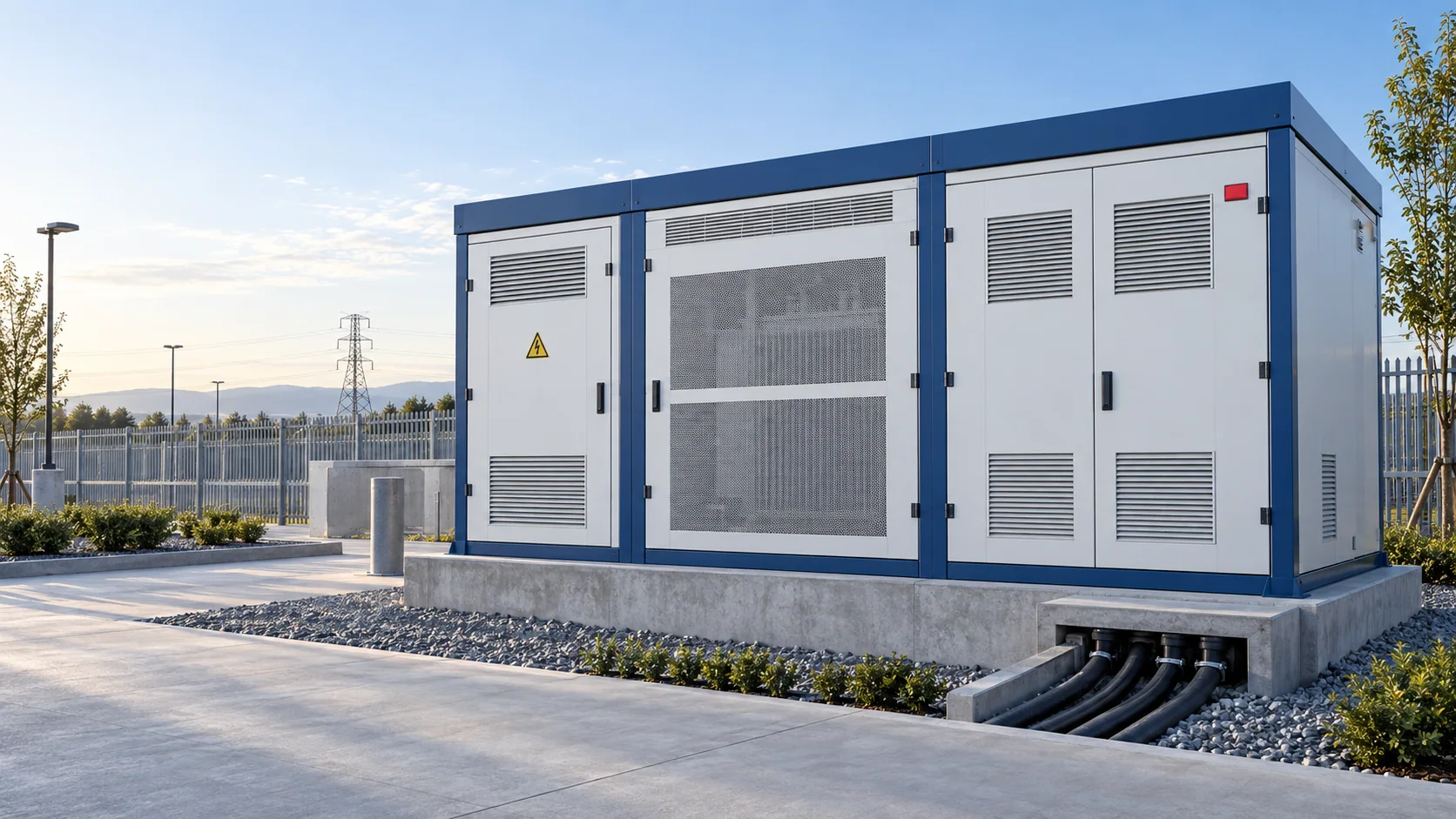
Consider an outdoor enclosure containing MV switchgear, a distribution transformer, an LV switchboard, internal connections and auxiliary services. It is assembled and integrated before delivery, occupies a small footprint and is supplied under one contract.
That project may be called:
- a prefabricated substation because it is an enclosed factory-assembled substation and may be specified against IEC 62271-202;
- a packaged substation because one supplier coordinates the included equipment and interfaces;
- a compact substation because the equipment is integrated into a space-efficient arrangement.
The terms answer different questions. “Prefabricated” asks what kind of assembly and standards framework applies. “Packaged” asks how the commercial scope and interfaces are bundled. “Compact” asks what layout objective the design serves.
This overlap explains why internet comparisons often contradict each other. They treat regional product names as if they were globally exclusive categories.
Terms that should not be treated as automatic synonyms
E-house or power distribution center
An E-house is generally a larger prefabricated electrical building or module that can contain multiple lineups, control systems, HVAC, fire systems and auxiliary services. It may be walk-in, transportable in sections and designed for industrial sites rather than public-access secondary distribution. Its applicable standards and tests depend on the actual design.
An E-house can be a packaged solution and is certainly prefabricated in the ordinary-language sense, but it is not automatically an IEC 62271-202 prefabricated substation.
Skid-mounted substation
A skid arrangement places equipment on a common structural base, often with open or semi-open construction. It can simplify transport and site installation, but the enclosure, accessibility and environmental boundary differ from a fully enclosed prefabricated substation. Define weather protection, fencing, fire/oil containment, cable routing and access separately.
Unit substation
“Unit substation” is common in North American practice for coordinated primary equipment, transformer and secondary distribution. Its construction and certification route may follow regional standards rather than IEC 62271-202. Do not translate the term mechanically into an IEC classification.
Pad-mounted or box-type transformer
A pad-mounted transformer can include high- and low-voltage compartments in one tamper-resistant enclosure, but it does not necessarily include separate MV switchgear and an LV switchboard. In some markets, “box-type substation” is used broadly for integrated equipment; in others, buyers distinguish European-style and American-style arrangements. The single-line diagram and compartment scope settle the meaning.
Modular prefabricated cabin
A modular cabin is a building-scale enclosure assembled from transportable modules. It can contain MV switchgear, control/protection equipment, DC systems and other auxiliaries, with or without a transformer. CANGO’s 10–40.5 kV modular prefabricated cabin belongs to this broader modular project category. It should not be assumed to have the same boundary as a compact MV/LV secondary substation.
Translate any label with three tests
1. The contents test
Ask for a single-line diagram and equipment schedule. Identify:
- incoming cable and termination;
- MV switching and protection functions;
- transformer quantity, technology and capacity;
- LV main switchboard, metering and outgoing feeders;
- station-service transformer, AC/DC auxiliaries, controls and communication;
- internal cables or busbars;
- spare ways and future extension.
If a component is not on the included-equipment schedule, the commercial label should not be used to imply it.
2. The enclosure and assembly test
Define whether the equipment is in one enclosure, multiple coupled enclosures, a walk-in building, a non-walk-in cabinet or an open/semi-open skid. State:
- indoor or outdoor installation;
- public or restricted accessibility;
- enclosure material and corrosion environment;
- ventilation or HVAC and its power supply;
- ingress-protection requirements;
- internal separation and access philosophy;
- internal-arc classification, if required, with accessible sides, current and duration;
- transformer removal route, doors, pressure relief and fire/oil provisions.
These requirements determine whether the marketed product and the cited standard are relevant to the actual site.
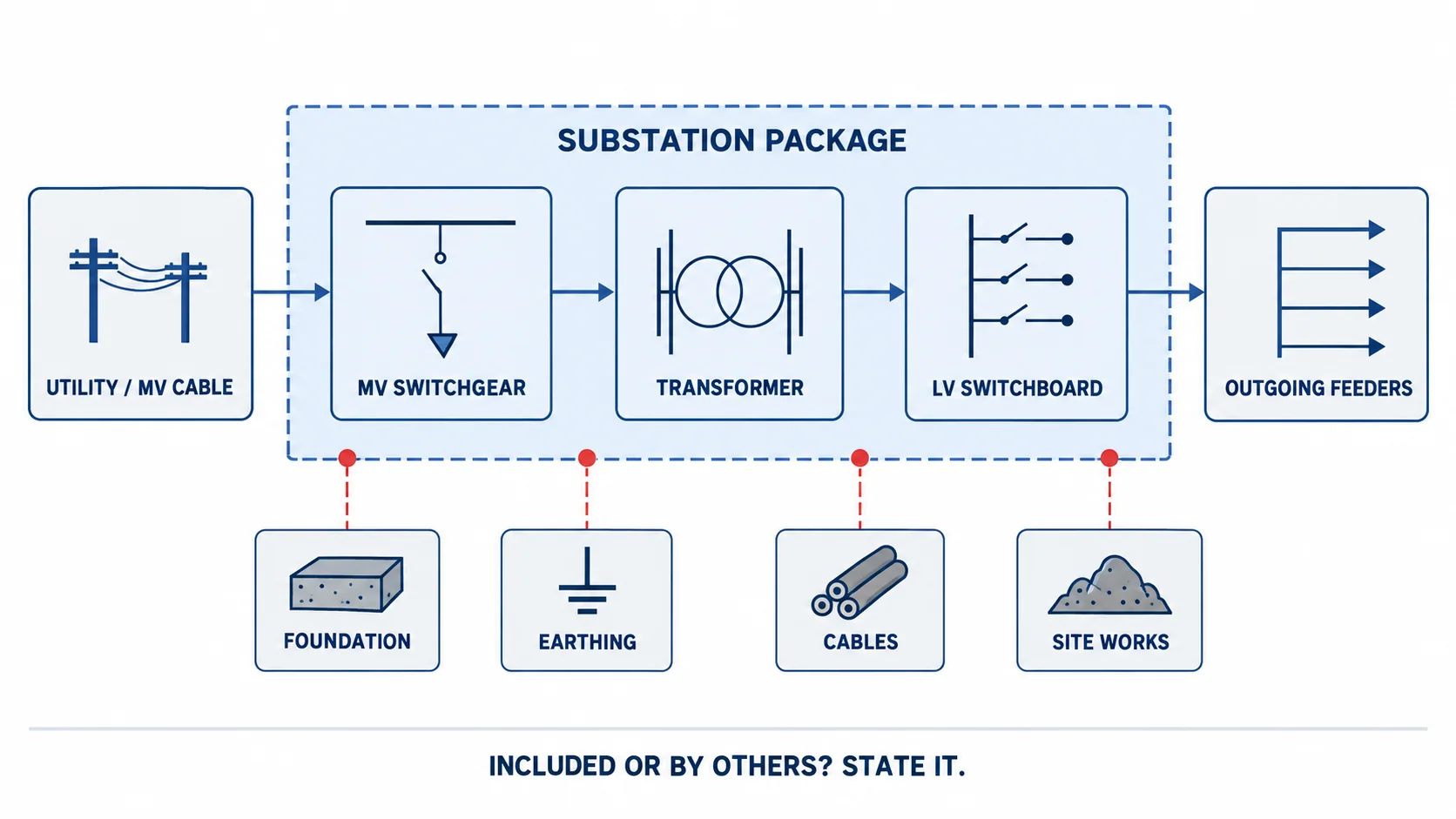
3. The supply-boundary test
Mark every interface as included, excluded or by others. The boundary should address:
- foundation, plinth, trench and building work;
- external MV and LV cables, terminations and testing;
- earthing grid and connection to the package;
- utility metering and approval interfaces;
- protection studies, relay settings and coordination;
- SCADA/communication gateway and field integration;
- fire detection/suppression, oil containment and drainage;
- transport, unloading, cranage, assembly and site commissioning;
- spares, tools, training and final documentation.
A buyer-ready terminology clause
Use wording like this in an inquiry or specification:
Provide an outdoor, enclosed prefabricated MV/LV substation comprising the scheduled medium-voltage switchgear, transformer, low-voltage switchboard, internal interconnections, enclosure and auxiliary systems. The proposed assembly shall be reviewed against IEC 62271-202:2022 where its scope applies, together with the relevant component and transformer standards. The supplier shall identify included and excluded equipment, ratings, accessibility, classifications, design-verification evidence, routine tests, transport sections, site interfaces and deviations. The terms packaged or compact shall not alter the defined technical scope.
Adjust the clause for the project country, utility requirements, voltage, accessibility and contractual model. A standard reference does not replace the project data schedule.
How to compare offers that use different names
Normalize each offer into the same table before comparing price or footprint:
| Comparison field | Required bidder response |
|---|---|
| Product description | Supplier’s term plus a neutral description of the actual construction |
| Standards | Exact standard and edition for assembly and major components |
| Equipment scope | MV, transformer, LV, auxiliaries, internal connections and accessories |
| Ratings | Voltage, frequency, transformer capacity, current and fault-duty schedule |
| Construction | Walk-in/non-walk-in, enclosure/skid, access, compartments and transport sections |
| Environment | Indoor/outdoor, public/restricted access, temperature, altitude, pollution/corrosion and IP |
| Verification | Applicable design/type-test evidence, routine tests and project-specific tests |
| Interfaces | Foundation, cables, earthing, controls, fire/oil systems, unloading and commissioning |
| Documents | SLD, GA, schematics, foundation plan, cable schedule, manuals, test records and deviations |
This process may reveal that two differently named offers are technically similar—or that two “compact substations” include materially different scopes.
How CANGO product families fit the terminology
CANGO’s prefabricated substation category includes several architectures:
- The YB0-12/0.4 family is presented as a compact prefabricated substation for ring-network or terminal-supply applications.
- The ZGS11-12 family is presented as a combined American-style prefabricated substation.
- The 10–40.5 kV modular prefabricated cabin addresses a larger modular-cabin arrangement.
These names identify starting families, not a complete project specification. Final selection depends on the single-line diagram, voltage and fault duty, transformer requirement, enclosure layout, access, environment, standards and supply boundary.
Use the prefabricated substation inquiry checklist after the terminology is settled. The building distribution guide and industrial power distribution guide provide application context for different sites.